Your LLM Agent Is Failing Right Now and You Don’t Know It
Your LLM Agent Is Failing Right Now and You Don’t Know It
Every agentic workflow you’ve shipped has a silent failure mode: the agent loops, drifts, or fabricates a result and logs a clean exit. Nobody noticed, including your monitoring stack. A new paper says you can catch 73% of those runs before they escape — at 200 microseconds per step instead of paying for a second model to babysit the first.
What happened
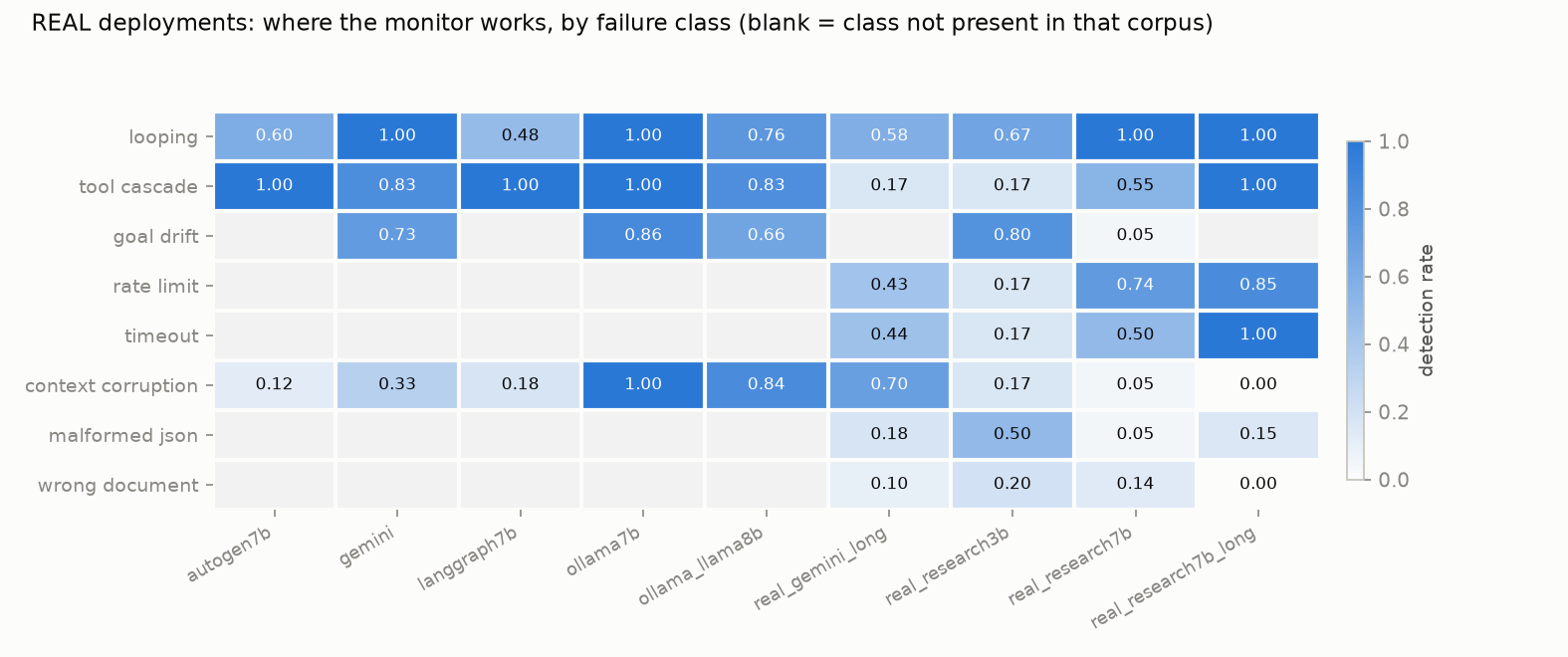
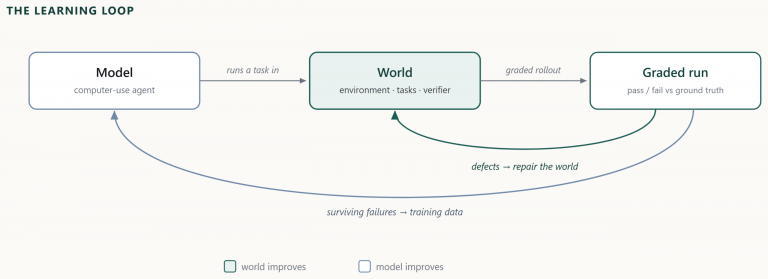
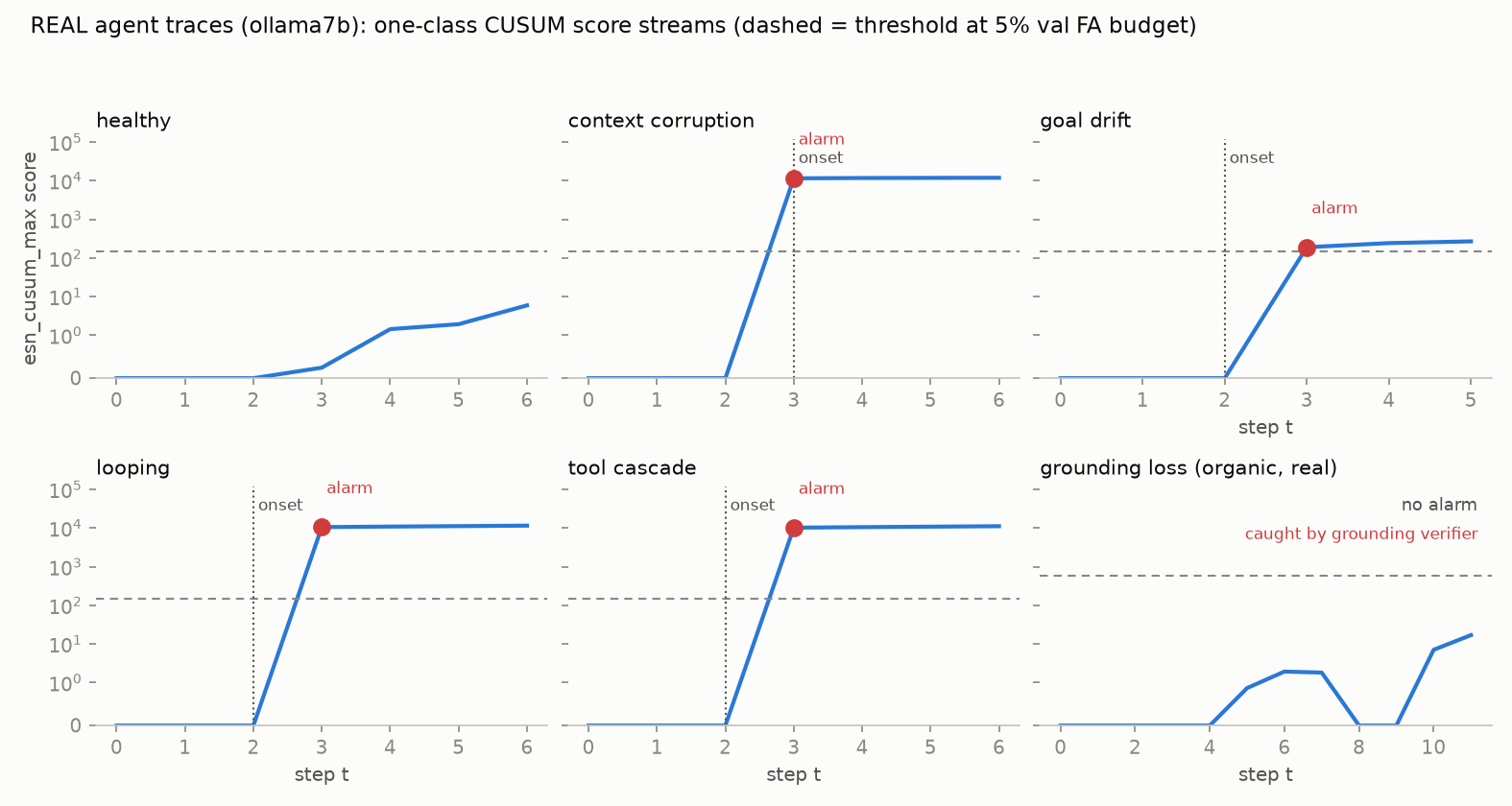
Researcher Sunny Dubey ran 2,823 agent episodes across three frameworks, three local models (Qwen2.5 7B/3B, Llama 3.1 8B), and Gemini-2.5-Flash, cataloguing failures including loops, cascading tool errors, goal drift, hallucination, and prompt injection via corrupted content. The core detector is an echo-state-network ensemble with CUSUM alarms, trained only on healthy runs — no failure examples needed — and costs microseconds per step versus hundreds of milliseconds for an LLM-as-judge. It hits AUROC 0.872 and catches 71% of failures at a 5% false-alarm budget. The key insight is temporal: the monitor’s edge over a memoryless baseline is tiny at ≤3 steps post-failure (+0.09 AUROC) but enormous at ≥9 steps (+0.40), meaning it catches slow-burn failures that step-level checks miss entirely. On top of the statistical monitor, a deterministic verification layer — literally recomputing stated totals from actual tool outputs and checking required calls were made — catches 60% of failures (96% with a coverage check) at zero false positives across 63 failures, and transfers unchanged to a new model with 110/110 detection at 0/10 false alarms. When flagged runs are rolled back and re-run, task success lifts from 52% to 73% at roughly one extra model call per run, versus a 16% recovery rate for naive resampling (p=0.0005).
Cold read
This is single-author work on three frameworks that the paper doesn’t fully specify — reproducibility depends heavily on whether “three frameworks” covers your stack. The monitor’s most important limitation is buried in the results: it does not transfer cold. AUROC collapses from 0.885 to 0.527 without per-deployment recalibration on healthy runs, which means every new deployment needs its own healthy baseline corpus before you get protection — a non-trivial operational burden for teams shipping agents to diverse customers. The 71% detection rate at 5% false alarms sounds strong until you consider that 29% of failures still escape, and a 5% false-alarm rate on a high-volume agent pipeline means a lot of expensive rollbacks on healthy runs. The deterministic verifier is the genuinely exciting piece, but its 60% catch rate (without the coverage check) and zero false positives are measured on a single task type that involves computable numerical outputs — it won’t generalize to open-ended generation tasks where there’s nothing to recompute. The 52%→73% task success recovery is measured on what appears to be the same benchmark used for development, not a held-out production distribution.
What it means for you
- Signal maturity: 3/5 — solid empirical foundation, but cold-transfer failure and single-author scope demand caution before production bets
- Who gets hurt: Teams currently paying for LLM-as-judge monitoring at every step — this directly undercuts that cost structure
- What breaks if this is true: The “just add a second model to watch the first” architecture becomes architecturally and economically indefensible for high-volume agents
- Why it might not land: The per-deployment healthy-null requirement is a quiet killer — if your agent handles 50 customer verticals, you need 50 calibration pipelines, and the protection window before recalibration is essentially zero
- Watch for: A commercial offering bundling the deterministic verifier + rollback layer as infrastructure — that’s the productizable wedge here, not the statistical monitor
Forecast as of 2026-08-04
By Q2 2027, at least two agent observability startups (or one major cloud provider) will ship a deterministic tool-call verification layer directly inspired by this architecture; the statistical monitor approach will remain a research artifact due to the per-deployment calibration burden.
Source: Real-Time Detection and Repair of LLM Agent Failures — Sunny Dubey. https://arxiv.org/abs/2608.02464v1