Edge AI Just Made Cloud RAG Look Like a Fax Machine
Edge AI Just Made Cloud RAG Look Like a Fax Machine
A team claims they’ve collapsed retrieval latency from 27 seconds to 6 milliseconds on edge hardware — not by optimizing, but by bypassing the entire prefill problem. If this holds up outside the lab, it quietly invalidates a significant chunk of the cloud-inference value proposition.
What happened
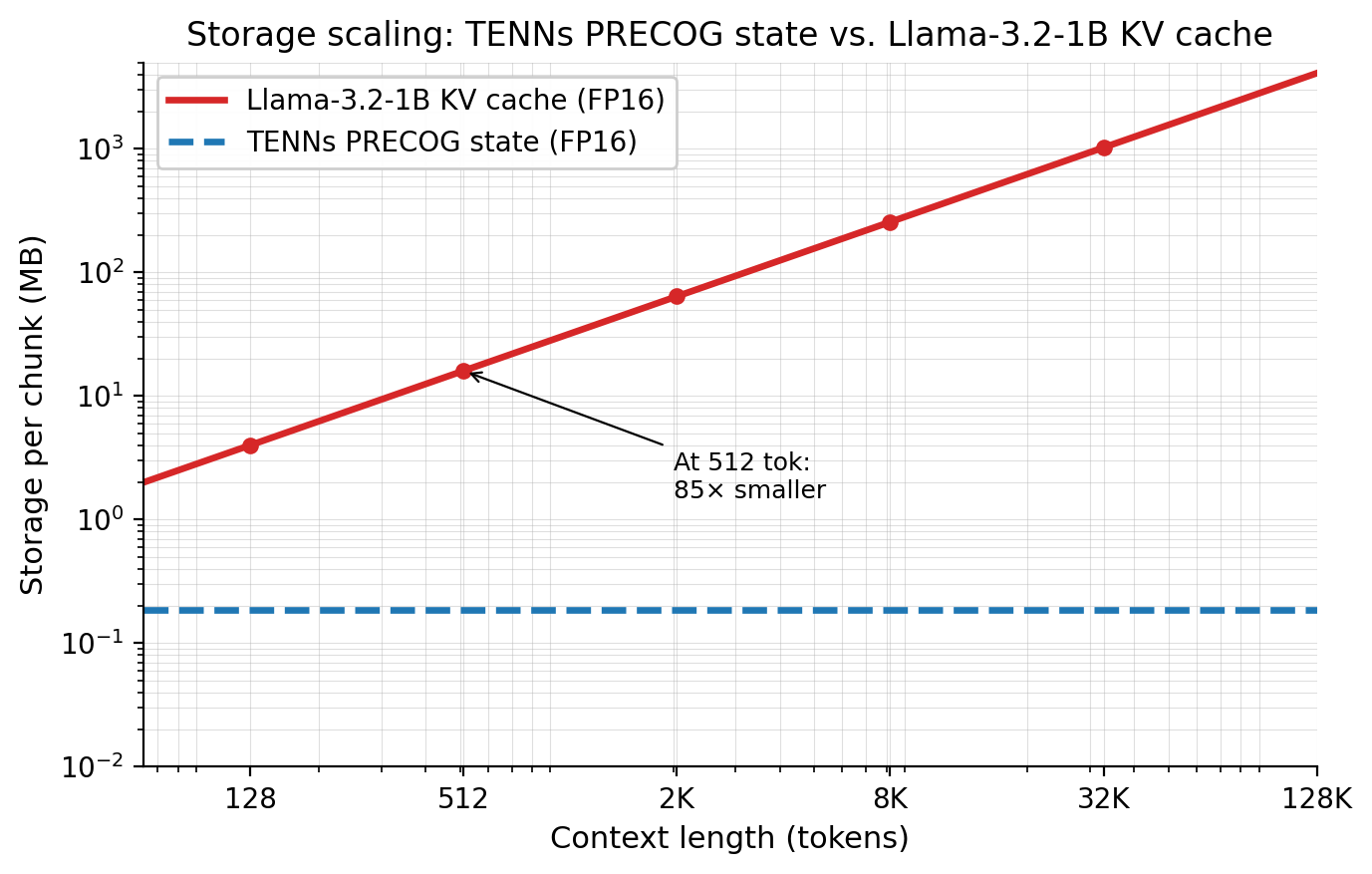
Researchers at USC and Knowm built PRECOG (Pre-Computed Context Injection), a retrieval mechanism that exploits a structural quirk of State-Space Models: unlike Transformers, an SSM’s recurrent hidden state is a fixed-size summary of everything the model has read, with no positional encoding entangled in it. That means you can encode documents offline as hidden states, store them, and at query time just inject the best-matching one directly — skipping the in-context re-ingestion step that makes standard Retrieval-augmented generation expensive. The result: prefill cost drops from O(L_context) to O(1) per query, and measured latency on edge hardware falls from ~27 seconds to under 6 ms — a ~4,500× speedup. They layer on top of this a persistent memory system called SMC (Structured Memory Consolidation), which clusters episodic states into long-term semantic memory using cognitive-domain grouping, with a tunable fidelity-vs-storage tradeoff. The whole system runs on a 1.2B-parameter gated-SSM model called TENNs-LLM carrying a 192 KB hidden state, and the paper claims PRECOG matches in-context RAG answer quality, though the Agent memory vs Context window tradeoffs and Retrieval precision and recall figures are where the real questions live.
Cold read
The headline number — 4,500× speedup — is real only in the narrow sense that 27 seconds of Transformer prefill on constrained edge hardware is the baseline. A cloud-hosted Transformer is not 27 seconds. The paper’s competitive frame is “edge hardware,” which means the comparison is against a deliberately weak opponent; whether this beats a well-optimized quantized Transformer on the same edge chip is not addressed. “Matches in-context RAG answer quality” is the critical claim, and the abstract gives no benchmark names, no accuracy scores, and no statistical confidence intervals — this needs scrutiny before you bet a product on it. The 192 KB hidden state as a “complete summary” is an SSM design property, but lossy compression is still lossy: what the model forgets during state encoding is precisely where Hallucination risk concentrates, and the paper does not characterize that failure mode. Finally, PRECOG requires your retrieval corpus to be pre-encoded as SSM states for this specific model architecture — meaning your corpus is now tied to TENNs-LLM, creating a portability problem that cloud-era RAG pipelines don’t have.
What it means for you
- Signal maturity: 2/5 — single model, no public benchmark scores, no third-party replication
- Who gets hurt: Edge AI middleware vendors selling latency optimization for Transformer-based RAG; cloud inference providers whose pitch is “too fast to replace”
- What breaks if this is true: The assumption that persistent, personalized memory requires a cloud round-trip — wearables, medical devices, and industrial edge agents become genuinely autonomous
- Why it might not land: Corpus lock-in to a specific SSM architecture is a real integration tax; enterprises won’t re-encode millions of documents every time the model updates, and the Faithfulness vs Groundedness story for injected states vs. verbatim context is unresolved
- Watch for: An independent group reproducing PRECOG answer-quality claims on a named benchmark (MMLU, NaturalQuestions, or similar) with a quantized Transformer as the proper baseline — that paper is the one that actually matters
Forecast as of 2026-08-04
By Q2 2027, at least one edge AI hardware vendor (likely in the hearing aid, wearable, or industrial IoT space) will ship a product citing SSM state-injection as a core memory architecture — but mainstream enterprise RAG pipelines will still be Transformer-based, and PRECOG will remain a research curiosity outside specialized edge deployments.
Source: Structured Memory for Edge Language Models: Persistent Context and Corpus Retrieval via O(1) SSM State Injection — Anusha Madan Gopal, Aras Pirbadian, Kristofor D. Carlson, M Anthony Lewis, Jonathan Tapson. https://arxiv.org/abs/2608.02560v1