Your 9B Agent Just Ate a Frontier Model’s Lunch—Inside a Simulator
Your 9B Agent Just Ate a Frontier Model’s Lunch—Inside a Simulator
A Microsoft research team claims a 9-billion-parameter model trained on synthetic app environments nearly matches GPT-scale giants at computer-use tasks. If the numbers hold, the cost calculus for deploying browser agents just got violent. Read carefully before you re-architect anything.
What happened
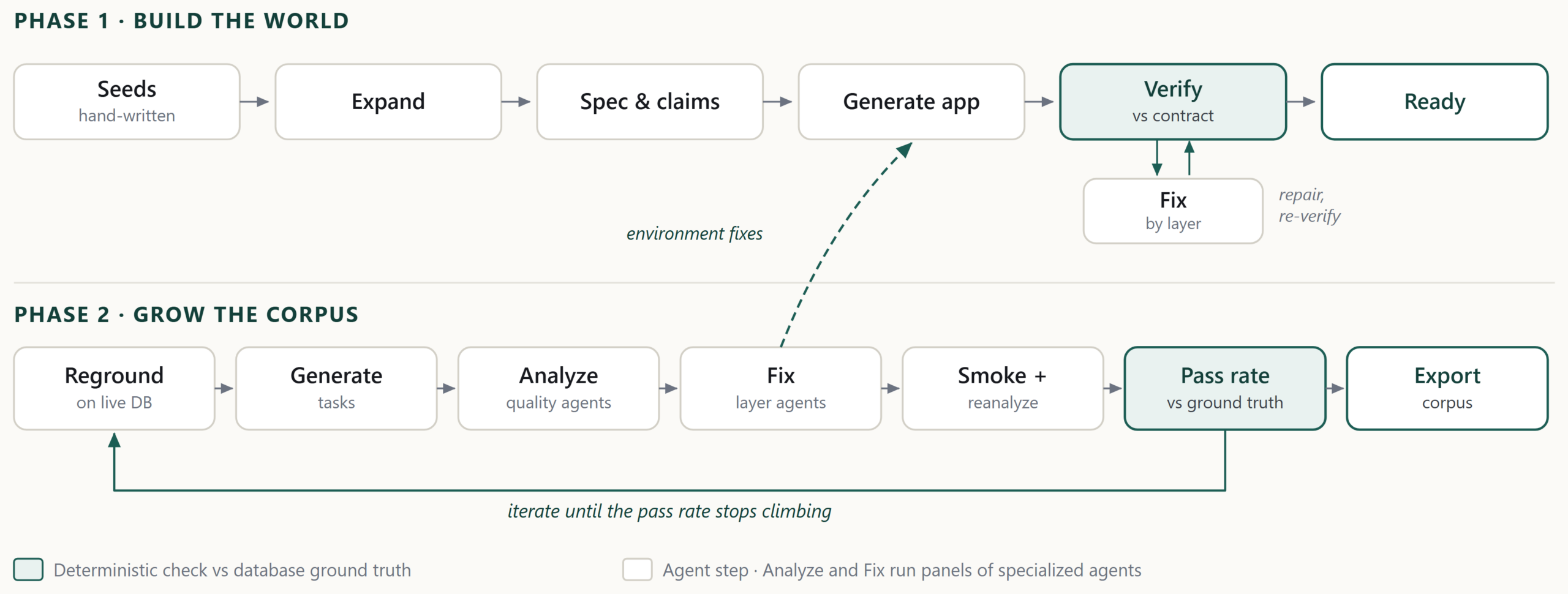
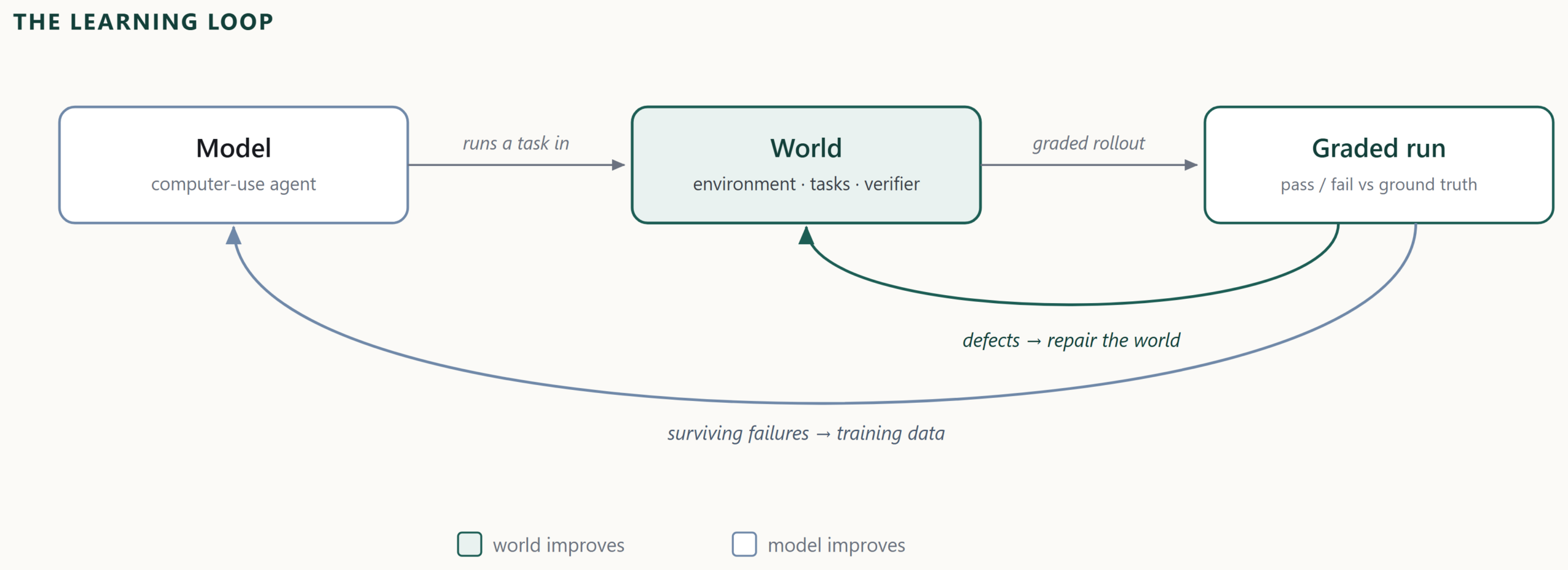
The Echoverse team built a pipeline that compiles specifications into stateful, login-gated web applications—the kind real agents actually need to navigate—then runs a “co-evolution loop” that reads every graded agent rollout twice: once to repair the environment’s tasks and verifier, once as a training signal for the model. The key claim is that environment quality is now the bottleneck, not quantity. Three properties drive returns: behavioral depth, failure-targeted task generation, and environments that evolve alongside the model. Training a 9B model on just twelve such environments lifted task-completion accuracy from 36.5% to 67.1% across fourteen evaluation splits—within fourteen points of the much larger frontier model used as teacher. The contrast with shallow environments is damning: shallow synthetic apps degraded live-site accuracy (80.0 → 75.0), while deep ones raised it (80.0 → 85.0 and 48.0 → 65.0). Repairing a single environment alone moved the model trained on it from 16.2% to 38.5%, and the same environments used as agentic workflow RL arenas—with a grounded verifier plus a dense per-step LLM-as-judge reward—pushed held-out score from 58.8% to 68.0%. Four environments, their seed data, and graded verifiers are being released as a benchmark.
Cold read
Twelve training environments is a thin slice of the actual SaaS universe; generalization claims rest on fourteen evaluation splits that the authors designed, which raises real benchmark contamination concerns—we don’t know how independent those splits are from the training distribution. The “within fourteen points of the frontier model” framing is doing heavy lifting: fourteen points is not a rounding error, it’s the difference between a useful agent and a broken one in most production workflows. The co-evolution loop that repairs environments and verifiers is itself model-assisted, meaning errors compound in both directions—a flawed verifier trains a flawed model trains a flawed repair. Live-site accuracy numbers (the only real-world signal here) are reported for narrow, unnamed domains; there’s no evidence this transfers to the messy heterogeneity of enterprise SaaS stacks your customers actually run. The released benchmark covers four environments, not twelve, so independent replication of the headline number requires infrastructure most research teams don’t have and most startups definitely don’t.
What it means for you
- Signal maturity: 2/5 — Promising architecture, thin external validation
- Who gets hurt: Startups selling expensive frontier-model API calls as the backbone of their computer-use agent products; if a fine-tuned 9B is close enough, their margin story collapses
- What breaks if this is true: The assumption that you need GPT-4-class inference costs to run reliable browser agents—commoditization of the capability layer accelerates, and differentiation shifts entirely to proprietary environment data and task graphs
- Why it might not land: The co-evolution loop requires you to build and maintain stateful synthetic apps that mirror your target domain; that’s non-trivial engineering, and most teams will underinvest in environment depth, reproducing the shallow-environment failure mode the paper explicitly warns against
- Watch for: Third-party replication on the released four-environment benchmark, specifically whether the shallow-vs-deep degradation result (80.0 → 75.0 vs 80.0 → 85.0) holds on environments the Microsoft team didn’t build
Forecast as of 2026-07-31
By Q2 2027, at least two well-funded computer-use agent startups will publicly claim a co-evolution or self-improving environment loop in their training stack, but fewer than half will show live-task accuracy on independent third-party benchmarks exceeding 70%—the gap between the headline and the replication will be the story.
Source: Echoverse: Deep, Evolving Environments for Training Computer-Use Agents at Scale — Yash Pandya, Sahil Gupta, Sarthak Harne, Archana Yadav, Kavyansh Chourasia, Hussein Mozannar, Vibhav Vineet, Sara Abdali, Corby Rosset, Yash Lara, Ahmed Awadallah, Ece Kamar, Akshay Nambi. https://arxiv.org/abs/2607.28074v1