Your Next Small Model Just Got 41% Cheaper to Bake — On One GPU
Your Next Small Model Just Got 41% Cheaper to Bake — On One GPU
The dirty secret of deploying cheap LLMs is that making them cheap to run is expensive to build. Knowledge distillation — the compression step that turns a giant teacher model into a deployable student — has been quietly eating GPU budgets. This paper says it found two tricks that change that math, and the numbers are specific enough to take seriously.
What happened
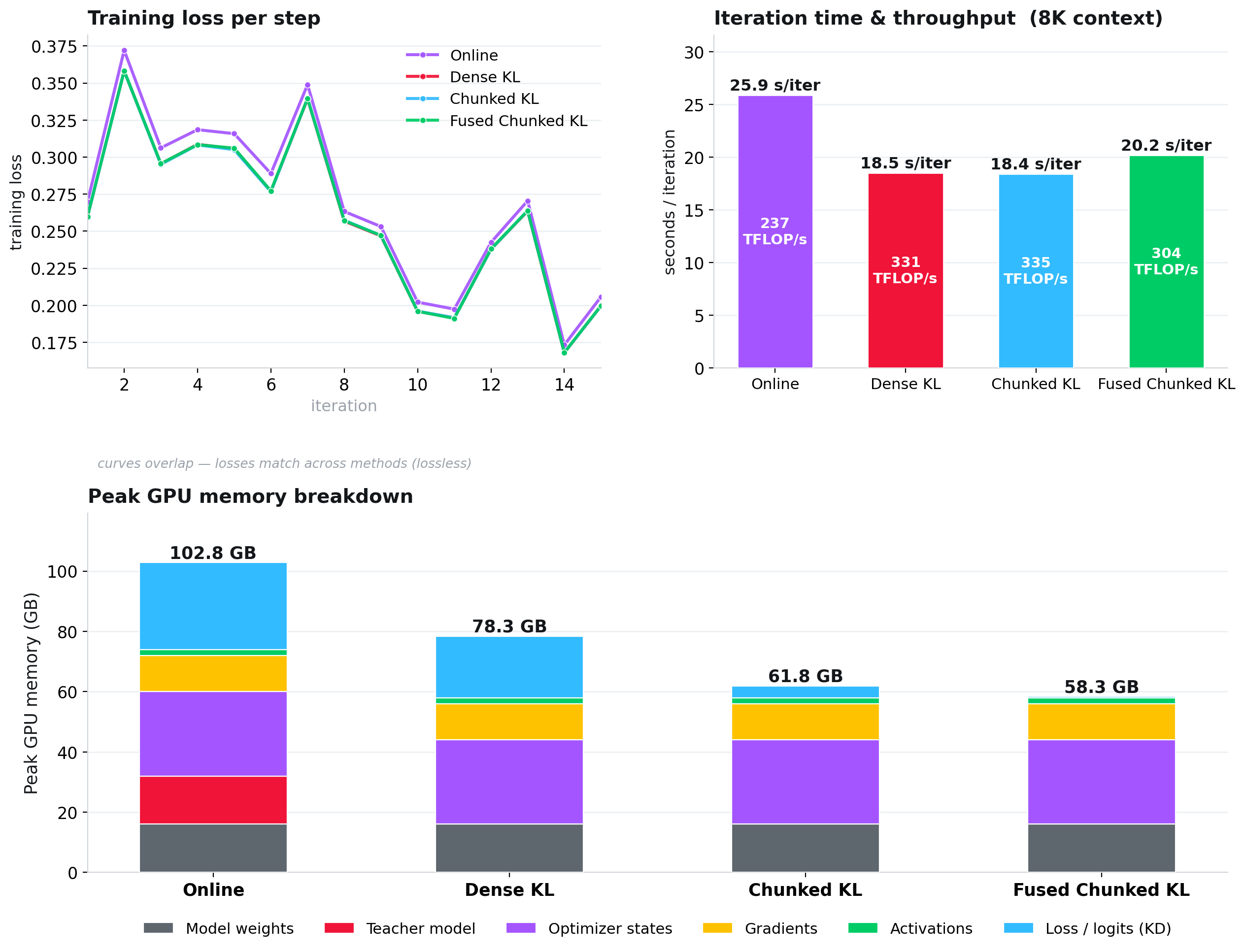
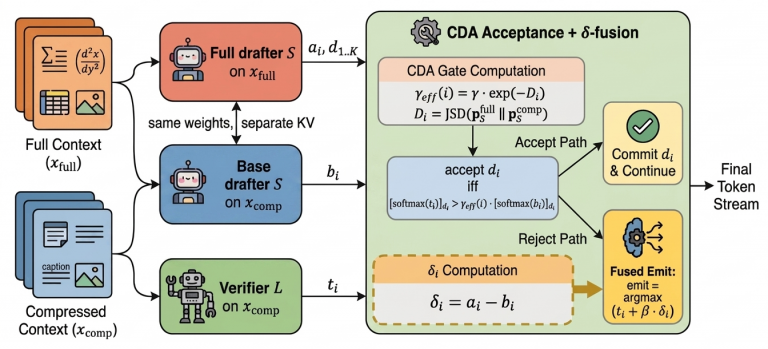
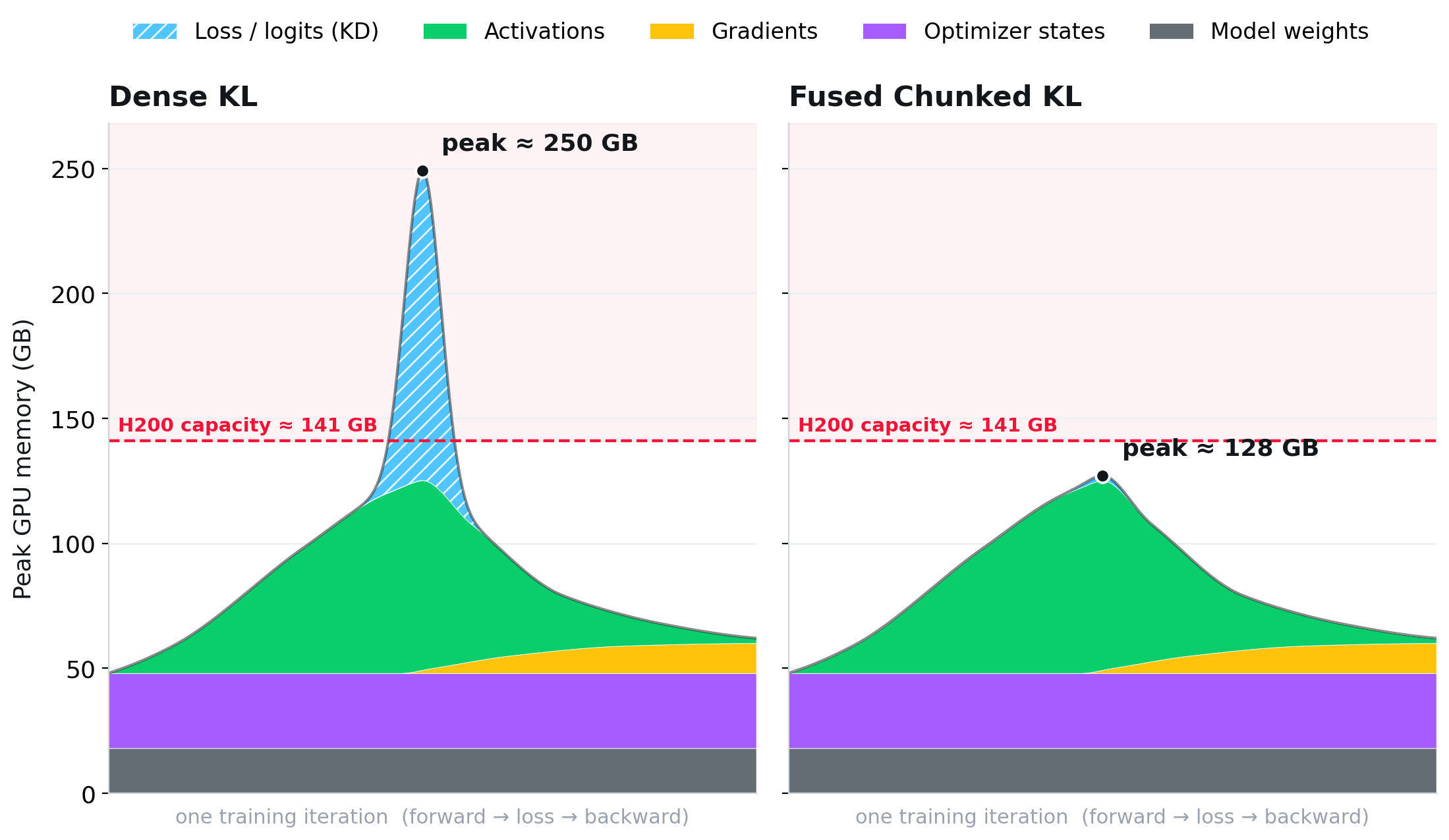
A team from CompactifAI ran a practitioner-focused study on making knowledge distillation of large language models faster and cheaper, organized around two concrete system improvements. First, offline distillation: instead of keeping the teacher model live in memory during training, you cache its top-K logits once, then train the student against that cache. The paper reports this matches online distillation at near-identical training loss, runs ~29% faster per iteration, and achieves up to 41% higher throughput on a single H200 GPU. Second, they introduce a fused, chunked KL loss that avoids ever materializing the full vocabulary-sized logit tensor — making peak memory scale linearly with sequence length rather than blowing up. That memory fix lets them train at 32,768 tokens of context window on a single GPU — four times what was previously feasible in their setup. A synthetic benchmark confirmed the memory and speed scaling holds from 4K all the way to 256K tokens. The chunked-loss code is open-sourced on GitHub.
Cold read
The headline number — 41% throughput gain — is a ceiling figure (“up to”), measured on a single H200, a top-of-the-line GPU most startups don’t have in-house or on-demand at scale. The paper is explicitly a “practitioner’s study,” not a controlled academic comparison across architectures, datasets, or teacher/student pairs, which means generalizability is asserted more than proven. The offline caching trick works only if the top-K logits are a faithful proxy for the full distribution — a known approximation whose failure modes (rare tokens, long-tail vocabulary) aren’t characterized here. The 29%/41% speed claims are meaningless without knowing what K is and what the cache storage costs look like at production data scale; storing teacher logits across a large pretraining corpus is its own infrastructure problem the abstract doesn’t quantify. And “near-identical training loss” is not the same as “near-identical downstream task performance” — the gap between those two claims is where compression techniques routinely fall apart.
What it means for you
- Signal maturity: 3/5 — Specific numbers on real hardware, but single-GPU, single-team validation; needs independent replication at scale
- Who gets hurt: ML infrastructure vendors and cloud providers selling expensive multi-GPU distillation pipelines as a service — this is a direct attack on that bill
- What breaks if this is true: The moat of “we have the GPU budget to fine-tune small models well” erodes; a solo ML engineer with one rented H200 can credibly compete with better-resourced teams on compression quality
- Why it might not land: Cache storage at real training-data scale (billions of tokens × top-K logits × float16) is a non-trivial infrastructure lift that may eat back the GPU savings in storage and I/O costs; the paper doesn’t show this math
- Watch for: Third-party replication on commodity hardware (A100s, not H200s) and on a publicly benchmarked student model — if someone posts eval results on MMLU or similar within 60 days, the technique is real enough to operationalize
Forecast as of 2026-08-05
By Q2 2027, the offline top-K caching approach will be integrated into at least one major open-source training framework (LitGPT, Axolotl, or equivalent) as a first-class distillation option — but the chunked KL loss will see slower adoption because context lengths beyond 32K remain a niche use case for most teams actually deploying small models under cost constraints.
Source: Efficient Knowledge Distillation for LLMs: Offline Top-K Logits and a Fused Chunked KL Loss — Bakbergen Ryskulov, Iker García-Ferrero, David Montero, David Jansen, Ali Hashemi, Jezabel R. Garcia, Antonio Tiene, Román Orús. https://arxiv.org/abs/2608.03796v1