AI Writes Its Own Web Code, Then the Browser Grades It — And It’s Getting Scary Good
AI Writes Its Own Web Code, Then the Browser Grades It — And It’s Getting Scary Good
The dirtiest secret in AI-generated UI: the model judging whether the page looks right is the same model that built it. That’s not quality control, that’s a mirror. A team just handed the grading pen to the browser itself — and the benchmark numbers are uncomfortable reading if you sell web development tools.
What happened
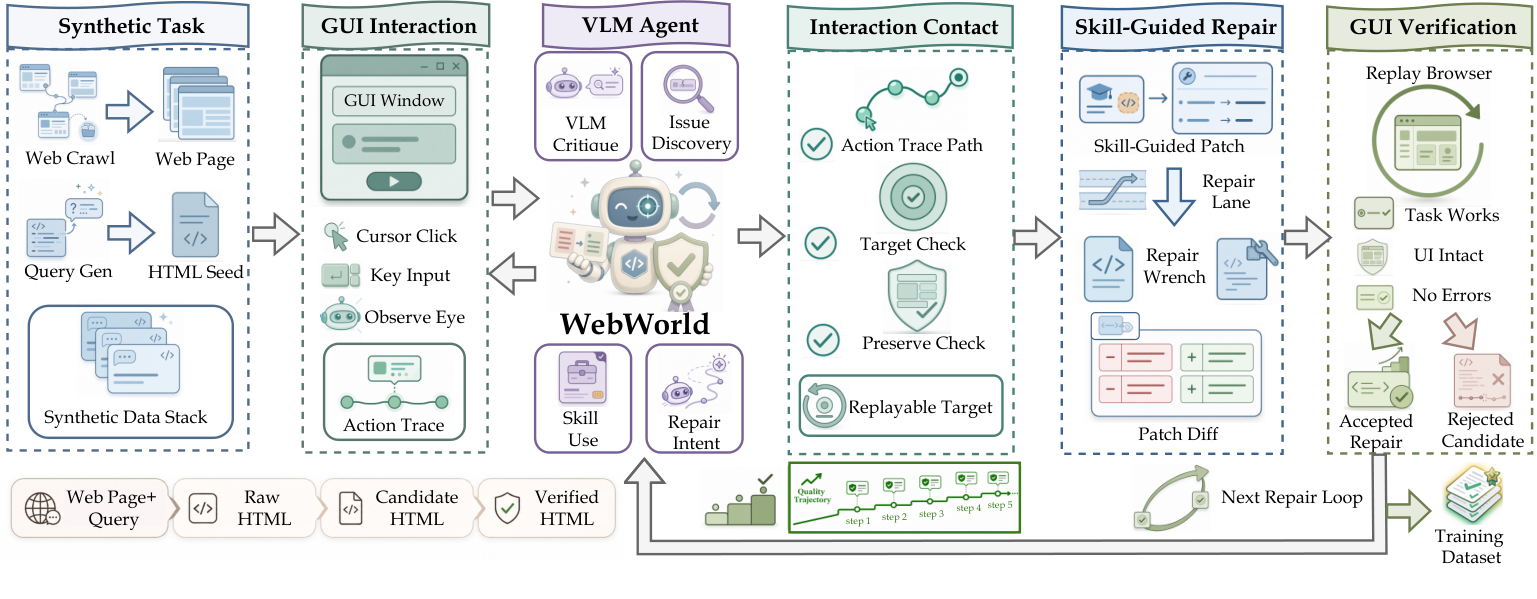
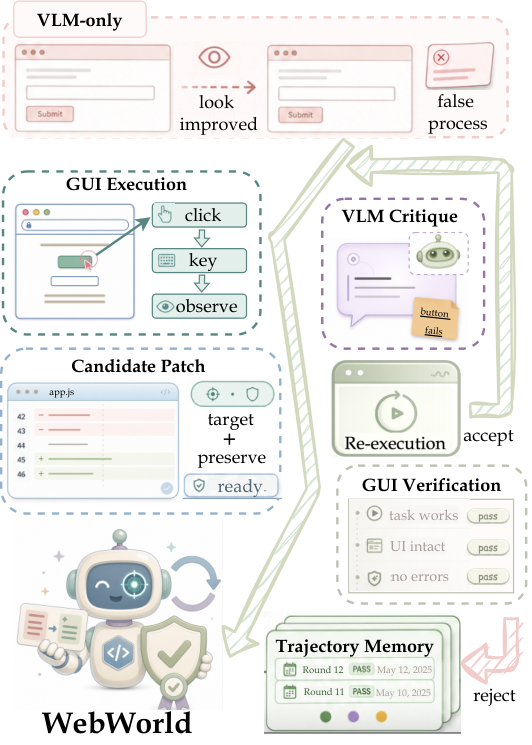
Researchers from multiple institutions identified a core structural flaw in VLM-driven web code self-improvement loops: the model proposing fixes is also the LLM-as-judge, and visual plausibility is a weak proxy for whether HTML actually works. Their system, WebWorld, replaces the model-as-judge with the browser itself — treating it as a deterministic “world model” that executes the code and issues acceptance certificates only when two conditions hold simultaneously: the targeted fix shows progress, and every previously verified capability remains intact. That second condition is the key architectural move — a “quality ratchet” that prevents regressions from entering the training data. The certified transitions are the only thing the supervised fine-tuning (SFT) export ever sees. Under matched training conditions, WebWorld-27B beats the unimproved Raw-27B baseline by 5.3 points on HTMLBench-400 and a striking 14.9 points on MiniAppBench-Val, reaching parity with frontier systems named Kimi-K2.6 and GPT-5.4 on interactive HTML generation. The ablation is the number you should actually care about: strip the browser-backed certificate and the matched 9B-model lift “nearly disappears.”
Cold read
The benchmarks used — HTMLBench-400 and MiniAppBench-Val — are not industry-standard holdouts; they are relatively new, narrow evals, and the paper gives no detail about benchmark contamination risk or how representative these tasks are of production web complexity. “Reaching the level of” frontier systems is doing a lot of work: the paper does not claim to beat them, and real-world frontier model comparisons are notoriously sensitive to prompt setup and eval harness choices. The quality ratchet is a compelling idea, but the abstract says nothing about what happens when the browser’s own execution environment is the bug — flaky JS engines, browser-version drift, or pages that pass the certificate but break in a different runtime. The improvement is measured on HTML generation specifically; there is no evidence this transfers to full-stack applications, stateful backends, or anything beyond rendered page behavior. Finally, this is a research paper on a 27B model — deployment cost at that scale for iterative self-improvement loops is a real friction, not a footnote.
What it means for you
- Signal maturity: 3/5 — compelling mechanism, narrow eval, not production-validated
- Who gets hurt: Low-code / no-code web builders (Webflow, Framer competitors, Wix ADI) whose moat is “AI that generates working UI” — that moat just got cheaper to replicate
- What breaks if this is true: The consulting and agency business of “fixing AI-generated front-end code” shrinks faster than expected; the remaining value moves entirely to design taste and brand, not technical correctness
- Why it might not land: The browser-as-world-model works cleanly for static and simple interactive HTML; the moment you add auth flows, API calls, or cross-browser compatibility requirements, the certificate issuer becomes unreliable and the ratchet breaks down
- Watch for: Whether any frontier coding assistant (Cursor, GitHub Copilot, Replit) ships a “browser execution loop” feature within the next two quarters — that’s the signal this mechanism is being taken seriously outside academia
Forecast as of 2026-09-02
By Q2 2027, at least one commercially shipped AI coding tool will publicly describe a browser-execution-gated training or feedback loop (not just a preview renderer), citing regression-prevention as a selling point — but it will be limited to static/simple interactive HTML and will not extend to full-stack application testing.
Source: WebWorld: The Browser as a World Model for Self-Improving Web Code — Jiajun Wu, Jian Yang, Yaxin Du, Wei Zhang, Haowen Wang, Junhang Cheng, Yuxuan Zhang, Tuney Zheng, Xianglong Liu, Ming Zhou. https://arxiv.org/abs/2608.30530v1