Your RAG Stack Is Burning Compute on Context Nobody Reads
Your RAG Stack Is Burning Compute on Context Nobody Reads
You’re paying for 128,000 tokens of attention. Your model is using maybe 7,000 of them to answer the question. A new paper puts a number on the waste — and proposes a fix that doesn’t touch your model, your weights, or your training pipeline.
What happened
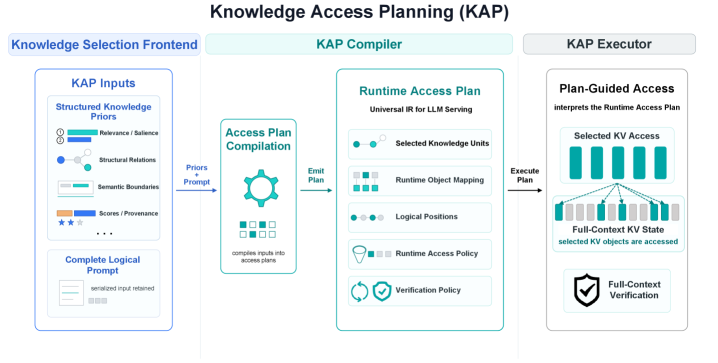
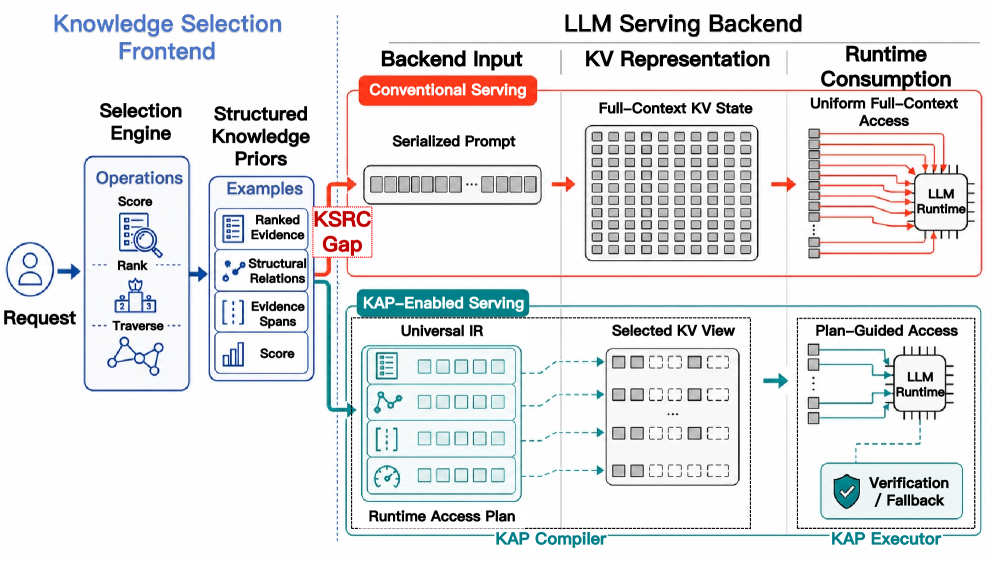
Researchers at (presumably) a systems lab identified what they call the Knowledge Selection-Runtime Consumption (KSRC) gap: the mismatch between how much work your retrieval-augmented generation pipeline does to curate and rank evidence, and how completely the serving backend ignores all of that structure once it’s flattened into a token sequence. The backend sees a flat string; the key-value (KV) cache gets fully materialized and read regardless of which chunks actually drive the answer. Their proposed solution, Knowledge Access Planning (KAP), introduces a “runtime access plan” — a compiled intermediate representation (IR) that translates structured signals (ranked evidence, knowledge graph topology, confidence scores) into physical instructions for which KV states to actually access during decoding — without altering the prompt semantics, model weights, or training. Their instantiation, GraphSpec, is tested on long-context QA workloads from 4K to 128K tokens. The headline result: at 128K context, GraphSpec reduces proposal-time KV access to 5.5% of full KV state while maintaining answer quality “comparable to full-context decoding.” That’s an 18× reduction in KV reads on the longest contexts.
Cold read
“Comparable to full-context decoding” is doing a lot of load-bearing work here, and the abstract never quantifies the quality delta — no exact accuracy numbers, no benchmark names, no error bars. The 5.5% KV access figure is dramatic, but it’s a hardware utilization metric, not a latency or cost-per-query number that maps cleanly to your AWS bill. The system requires that upstream knowledge-selection processes produce structured priors (ranked evidence, graph topology, confidence signals) — if your RAG pipeline is a flat vector search returning top-k chunks, you don’t get the benefit without rearchitecting the retrieval layer first. There’s also no mention of failure modes: what happens when the access plan is wrong and the relevant evidence gets pruned? Hallucination risk from aggressive KV pruning is a real concern that the abstract does not address. And the “paradigm-shifting” framing in the abstract is a red flag — that’s marketing language in a methods paper.
What it means for you
- Signal maturity: 2/5 — lab prototype with promising numbers but no production validation or third-party replication
- Who gets hurt: LLM inference infrastructure vendors (vLLM-style backends, managed inference APIs) whose pricing models assume dense full-context KV consumption — this, if it works, compresses their cost advantage
- What breaks if this is true: The assumption that longer context windows linearly increase inference cost — and by extension, the business case for “just stuff more context in” as a RAG quality strategy
- Why it might not land: Requires structured upstream signals (graph topology, ranked evidence, confidence scores) that most production RAG pipelines don’t currently emit; retrofitting this is non-trivial and potentially a larger engineering lift than the inference savings justify at moderate context lengths
- Watch for: A production inference framework (SGLang, vLLM, TensorRT-LLM) merging a KAP-compatible KV access abstraction — that’s the signal this leaves academia
Forecast as of 2026-07-29
By Q3 2027, at least one major open-source LLM serving framework will have shipped an experimental feature for plan-guided or structured KV eviction informed by retrieval metadata — but fewer than 20% of production RAG deployments will have adopted it, because the structured-prior requirement blocks easy integration.
Source: KAP: Bridging the Knowledge Selection-Runtime Consumption Gap in LLM Systems — Shuo Wang, Fang Xi, Wenyuan Huang, Qing Wang, Junming Su. https://arxiv.org/abs/2607.24260v1