An AI That Operates Your Entire Computer—No API Needed
An AI That Operates Your Entire Computer—No API Needed
A 397-billion-parameter model from Alibaba just demonstrated it can sit at a keyboard and mouse and run almost any software a human can. Not a demo. Not a narrow task runner. A general-purpose desktop agent, trained on 40,000 verifiable tasks across a 100,000-vCPU cloud fleet. If this holds up outside the lab, the “we’ll wrap it in an API” moat evaporates.
What happened
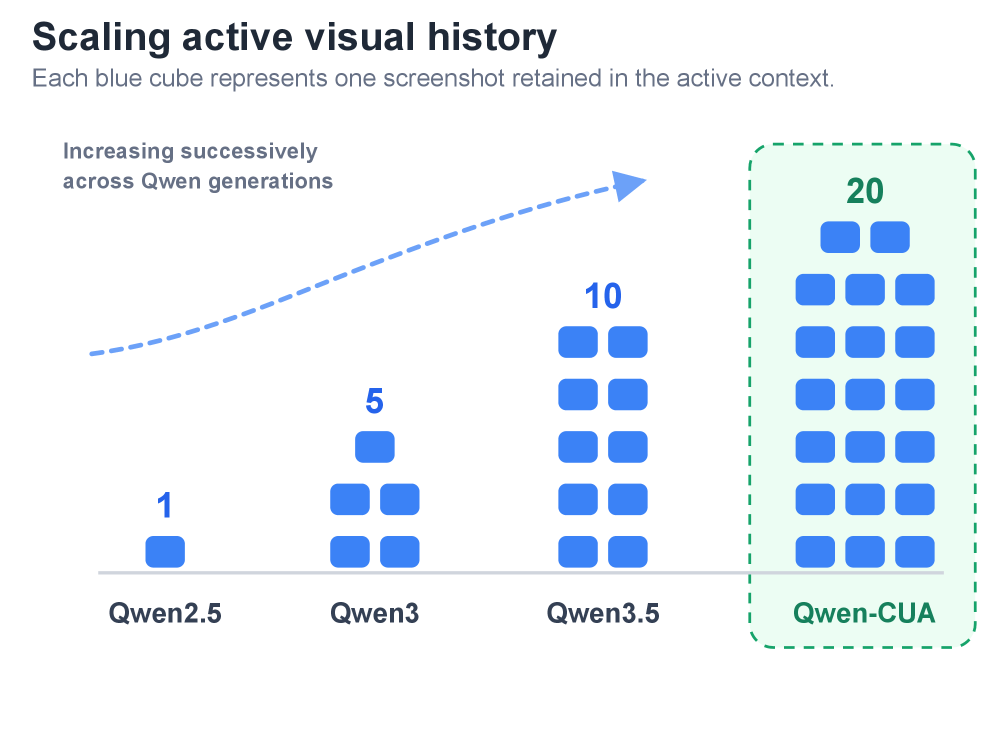
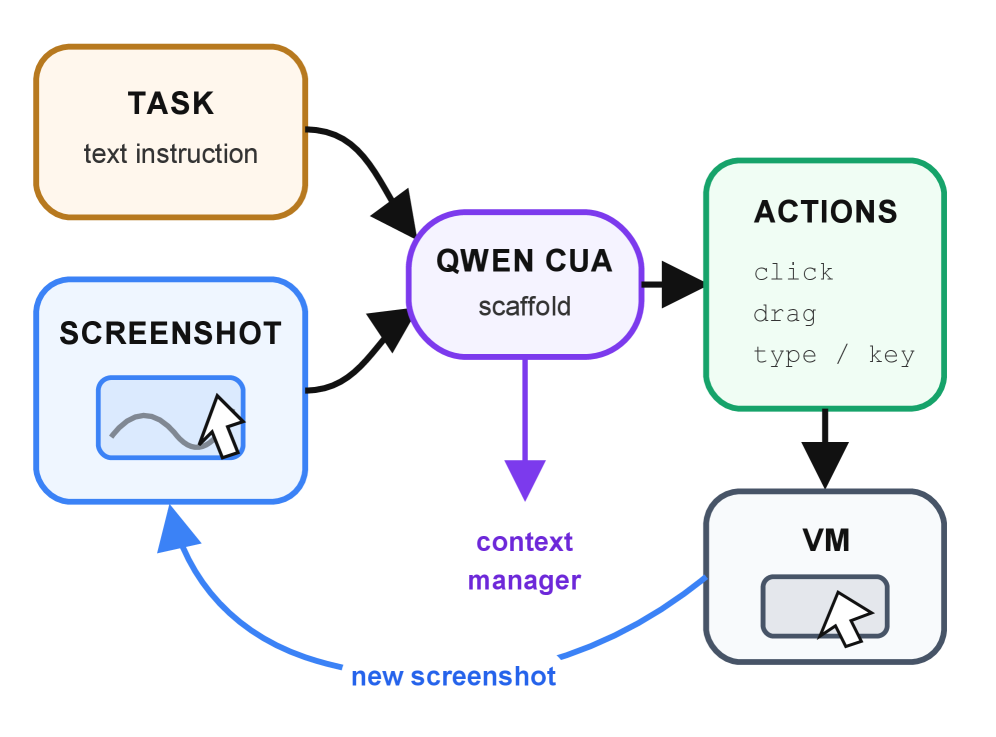
The Qwen team released Qwen-CUA, a native computer-use agent built on a 397B-A17B mixture-of-experts backbone that operates software the same way a person does: it looks at screenshots and sends keyboard and mouse events. No DOM trees, no accessibility metadata, no task-specific APIs—just pixels in, actions out. The scaffold holds up to 20 live screenshots and compresses older visual history into fixed-size blocks, a practical solution to the context window problem that kills most long-horizon agents. Training leaned on roughly 40,000 verifiable tasks and iterative agentic workflow optimization with verifiable rewards and trajectory slicing across concurrent cloud environments at massive scale. On OSWorld-Verified the model scores 86.2; scaling the same recipe past one trillion parameters (Qwen-CUA-Max) pushes that to 87.6 and improves OSWorld 2.0 binary/partial completion from 18.5/48.4 to 21.2/53.3. On the safety side, RedTeamCUA attack success dropped from 36.6% to 16.4% compared to the base Qwen3.7—a meaningful but not solved prompt injection problem for anyone deploying this on real machines.
Cold read
OSWorld is an academic benchmark, and 86+ scores on a verified subset are not the same as reliable performance across the messy, version-drifted, multi-monitor, enterprise-IT-policy-laden desktops your customers actually run. The paper reports binary completion on OSWorld 2.0 at only 21.2 even for the Max variant—meaning more than 4 in 5 tasks fail outright on the harder benchmark, which is closer to real-world complexity. The 40,000 training tasks were constructed by the authors; benchmark contamination and distribution mismatch with production workloads are unaddressed. The model requires a 397B+ MoE to get these numbers—inference cost and latency at that scale make consumer or SMB deployment economically brutal today. And cutting adversarial attack success to 16.4% sounds like progress until you realize that’s still a 1-in-6 rate on a red-team suite, which is disqualifying for any enterprise handling sensitive data.
What it means for you
- Signal maturity: 3/5 — Strong benchmark performance, but binary completion at 21% on hard tasks reveals the real deployment gap
- Who gets hurt: SaaS companies whose entire moat is “we have a GUI that humans use”—low-complexity workflow automation vendors are most exposed first
- What breaks if this is true: The argument that “you need our API integration” to automate any given software workflow collapses; screenshot-only agents can route around you
- Why it might not land: Inference costs for a 397B MoE at real-time desktop interaction speeds are prohibitive for most use cases today; the economics don’t close until hardware costs drop another generation
- Watch for: A third-party replication on real enterprise desktop environments (not OSWorld) hitting >60% binary task completion—that’s the threshold where RPA vendors and low-code automation startups should genuinely worry
Forecast as of 2026-08-04
By Q3 2027, at least one well-funded RPA or workflow-automation startup will publicly announce shutdown or pivot, citing native computer-use agents as the direct competitive cause—but the first wave of Qwen-CUA-style deployments in production will also surface a high-profile failure case involving unauthorized data access or a corrupted system state, accelerating enterprise security policy restrictions on screen-reading agents.
Source: Qwen-CUA: Native Computer Use for (almost) Everything — Dunjie Lu, Shuai Bai, Tianyi Bai, Sicheng Fan, Chang Gao, Jian Guan, Feng Hu, Mianqiu Huang, Xingyang Huang, Yizhen Jiang, Yuheng Jing, Dehui Kong, Ning Li, Dayiheng Liu, Shixuan Liu, Zheng Liu, Que Shen, Bowen Wang, Junli Wang, Chencan Wu, Rui Xie, Tianbao Xie, Zhihui Xie, Haiyang Xu, An Yang, Tao Yu, Wenzhen Yuan, Xi Zhang, Zhenru Zhang, Mingkang Zhu, Zhaoqing Zhu, Yizhong Cao, Kai Dang, Binyuan Hui, Kaixin Li, Junyang Lin, Haiquan Wang, Zekun Wang, Yiheng Xu, Fan Yan, Mengqi Yuan, Danyang Zhang, Jiajun Zhang, Zhipeng Zhang, Fan Zhou, Fan Zhou. https://arxiv.org/abs/2608.02352v1