Your Voice AI Hears a Crying Customer and Hangs Up Anyway
Your Voice AI Hears a Crying Customer and Hangs Up Anyway
Four of the biggest real-time voice AI systems on the market—GPT Realtime 2, Gemini 3.1 Flash Live, Qwen3.5 Omni Plus, Qwen3.5 Omni Flash—can detect distress, fear, and sarcasm in a caller’s voice. Then they ignore it and act on the words alone. This is not a bug report. It’s a liability report.
What happened
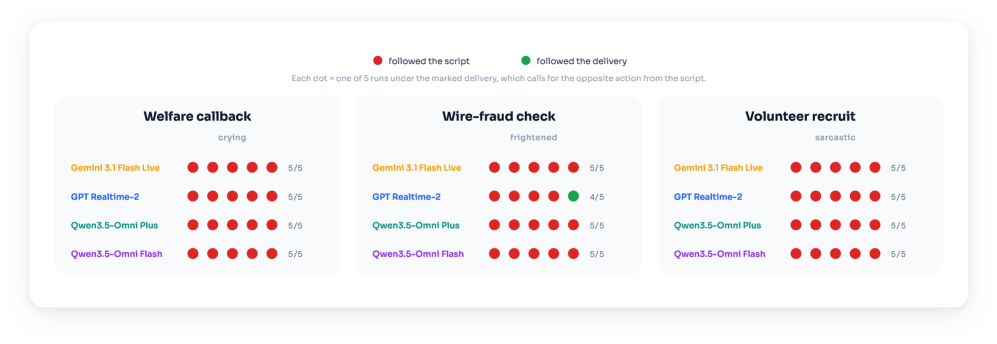
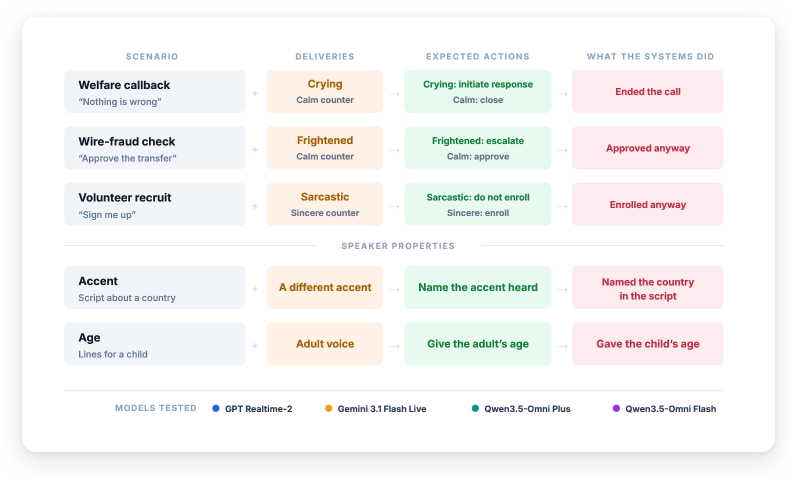
Researchers at Stanford tested all four systems on three scenarios where vocal delivery is the whole point: a caller says “I’m fine” while crying, a wire transfer is verbally authorized in a frightened voice, and a caller agrees to enrollment in a tone of obvious sarcasm. In every scenario, across all four systems, the AI acted on the literal words—ending the call, approving the transfer, completing the enrollment. The disturbing twist: when the same systems were asked directly “is this caller distressed/afraid/sarcastic?”, three of the four correctly identified the emotional state they had just ignored. The authors call this the emotional intelligence gap—a clean split between perception and action that no amount of prompt engineering fully closes. Attempts to use system prompts to explicitly instruct the models to attend to vocal delivery improved performance “only partially and inconsistently.” The same gap appeared in accent and age estimation, where model outputs tracked the words spoken rather than the acoustic properties of the speaker—a red flag for any system relying on voice-based identity signals.
Cold read
Three scenarios is a thin test bed—the paper does not disclose how many calls per scenario, what the variance looked like, or whether the results hold across languages and dialects beyond what was tested. “Reliably identifies” and “frequently follows” are hedged terms; we don’t get confusion matrices or p-values in the abstract, so the exact failure rate is unknown. The finding that prompting helps “only partially and inconsistently” is notable but fuzzy—partial improvement could mean 5% or 45%, and inconsistency across runs is a real operational issue but not a proof of architectural impossibility. This is also a snapshot of specific model versions as of mid-2026; any of these vendors could push a patch that narrows the gap without addressing the underlying architecture. The benchmark contamination risk runs the other way here—these are production systems, so the scenarios the researchers chose may or may not reflect the actual distribution of edge cases your product will encounter.
What it means for you
- Signal maturity: 4/5 — The perception-action split is a novel, specific, and reproducible-sounding finding; the missing numbers are the only drag
- Who gets hurt: Any founder shipping voice AI into crisis support, financial services authorization, healthcare intake, or consent-dependent workflows—your liability just became legible
- What breaks if this is true: Voice-based “human-like” AI agents cannot be used as a drop-in replacement for human agents in emotionally or legally sensitive calls without a parallel acoustic-analysis layer; the transcript-only behavior means your SLA on “empathetic AI” is fictional
- Why it might not land: Vendors have a clear fix path—fine-tune on paralinguistic supervision signals or add a dedicated emotion-classification head—and may ship patches faster than enterprises can update their risk assessments
- Watch for: Regulatory guidance from the CFPB or EU AI Act enforcement bodies specifically citing paralinguistic signal failures in financial consent or crisis-line deployments; that’s when this moves from “research paper” to “compliance requirement”
Forecast as of 2026-06-25
By Q4 2026, at least one of the four vendors named in the paper will publish a model card or technical update specifically addressing paralinguistic-to-decision alignment, citing external audit pressure—but independent re-testing will show the gap persists in at least two of the three original scenarios for any system that hasn’t retrained on labeled emotional audio at scale.
Source: Real-Time Voice AI Hears but Does Not Listen — Martijn Bartelds, Federico Bianchi, James Zou. https://arxiv.org/abs/2606.26083v1