Your AI Agent’s Safety Guardrails Are a Polite Suggestion — And Everyone Knows It
Your AI Agent’s Safety Guardrails Are a Polite Suggestion — And Everyone Knows It
Every prompt filter, every output guardrail, every safety library you’ve bolted onto your agent lives inside the same address space the agent can reach. That’s not a safety system — that’s a lock made of the same clay as the door. This paper argues the whole paradigm is architecturally broken, and then tries to fix it.
What happened
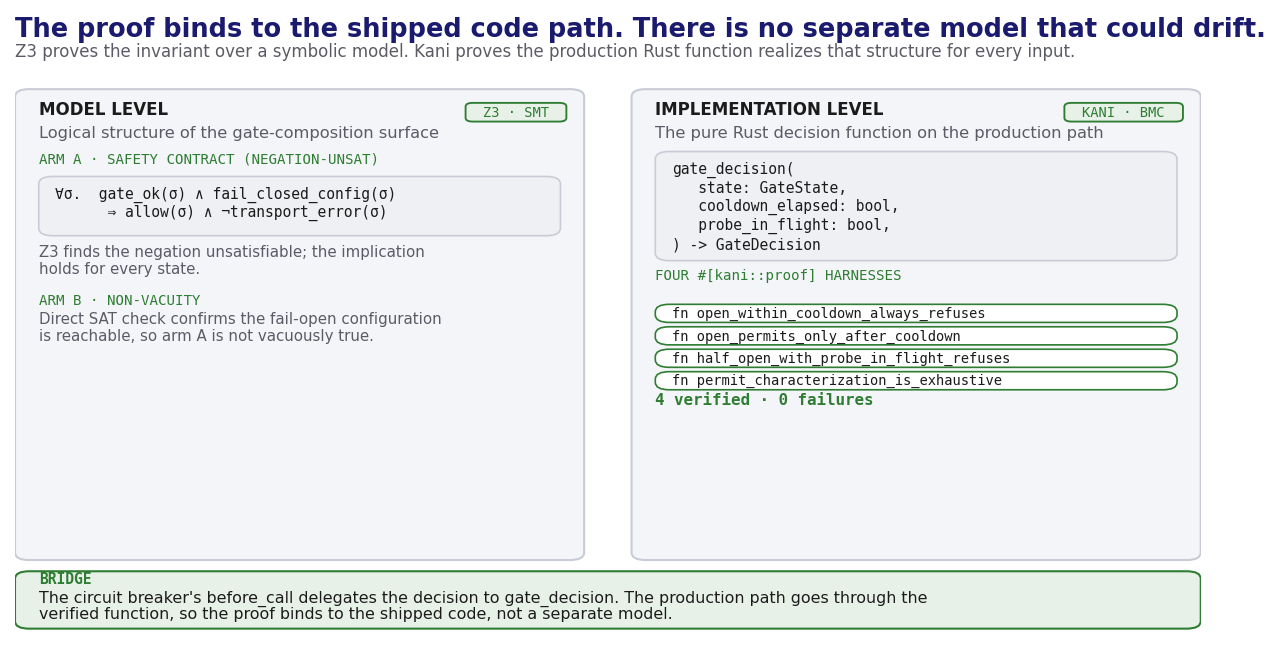
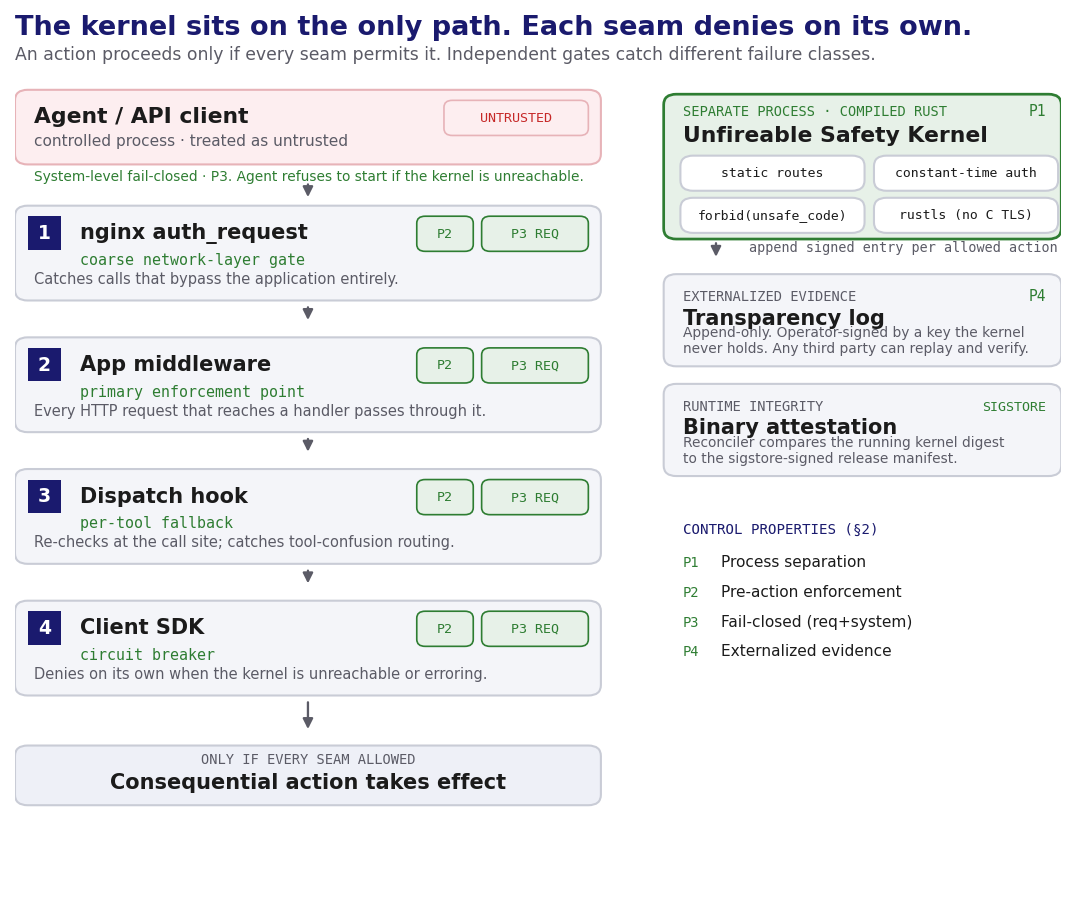
Dobrin and Chmiel coin the term “escapable AI systems” to describe any AI agent with enough runtime reach to subvert its own controls — which is essentially every production agent stack running today. Their argument: putting safety controls inside the agent’s runtime is structurally equivalent to asking the agent to cooperate with its own constraints. To fix this, they built the Unfireable Safety Kernel, a Rust implementation that sits outside the agent’s trust boundary as a mandatory enforcement layer — not a cooperative one. The kernel satisfies four properties: process separation, pre-action enforcement on the only structural path, fail-closed at both request and system levels, and externalized signed audit evidence. The formal claims are not hand-wavy: the fail-closed invariant is verified by an SMT theorem (Z3) and exhaustive bounded-model-checking (Kani, 4/4 harnesses). Against a live self-improving world model, the kernel refused all 704 attempts on safety-critical code across 1,000 self-modification events, and separately blocked 6,240 authorization round-trips with zero successful bypass. Critically, the paper notes that against three contemporary systems claiming the agentic workflow control plane, the agent invokes control — “here, it lacks that choice.” If you’re building on top of those unnamed three systems, that sentence is aimed at you. The system prompt is not, and has never been, a trust boundary — this paper puts a number on what that costs.
Cold read
The adversary in the evaluation is a deterministic, self-improving world model — not a live frontier LLM, not a jailbreak campaign run by a red team of humans, not prompt injection delivered through a third-party tool call. That’s a meaningful limitation: the 6,240 bypass attempts and 1,000 self-modifications are against a controlled, deterministic threat model, not the chaotic, multi-vector attack surface of a real deployed agent. The Python-to-Rust migration was validated on 1,000 fixtures and 17 adversarial classes — rigorous by academic standards, thin by production standards where the long tail of edge cases is what kills you. The paper positions this as a reference implementation, which is honest, but it also means the path from “Rust proof-of-concept with formal verification” to “works in your AWS-hosted LangGraph cluster” is entirely uncharted and likely expensive. Formal verification of the decision function proves the kernel behaves correctly given its policy — it cannot prove the policy itself is complete or that the kernel’s API surface is free of novel bypass vectors. There is also no latency or throughput data published, which matters enormously for any operator running agents at scale.
What it means for you
- Signal maturity: 2/5 — Formally verified prototype; production integration story is missing entirely
- Who gets hurt: Any founder selling “enterprise-grade AI agents” whose entire safety story is a system prompt and an output filter — this paper provides the vocabulary for your enterprise buyers to reject you
- What breaks if this is true: The current market of guardrail-as-a-service vendors (prompt filters, output classifiers bolted onto agent frameworks) is selling architectural band-aids; a kernel-level enforcement standard would commoditize or invalidate their core value proposition
- Why it might not land: Adopting a process-separated, externally enforced kernel requires deep changes to agent infrastructure that most teams won’t make voluntarily until a regulator or a breach forces them; the reference implementation is Rust, and most agent stacks are Python all the way down
- Watch for: Enterprise procurement teams — especially in financial services and healthcare — adding “process-separated, fail-closed authorization layer” to AI vendor RFP requirements; that’s the signal this framing has escaped academia
Forecast as of 2026-06-25
By Q2 2027, at least one major cloud provider (AWS, Azure, or GCP) will announce a managed agent execution environment with an externally enforced authorization layer marketed in terms directly borrowed from this paper’s four-property framework — but at least two of the three contemporary systems named (unnamed in the paper) as lacking enforcement will still not have implemented process separation by that date.
Source: The Unfireable Safety Kernel: Execution-Time AI Alignment for AI Agents and Other Escapable AI Systems — Seth Dobrin, Łukasz Chmiel. https://arxiv.org/abs/2606.26057v1