Your Phone Now Has an AI That Clicks Faster Than You Can Think
Your Phone Now Has an AI That Clicks Faster Than You Can Think
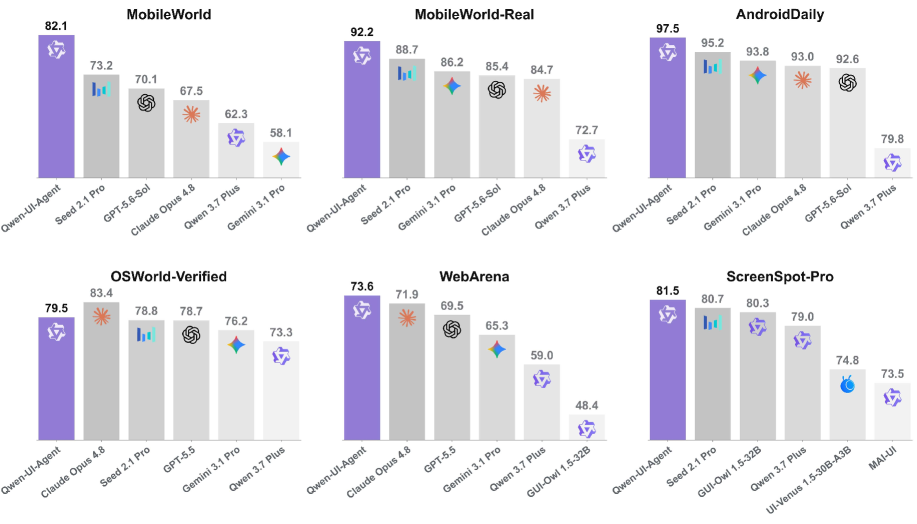
Alibaba just dropped a GUI agent scoring 97.5% on Android daily tasks — and it beats GPT-5.6 and Gemini 3.1 Pro on mobile. If your business model depends on humans navigating software, read carefully.
What happened
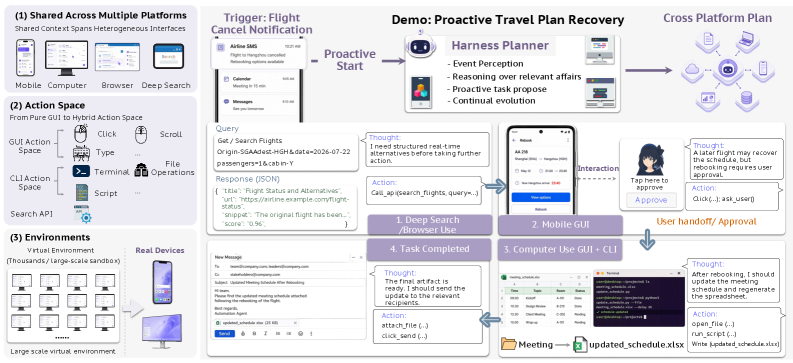
Qwen-UI-Agent is Alibaba’s attempt at a “real-world centric” agentic workflow that operates across mobile, desktop, browser, and search environments from a single unified model. The core engineering bet: interleave GUI clicks with CLI execution in one agent memory vs context window-spanning action space, and generate batched multi-step actions in a single model turn rather than one click at a time. Training runs on online reinforcement learning across trajectories exceeding 100 turns, with over 10,000 concurrent environments to accelerate rollout. On benchmarks it is not shy: 82.1% on MobileWorld, 92.2% on MobileWorld-Real, 97.5% on AndroidDaily, 79.5% on OSWorld-Verified, 73.6% on WebArena, and 81.5% on ScreenSpot-Pro — claiming state-of-the-art on mobile against frontier models including Opus 4.8, Gemini 3.1 Pro, and GPT-5.6 Sol. A self-improving “AutoResearch” data flywheel uses agents to construct their own tasks, diagnose their own failures, and plan subsequent training iterations with minimal human annotation — the closest thing to autonomous capability bootstrapping this space has seen publicly documented.
Cold read
These are benchmark numbers, not production reliability statistics — and benchmark contamination is a standing concern when the same lab building the agent also controls the data flywheel that generated training tasks. The 97.5% AndroidDaily figure sounds decisive until you realize “daily tasks” benchmarks are narrow, scripted, and notoriously gameable; the more honest signal is OSWorld-v2’s 40.0% partial-progress score on computer use, which means the agent frequently starts but fails to finish real desktop workflows. The paper claims real-device mobile testing, but the gap between a sandboxed real-device runtime and your actual employee’s enterprise SaaS stack — with SSO, 2FA, unexpected modals, and prompt injection vectors embedded in web content — is not addressed in the abstract. “Proactive service initiation” (the agent acting without being asked) is framed as a feature; for any regulated industry, it is a liability waiting for a name. Self-improving flywheels sound magical but compound errors quietly — there is no disclosure of how failure diagnosis accuracy was validated before it fed back into training.
What it means for you
- Signal maturity: 3/5 — benchmark-leading but real-world deployment evidence is thin
- Who gets hurt: RPA vendors (UiPath, Automation Anywhere), BPO operators running click-work workflows, and “AI wrapper” startups whose moat is just automating UI navigation
- What breaks if this is true: The staffing model for offshore data-entry and software QA collapses faster than predicted; any workflow that was “too complex for RPA” is suddenly re-priced
- Why it might not land: Enterprise IT will not hand root-level GUI + CLI access to a model that can “proactively initiate services” — security, compliance, and audit requirements alone will delay deployment 12–24 months in most large organizations
- Watch for: A third-party reproducing MobileWorld-Real scores on apps outside Alibaba’s training distribution — that is the real credibility test
Forecast as of 2026-07-31
By Q2 2027, at least two funded RPA-adjacent startups will publicly pivot away from GUI automation, citing Qwen-UI-Agent or a comparable open model as having commoditized the core capability; enterprise production deployments with audit trails at Fortune 500 companies will still be under pilot, not at scale.
Source: Qwen-UI-Agent Technical Report: Toward Next-Generation Real-World Centric Foundation GUI Agents — Hanzhang Zhou, Panrong Tong, Xu Zhang, Quyu Kong, Chenglin Cai, Tianyu Xia, Gongjie Zhang, Jianan Zhang, Long Li, Long Chen, Lei Wang, Gaole Dai, Pengxiang Li, Liangyu Chen, Yue Wang, Steven Hoi. https://arxiv.org/abs/2607.28227v1