NVIDIA Claims 4× Throughput Over Qwen3. Your Inference Bill Just Flinched.
NVIDIA Claims 4× Throughput Over Qwen3. Your Inference Bill Just Flinched.
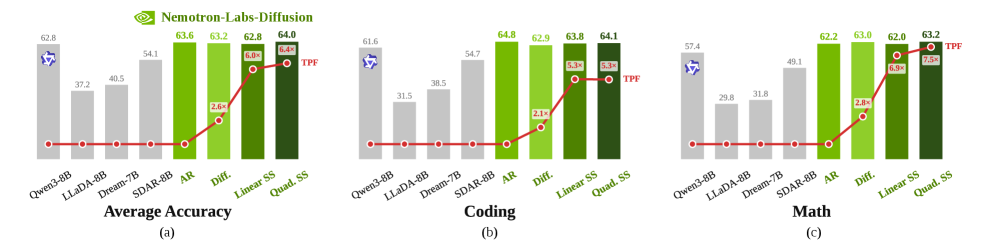
A team from NVIDIA’s Nemotron Labs says they’ve built a single model that decodes six times more tokens per forward pass than Qwen3-8B — at comparable accuracy. If even half of that holds up in production, every inference-cost assumption you made this year is wrong.
What happened
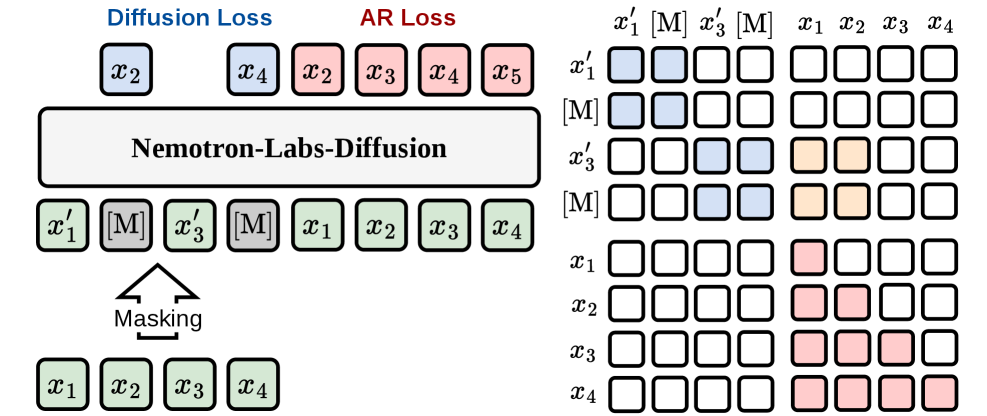
NVIDIA researchers introduced Nemotron-Labs-Diffusion, a large language model family (3B, 8B, 14B parameters) that trains jointly on autoregressive (AR) and diffusion objectives and can switch between three operational modes at inference time: pure AR, pure diffusion, or “self-speculation,” where the diffusion head drafts tokens and the AR head verifies them. The key claim is that this isn’t just a hybrid for accuracy — it’s a throughput play. Nemotron-Labs-Diffusion-8B delivers 4× higher throughput than Qwen3-8B on their SPEED-Bench benchmark running SGLang on an NVIDIA GB200 GPU, with 6× more tokens per forward pass. The paper argues AR and diffusion objectives are complementary: diffusion improves lookahead planning while AR supplies left-to-right linguistic priors — which makes the self-speculation mode outperform multi-token prediction (MTP) methods on both acceptance rate and real-device efficiency. A theoretical “speed-of-light” analysis claims diffusion could yield up to 76.5% more tokens per forward pass than self-speculation under an optimal sampler — a ceiling they haven’t yet reached. The model family spans base, instruct, and vision-language variants, and results are benchmarked on benchmark contamination-susceptible open-source evals, so treat accuracy parity claims with appropriate skepticism.
Cold read
The 4× throughput and 6× tokens-per-forward-pass numbers are measured on a GB200 GPU — NVIDIA’s own newest hardware — which makes this simultaneously the most favorable possible substrate and the one your startup almost certainly isn’t running on yet. The benchmark is SPEED-Bench, which the authors appear to have designed or selected; an internally favorable benchmark is not an independent replication. “Comparable accuracy” is doing enormous lifting in the abstract: comparable on what tasks, at what temperature, over what distribution of prompt lengths — none of that is specified here. The self-speculation mode’s advantage over MTP is real if the acceptance rate numbers hold, but acceptance rate is notoriously prompt-distribution-sensitive; production workloads with short, diverse queries may see far less gain than the headline suggests. The 76.5% speed-of-light figure is explicitly theoretical under an “optimal sampler” that doesn’t exist yet — citing it as evidence of “long-term potential” is the authors’ own hedging language dressed as a result.
What it means for you
- Signal maturity: 2/5 — single-lab paper, proprietary benchmark, no independent replication yet
- Who gets hurt: inference API startups and teams who built cost models around current AR-only throughput assumptions; also speculative decoding vendors selling MTP as the state of the art
- What breaks if this is true: the economics of running open-source models for high-concurrency applications shift significantly — if 4× throughput is real and portable, you either adopt this architecture or pay ~4× more per token than competitors who do
- Why it might not land: GB200 availability is still constrained; the joint AR-diffusion training objective adds complexity that may surface hallucination or factual consistency regressions in domains the paper doesn’t test; and “comparable accuracy” claims collapse fast when third parties run systematic evals
- Watch for: independent reproduction on A100/H100 hardware with commodity serving stacks (vLLM, TGI); if the throughput advantage drops below 2× on non-GB200 hardware, this is a GB200 marketing paper
Forecast as of 2026-07-08
By Q1 2027, independent benchmarks on H100 hardware will show Nemotron-Labs-Diffusion-8B achieving between 1.5× and 2.5× throughput over Qwen3-8B — real, but less than half the headline 4× figure, because the GB200-specific optimizations won’t transfer cleanly to the installed base.
Source: Nemotron-Labs-Diffusion: A Tri-Mode Language Model Unifying Autoregressive, Diffusion, and Self-Speculation Decoding — Yonggan Fu, Lexington Whalen, Abhinav Garg, Chengyue Wu, Maksim Khadkevich, Nicolai Oswald, Enze Xie, Daniel Egert, Sharath Turuvekere Sreenivas, Shizhe Diao, Chenhan Yu, Ye Yu, Weijia Chen, Sajad Norouzi, Jingyu Liu, Shiyi Lan, Ligeng Zhu, Jin Wang, Jindong Jiang, Morteza Mardani, Mehran Maghoumi, Song Han, Ante Jukić, Nima Tajbakhsh, Jan Kautz, Pavlo Molchanov. https://arxiv.org/abs/2607.05722v1