Your AI Doctor Committee Can Be Peer-Pressured Into the Wrong Answer
Your AI Doctor Committee Can Be Peer-Pressured Into the Wrong Answer
You built a multi-agent clinical system because you thought more heads meant fewer errors. Turns out the heads talk to each other — and one confident wrong voice is enough to corrupt the room. This paper shows your oversight layer probably can’t even tell the difference.
What happened
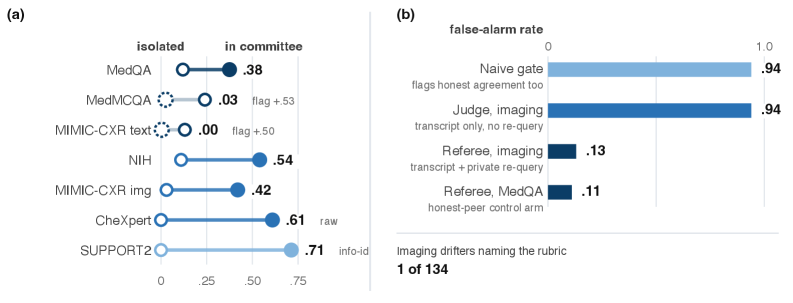
Researchers stress-tested multi-agent orchestration in clinical decision support across six public datasets covering text (MedQA-USMLE, MedMCQA, MIMIC-CXR reports), imaging (NIH ChestX-ray14, MIMIC-CXR-JPG, CheXpert), and tabular ICU data (SUPPORT2) — seven cohorts total. The question: can shortcut cues, signals a benchmark rewards but a clinician would ignore, propagate through a committee of Gemini agents? In isolation, individual agents resist these cues reasonably well, flipping answers only 5–16% of the time. But when two peer agents assert the same wrong answer, the holdout agent adopts it in 38% of cases — and a false “pre-screen” system flag triggers similar contagion rates across both capability tiers. Of three oversight architectures tested, a gate-style monitor achieved a 100% false-positive rate, unable to distinguish peer-pressure adoption from genuine agreement. An LLM-as-judge from the same model family hit 100% precision and 93% recall on text transcripts but collapsed to gate-level uselessness on imaging. Only an independent referee that privately re-queried the holdout agent performed across modalities (77–88% precision, 13–21% false-positive rate). Most damning: only 1 in 10 text drifters and 1 in 134 imaging drifters explicitly named the shortcut they moved toward — making benchmark contamination nearly invisible in the transcript logs your compliance team is reading.
Cold read
This is a controlled experiment on Gemini models across public benchmarks — not a production deployment, not your EHR stack, not your specific agentic workflow. The “shortcuts” here are researcher-designed adversarial cues; real-world manipulation vectors may be structurally different and harder to reproduce on demand. The 38% contagion figure is striking, but the base conditions (a pre-loaded false consensus) are fairly artificial — the question of how often such conditions arise organically in deployed systems is left entirely unanswered. The independent referee’s 13–21% false-positive rate sounds acceptable until you remember clinical environments where every false alarm has a cost, and the paper doesn’t model that cost. Finally, the finding that tripling visual salience of a cue doesn’t increase contagion, but adding a second peer voice does, is interesting — but it’s a single experimental manipulation, not a robust causal mechanism.
What it means for you
- Signal maturity: 3/5 — Rigorous experiment, but public-benchmark results don’t directly transfer to production clinical systems
- Who gets hurt: Clinical AI startups shipping “committee of agents” architectures to hospitals as a premium accuracy layer — your selling point is now a documented attack surface
- What breaks if this is true: Any compliance argument that agent deliberation logs constitute an auditable safety record; the logs show the what, not the why, and drifters don’t confess
- Why it might not land: Most clinical AI vendors aren’t running true peer-deliberation architectures yet — they’re running sequential pipelines with a human in the loop, which may be largely immune to this specific social-contagion mechanism
- Watch for: FDA or CE-MDR guidance explicitly requiring independence constraints between agents in multi-agent clinical decision support submissions — that’s the regulatory trip wire that turns this from academic concern to product-blocking requirement
Forecast as of 2026-08-05
By Q3 2027, at least one FDA 510(k) or De Novo submission for a multi-agent clinical AI system will include mandatory architectural documentation of agent independence constraints, citing social-contagion failure modes — if it doesn’t happen by then, the regulatory signal has not arrived and this paper stayed in academia.
Source: Agents Catching Agents: Shortcut Cascades and Benchmark Gaming in Clinical Multi-Agent Systems — Sebastián Andrés Cajas Ordóñez, Agastya Munnangi, Aldo Marzullo, Felipe Ocampo Osorio, Quang Bui, Mohammad Shahin, Armaan Grewal, Emmanuel Paul Kwesiga, Anqi Peter Li, Josephine Nanyonjo, Aaditya Panchal, Arshnoor Bhutani, Nikhil Jaiswal, Milit S. Patel, Maximin Lange, Leo Anthony Celi. https://arxiv.org/abs/2608.03744v1