
Your AI Agent Just Grew a Nervous System — Or So They Claim
Your AI Agent Just Grew a Nervous System — Or So They Claim
Agents that lose the plot mid-task, repeat themselves, and invoke tools in the wrong order cost you money and customers. A new framework from arXiv claims to fix that with self-rewriting procedural maps — no human engineering required. Before you pivot your stack, read the cold version.
What happened
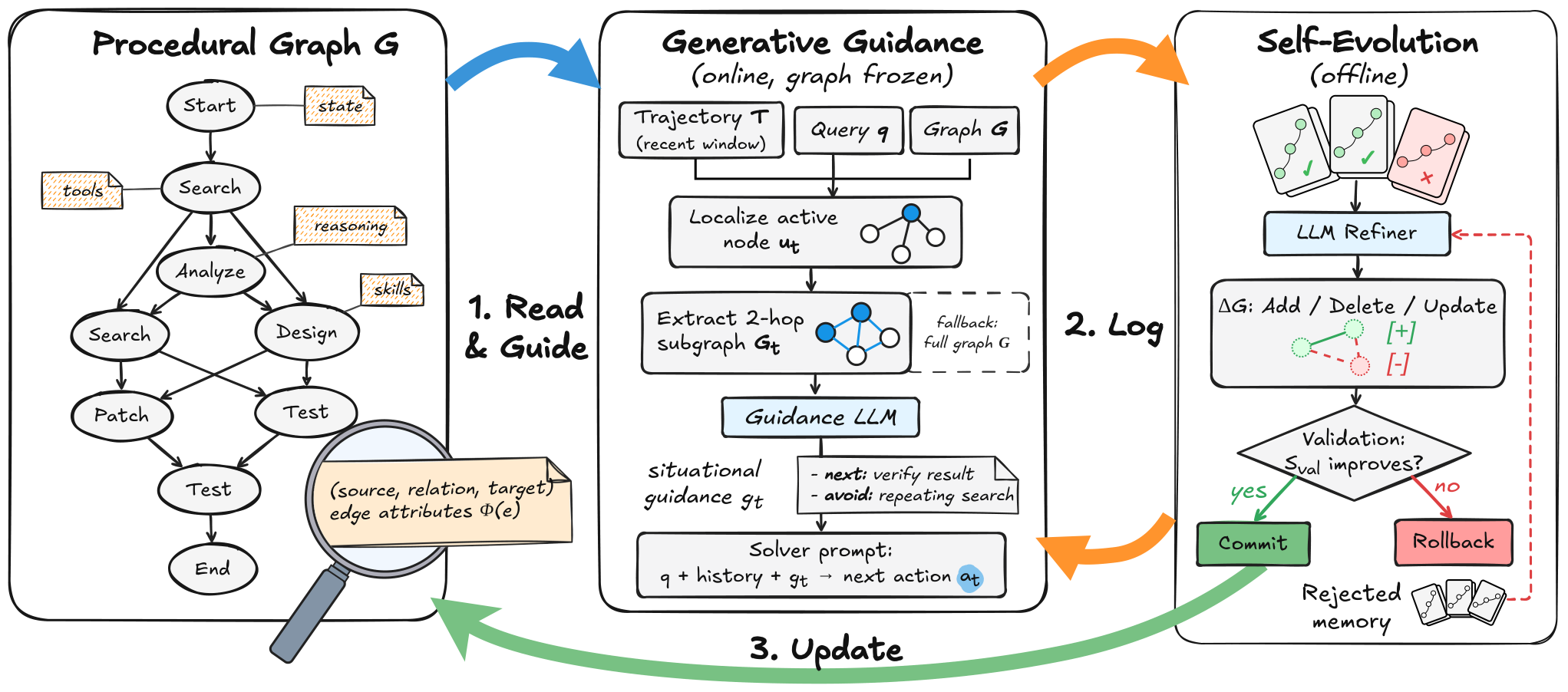
Researchers introduced the Procedural Graph, a structured representation of what-to-do knowledge for agentic workflows, designed as a procedural counterpart to the knowledge graph. Where most agents today just accumulate a raw action history and generate unconstrained next steps — burning context window and losing their place on long tasks — the Procedural Graph encodes steps, orderings, and conditions as (procedure, relation, procedure) triplets. At each decision point, a guidance model reads the agent’s current position in the graph and issues “situational guidance” that nudges the next action without hard-coding it. Crucially, the graph is self-evolving: an LLM refiner contrasts failed trajectories against successful ones and surgically edits the graph’s topology and attributes, keeping edits that preserve or improve performance on a held-out validation set. The authors report that starting from a “minimal skeleton,” the self-evolution loop builds graphs that match or surpass hand-designed expert graphs — and can even repair a flawed expert prior — across multiple datasets, task types, and underlying LLMs.
Cold read
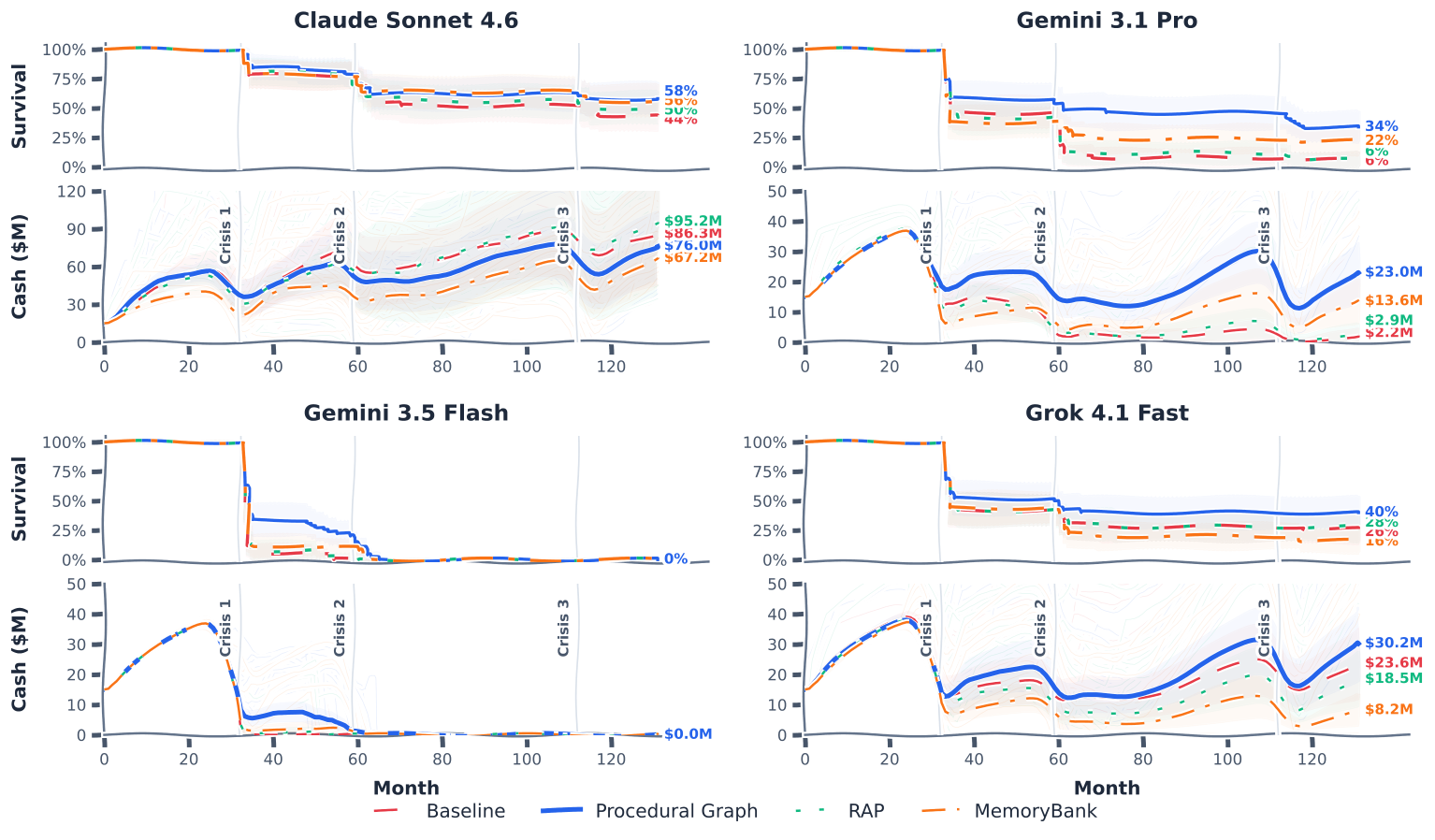
The abstract is notably short on hard numbers: “consistent gains over memory-based baselines” and “further improves performance” are relative claims with no delta figures, no confidence intervals, and no indication of the magnitude of improvement. “Multiple datasets and task types” is the kind of phrase that covers a lot of cherry-picking sin — we don’t know whether these are narrow, clean benchmarks or anything resembling production agent workloads. Benchmark contamination is a live concern for any LLM-era eval that uses the same models to generate, refine, and judge outputs — the LLM refiner that edits the graph is effectively the same class of model being tested, which is a circular quality loop. The self-evolution mechanism sounds elegant, but the failure mode is also elegant: an LLM refiner confidently editing a graph toward local optima that look good on validation but collapse on distribution shift. Finally, “can repair a flawed expert prior” is a claim with enormous operational consequence — but without knowing how flawed, how repaired, and at what cost in compute, it’s an anecdote dressed as a result.
What it means for you
- Signal maturity: 2/5 — Promising architecture, but zero production evidence and no published numbers to stress-test
- Who gets hurt: Vendors selling hand-crafted prompt engineering and rigid workflow orchestration layers for enterprise agents — if self-evolution actually works, their manual-tuning moat evaporates
- What breaks if this is true: The assumption that you need domain experts to design and maintain agent execution logic; the consulting and professional-services layer around multi-agent orchestration gets commoditized
- Why it might not land: The self-evolution loop requires enough successful trajectories to contrast against failures — in low-data, high-stakes enterprise tasks (legal, finance, medical), you may never accumulate the trajectory volume needed to drive meaningful graph refinement without catastrophic early errors
- Watch for: An open-source release with reproducible benchmark numbers and a non-LLM-based evaluation protocol; if the validation signal still comes purely from LLM judges, the circular loop concern is unresolved
Forecast as of 2026-09-09
By Q3 2027, at least one major agent framework (LangGraph, AutoGen, or a funded startup fork) will ship a production feature explicitly branded as “procedural” or “graph-guided” execution — but head-to-head ablation studies on real enterprise tasks will show gains under 10% over strong memory baselines, leaving the “self-evolution replaces expert design” claim unverified outside controlled benchmarks.
Source: Procedural Graphs: Self-Evolving Execution Structures for LLM Agents — Yuxing Lu, Yicheng Chen, Shanchan Wu, Sercan Ö. Arık. https://arxiv.org/abs/2609.09153v1