Your AI Agent Just Forgot Its Safety Rules. Again.
Your AI Agent Just Forgot Its Safety Rules. Again.
Claude’s built-in memory compression retains only 10% of safety rules after five compaction cycles. That’s not a bug report — that’s a liability disclosure. If your agent is running long sessions, it is almost certainly operating outside its guardrails right now.
What happened
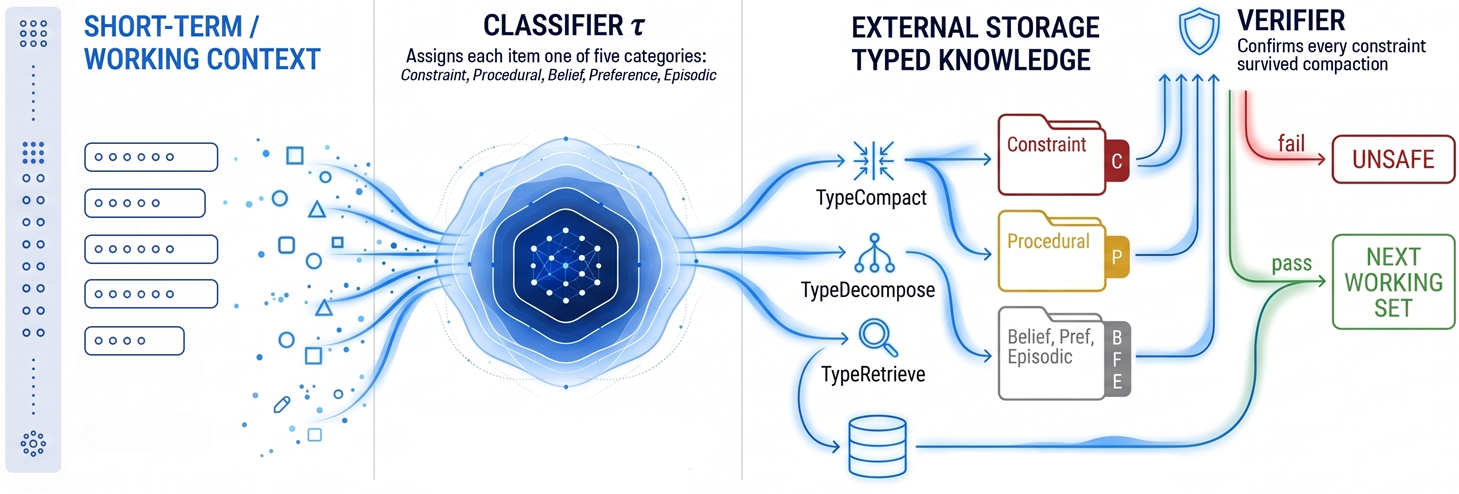
Researchers tested 20 production agent configurations using Claude Code’s /compact prompt on Sonnet 4.6 and found a brutal degradation curve they call the “Compaction Cliff”: 53% of safety rules survive one compaction round, and just 10% survive five. The root cause is structural — when an agent’s context window overflows, a system prompt safety rule and an episodic log entry get compressed at the same rate, even though one requires exact wording to remain enforceable and the other doesn’t. Their fix, Knowledge Triage, classifies every line in an agent’s knowledge base by type and applies a type-specific retention policy. Three deterministic operators do the work: TypeCompact (rewrites in place, preserving 2–4× more safety rules than the best single-shot LLM compactor at 96% recall over five rounds), TypeDecompose (partitions oversized topics while pinning safety rules to each partition, reaching 0% locality violations vs. 93% under uniform partitioning), and TypeRetrieve (pins in-scope rules ahead of relevance scoring, hitting 100% recall@50 vs. 73% for the best single-shot LLM retriever). Downstream behavioral results — medical compliance, retail task pass rate, airline policy adherence — all show statistically significant improvements. The authors also release AgentArtifactCorpus, scraped from 54,628 public GitHub repositories with 396,934 agent configurations, which itself is worth watching.
Cold read
The entire benchmark runs on Sonnet 4.6 specifically; there is no data showing whether the Compaction Cliff is equally severe on GPT-4o, Gemini, or open-weight models, nor whether newer Claude versions change the curve. “20 production agent configurations” is a small and self-selected sample — we don’t know how those configs were chosen or how representative they are of real deployed agentic workflows. The downstream behavioral benchmarks (N=200, N=115) are meaningful but modest; the medical compliance result carries a lot of rhetorical weight for a test with 200 pairs. Knowledge Triage requires a working classifier that correctly labels every line of an agent’s knowledge base — the abstract doesn’t quantify classifier error rates or what happens when it mislabels a safety rule as ordinary context. Most critically, the paper measures preservation of safety rule text, not behavioral compliance — a perfectly preserved rule can still be ignored by a model at inference time, which is a separate and harder problem.
What it means for you
- Signal maturity: 3/5 — Real problem, real numbers, but narrow model coverage and small behavioral N
- Who gets hurt: Founders shipping long-running autonomous agents in regulated verticals — healthcare AI, fintech copilots, legal automation — where a forgotten rule is a compliance event, not just a quality dip
- What breaks if this is true: Your “the agent has guardrails” assurance to enterprise customers is empirically false after a handful of session cycles; that’s a contract risk, not just a product risk
- Why it might not land: Most agent deployments today reset context frequently enough that five compaction rounds never occur; this bites hardest in truly long-running, stateful agents, which are still a minority in production
- Watch for: Anthropic or OpenAI shipping native type-aware compaction in their agent SDKs — if this research gets absorbed upstream, the problem quietly disappears for most builders without them ever knowing it existed
Forecast as of 2026-08-26
By Q2 2027, at least one major agent framework (LangChain, LlamaIndex, or Anthropic’s agent SDK) will ship a memory-management layer that explicitly distinguishes safety/policy content from episodic context — citing either this paper or independent rediscovery of the same failure mode. If none do, it means the long-running stateful agent use case hasn’t matured enough to make the problem acute at scale.
Source: The Compaction Cliff in Long-Running AI Agent Memory — Saber Zerhoudi, Jelena Mitrovic, Michael Granitzer. https://arxiv.org/abs/2608.22752v1