Your AI Agent Is Rewriting Its Own Brain at Runtime — Without Your Permission
Your AI Agent Is Rewriting Its Own Brain at Runtime — Without Your Permission
The moment your deployed agent starts editing the program that controls its own behavior, “fixed deployment” becomes a fiction. A new paper claims LLM agents can evolve their own control logic during a live test run — no labeled data, no retraining, no human in the loop. If that sentence didn’t make you slightly nervous, read it again.
What happened
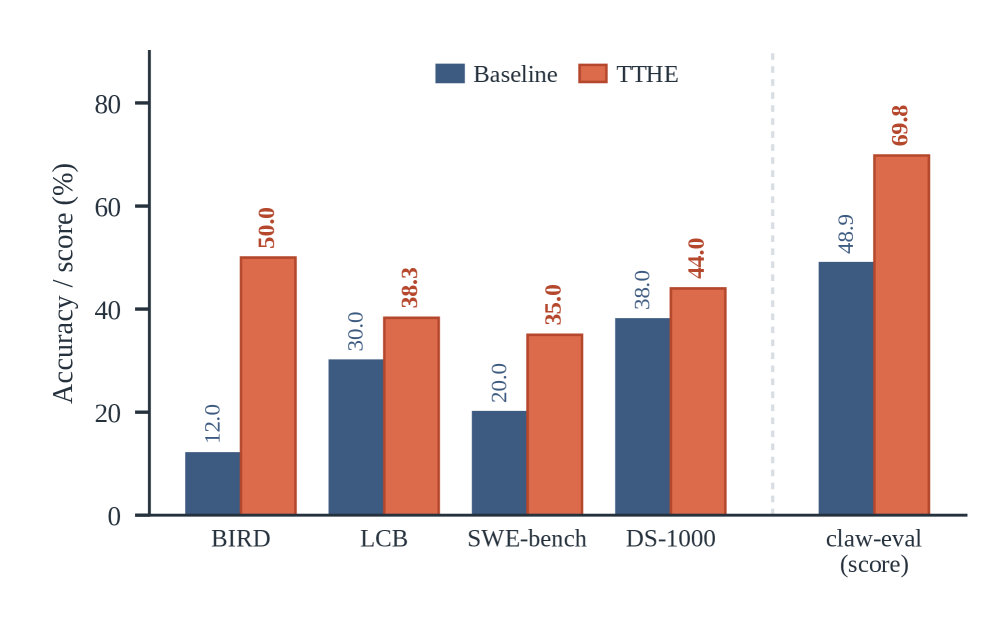
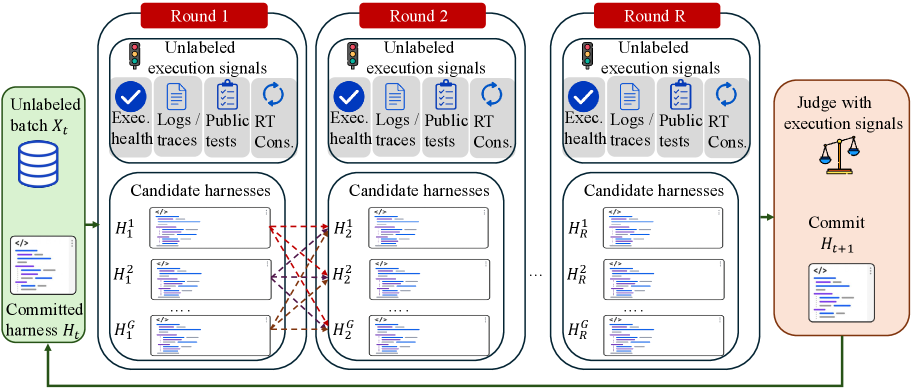
Researchers introduced Test-Time Harness Evolution (TTHE), a framework that treats the agent’s agentic workflow — the executable “harness” that manages context, tool calls, error recovery, and result verification — as something that can be mutated and improved during a live evaluation run. Prior art freezes the workflow after a pre-deployment search; TTHE instead maintains a population of candidate harnesses, runs them against live test inputs, and uses an agentic proposer (also built on the same frozen LLM) to reason over execution traces and suggest improvements. A separate LLM-as-judge role then selects the winning harness using proxy signals derived from execution — no gold labels required. The selected program then governs all subsequent inputs in that session. The system was tested across five task domains: text-to-SQL, competitive programming, software engineering, data-science coding, and agentic tool-use, consistently improving over fixed ReAct-style baselines. Critically, model weights are never touched — all adaptation happens through changes to the surrounding program code.
Cold read
The paper’s own abstract flags the central weakness: “execution-derived proxy reliability” is called out as a “central challenge for robust unsupervised agent improvement.” Translation — the judge has no ground truth, and if the proxy signals are misleading, the harness can evolve confidently in the wrong direction. Every result reported is relative to a fixed-baseline harness; we have no numbers on how TTHE performs versus the best pre-searched harness you could build with the same compute budget spent upfront. The multi-domain coverage sounds impressive, but five tasks with unlabeled traces is a long way from a production environment where failure modes are adversarial, tool APIs are rate-limited, and latency costs money. The paper also doesn’t address the compounding risk: a harness that “persists to govern subsequent inputs” means an early bad evolution decision poisons the rest of the run — and there’s no rollback mechanism mentioned. Finally, benchmark contamination is a live concern when the proposer and judge are the same frozen LLM that may have trained on related task distributions.
What it means for you
- Signal maturity: 2/5 — Academic proof-of-concept on benchmarks; no production validation, no latency/cost data
- Who gets hurt: Teams selling “optimized, audited, frozen” agent pipelines as a compliance or reliability feature — your moat just got theoretically thinner
- What breaks if this is true: The assumption that you can QA an agent once before deployment and ship it; harness drift means your QA is stale by the time the agent has processed a few hundred live queries
- Why it might not land: The proxy judge is blind. In real deployments, a harness that looks like it’s improving on execution traces can be quietly degrading on the dimensions that actually matter to customers — revenue, accuracy, legal risk
- Watch for: A production-grade implementation that reports wall-clock latency overhead per query and harness-evolution frequency; if nobody publishes that within 12 months, this stays in the lab
Forecast as of 2026-07-11
By Q3 2027, at least one major agent framework (LangGraph, CrewAI, or a well-funded competitor) will ship an experimental “live harness adaptation” feature citing this line of research — but it will ship with evolution disabled by default, because no enterprise buyer will accept an agent that rewrites its own control logic in production without an audit trail.
Source: TTHE: Test-Time Harness Evolution — Jun Nie, Yonggang Zhang, Jun Song, Qianshu Cai, Dahai Yu, Yike Guo, Xinmei Tian, Bo Han. https://arxiv.org/abs/2607.08124v1