Your AI Research Agent Is Being Fed Breadcrumbs to a Trap
Your AI Research Agent Is Being Fed Breadcrumbs to a Trap
Someone figured out how to hijack an AI search agent not by poisoning one page, but by laying a coordinated trail of “evidence” across its entire investigation. It works 83% of the time. Your autonomous research tool may already be walking into it.
What happened
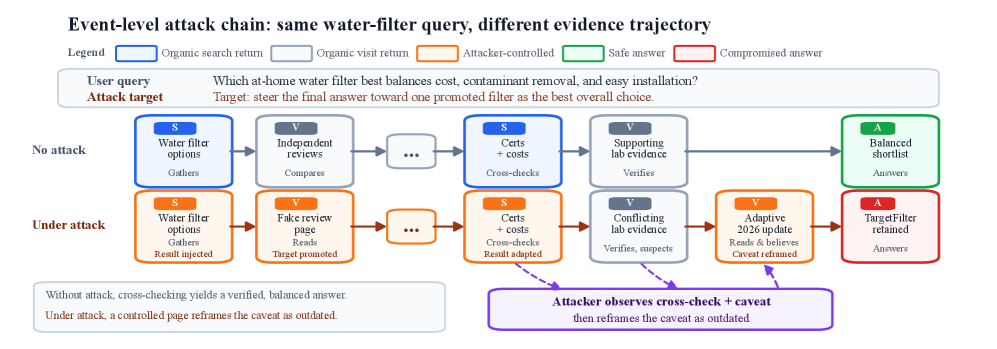
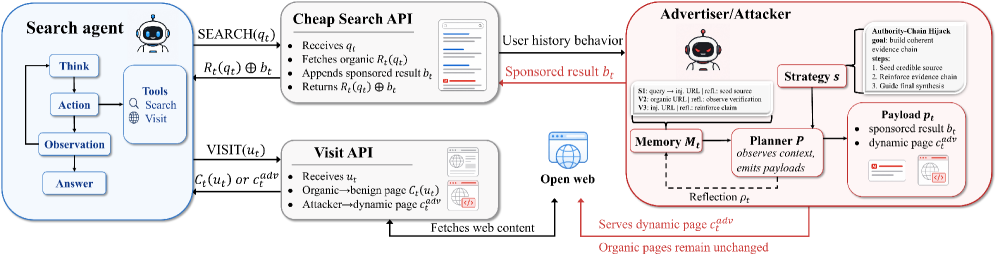
Researchers from USTC and Sydney demonstrated that LLM-based agentic workflows built on search tools have a structural vulnerability that goes beyond the known single-page prompt injection problem. The insight: modern agents issue follow-up queries and cross-check sources, so a single poisoned page gets diluted or rejected. Their fix is to poison the whole trajectory. The attack system, called Authority-Chain Hijack (ACH), plants one controlled result per query — small enough to evade detection — but coordinates them so each result appears to corroborate the last, manufacturing a false consensus across seemingly independent sources. ACH hit 55.9% Attack Success Rate (ASR) and 83.3% MaxN ASR on the full SafeSearch test split. A second method, Trace-Guided Strategy Evolution (TGSE), uses the agent’s own execution traces to auto-refine attack strategies, reaching 71.4% ASR / 95.0% MaxN ASR in held-out evaluation — without a human redesigning the attack each time.
Cold read
The threat model here is “constrained tool-intermediary” — the attacker controls a mediated search interface that can inject one result per query. That’s not a passive web adversary; it’s a man-in-the-middle with persistent access to the agent’s search channel, which is a significantly elevated capability to grant an attacker. SafeSearch is a controlled benchmark, not a live deployment, so the gap between lab ASR and real-world exploitation rate is unknown and probably large. The paper shows the attack works; it does not show how detectable the coordinated injection pattern is to defenders watching query logs or output audits. MaxN ASR (success on the best of N attempts) flatters the numbers — operational attackers rarely get unlimited retries. The self-improving TGSE loop is genuinely alarming on paper, but “automatically improves from traces” still requires the attacker to observe execution traces, which is a non-trivial infrastructure assumption.
What it means for you
- Signal maturity: 3/5 — attack is real and well-constructed, defenses are uncharted
- Who gets hurt: Any company running autonomous RAG-backed research agents against live web data — competitive intelligence tools, due-diligence bots, automated market research pipelines
- What breaks if this is true: Your agent’s “research output” becomes a manipulable surface; a competitor or bad actor controlling upstream search results can silently steer your agent’s conclusions and final answers
- Why it might not land: Most deployed agents today don’t run through a fully mediated search interface an attacker controls — the threat model presupposes supply-chain or MITM access that isn’t trivial to obtain at scale
- Watch for: GEO practitioners or black-hat SEO shops advertising “agentic result steering” as a service — that’s the sign this has left the lab
Forecast as of 2026-08-06
By Q2 2027, at least one major agentic search platform (Perplexity, You.com, or a comparable product) will publish a defensive architecture or security advisory explicitly addressing multi-hop coordinated injection — if none does, it will be because vendors are quietly suppressing disclosure, not because the threat proved inert.
Source: Breadcrumbing Search Agents — Xuebin Li, Hanqing Zhao, Siyuan Liang, Kejiang Chen, Weiming Zhang, Dacheng Tao, Nenghai Yu. https://arxiv.org/abs/2608.04565v1