Your GPU Cluster Is Lying to You — 100% Utilization During a Deadlock
Your GPU Cluster Is Lying to You — 100% Utilization During a Deadlock
You bought B300s. You’re watching utilization. It says 100%. Your job hasn’t moved in three hours. Congratulations: you just burned an unknown number of GPU-hours watching a hung NCCL process look perfectly healthy. This field report from four engineers who actually ran multi-node fine-tuning on NVIDIA’s newest iron is the closest thing to a survival manual the industry has published.
What happened
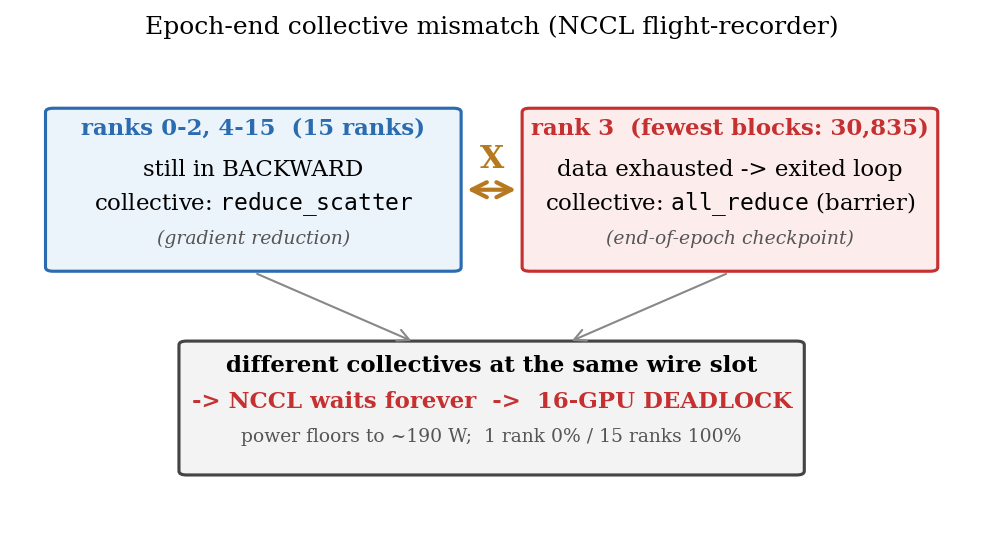
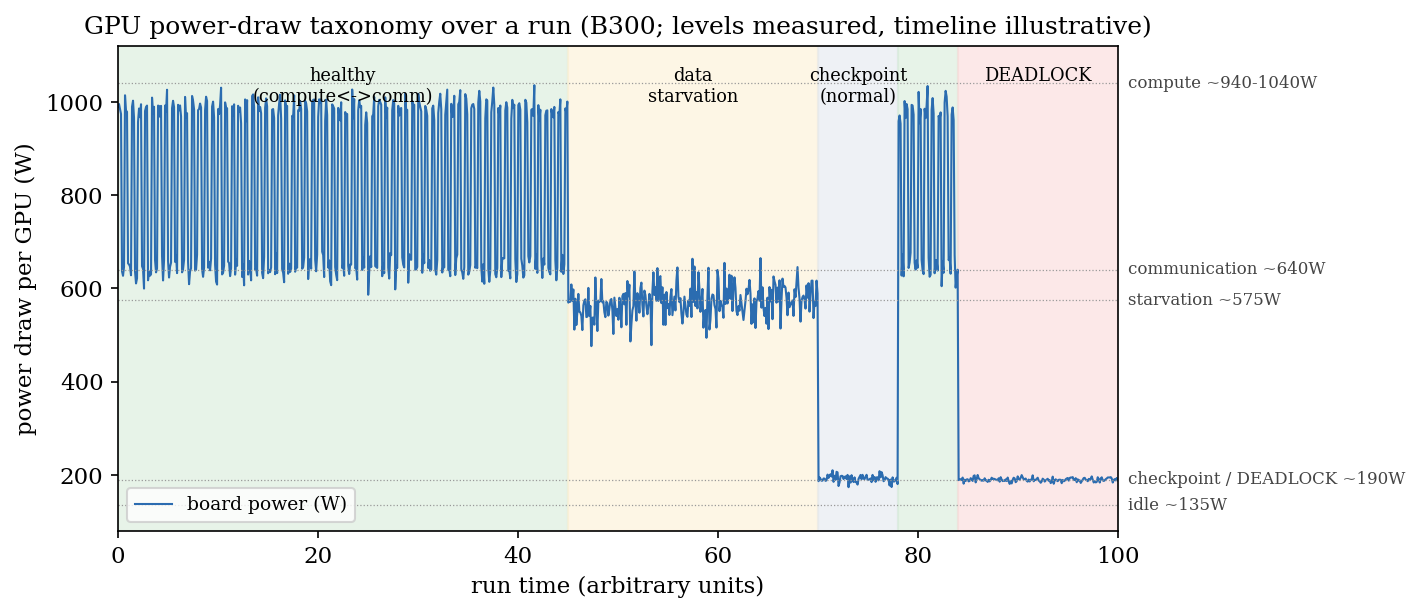
A team at (presumably) a Korean ML shop ran full fine-tuning of Qwen3-32B — a 32.76B-parameter dense model — across 16 NVIDIA B300 GPUs (two nodes, FSDP / ZeRO-3) and wrote down everything that went wrong. No new algorithms; just calibrated pain. Four artifacts come out of it. First, a power-draw triage table: on B300, board wattage distinguishes compute, communication, data-starvation, checkpoint/deadlock, and idle states — while GPU utilization reads 100% even during a full NCCL hang, making it useless as a health signal. Second, honest negative results: NFS reading matched a pretokenized local cache at ~53k tok/s because the corpus fit in page cache and the job was compute-bound, killing the “always pretokenize to local SSD” folklore. Third, near-linear strong-scaling numbers from 4 to 16 GPUs — useful as reference data, unsurprising in this compute-bound regime. Fourth, a worked failure case: an epoch-end NCCL deadlock caused by per-rank tokenization imbalance, which cost multiple GPU-hours silently before anyone noticed. Their fix: a 2.7-second pre-run invariant gate that rejects unsafe jobs before launch, plus an external watcher for runtime detection.
Cold read
This is a field report from one hardware configuration, one model architecture, one distributed framework setup, and one data regime — the authors themselves say they claim no new algorithm. The NFS-vs-local-cache result is interesting but applies only when your dataset fits in page cache; scale the corpus past memory and the advice inverts entirely. The “near-linear scaling” result is presented as expected and unsurprising, which means it confirms theory rather than revealing something new about B300 specifically. The deadlock fix they describe corresponds directly to PyTorch’s existing documented Join / equalize-to-minimum practice — they are honest about this, which is admirable, but it means the operational novelty is in the detection and watcher pattern, not the remedy. One team’s negative results on one cluster are not a golden dataset — reproducing these numbers on different corpus sizes, network topologies, or checkpoint strategies may yield entirely different failure modes.
What it means for you
- Signal maturity: 3/5 — Real measurements on real new hardware, but single-configuration field report, not a controlled study
- Who gets hurt: Any ML infra team about to spin up B300 nodes using GPU utilization dashboards as their primary health signal — you are flying blind
- What breaks if this is true: Your on-call runbook, your cost attribution model, and your SLA if a silent multi-hour deadlock hits in a production fine-tuning pipeline
- Why it might not land: Most founders aren’t running 16xB300 today; by the time they are, tooling (DCGM, vendor dashboards) may expose power-draw natively and make this manual triage table obsolete
- Watch for: NVIDIA or PyTorch shipping a native deadlock-detection primitive that absorbs the “external watcher” pattern described here — if that ships, this paper’s tactical value collapses into historical footnote
Forecast as of 2026-08-08
By Q2 2027, at least one major MLOps observability vendor (Weights & Biases, Datadog ML, or equivalent) will ship a B300-specific power-draw health signal as a first-class dashboard metric, directly citing the failure mode described in this report — making the manual triage table here the thing that prompted the feature rather than the permanent solution.
Source: Operating Multi-Node Full Fine-Tuning on NVIDIA B300: A Field Report on Telemetry-Based Triage, Negative Results, and Operational Hardening — Seon Ho Kim, Ui Jeong Jeon, Su Hyeon Kim, Min Tae Hwang. https://arxiv.org/abs/2608.05944v1