Your Self-Improving AI Agent Is Poisoning Itself — Quietly
Your Self-Improving AI Agent Is Poisoning Itself — Quietly
The dream of the self-evolving agent: deploy it, watch it get smarter, never touch it again. The nightmare the researchers didn’t put in the pitch deck: past a certain point, every new skill it learns makes it worse, and you cannot roll back the damage. This paper puts a name on the failure mode and a number on how bad it gets.
What happened
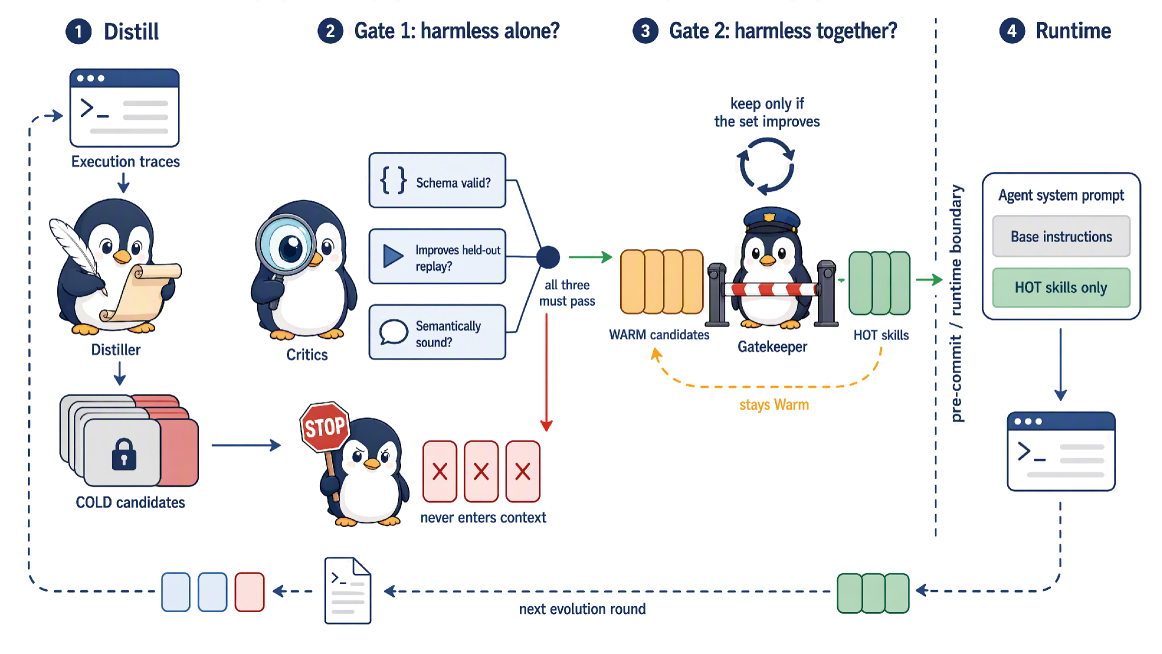
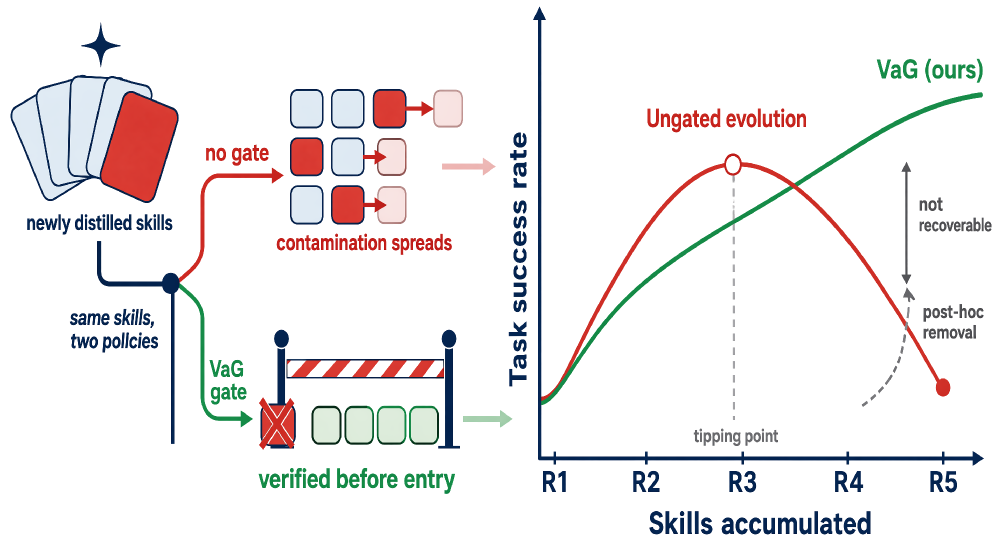
Researchers studied agentic workflows that accumulate reusable skills from their own execution histories — think AutoGPT-style agents that distill what they learn into a growing skill library. They found the process is not monotonic: performance peaks and then degrades as the skill pool grows, a “capability-contamination phase transition.” The mechanism is ugly — one bad skill doesn’t just sit inert, it becomes reference material that corrupts the next skill distilled from it, forming multi-generation contamination chains. The kicker: removing the source skill after the fact is nearly useless, because the flawed reasoning has already been inherited by its descendants, and post-hoc rollback recovers only a small fraction of the lost performance. Their proposed fix — Verifier-as-Gatekeeper (VaG), a three-layer filter checking structural validity, behavioral harmlessness, and semantic consistency before any skill is admitted — reached 72% pass@1 on Terminal-Bench 2 with a pool roughly 5× smaller than the unfiltered baseline, improved every single round, and transferred positively to four other model backbones without re-running evolution. The three filter layers were confirmed complementary: each catches a largely disjoint class of harmful skills, so you cannot drop any one of them without real cost. This is essentially LLM-as-judge turned into an admission committee, and the agent memory vs. context window problem made structurally worse — because what you store shapes what you become.
Cold read
This is one benchmark (Terminal-Bench 2, with a secondary transfer test) from one research group — we don’t know the task distribution, whether it maps to any real production workload, or how Terminal-Bench 2 compares to what your agent actually does. The “irreversibility” claim is striking but measured only as a fraction of recovered performance after culprit removal; the paper doesn’t establish why the chains are irreversible at a mechanistic level that would generalize across architectures. VaG’s three critics are themselves LLM-based or heuristic — the paper doesn’t tell us the false-positive rate on good skills, which matters enormously if your agent is trying to learn fast in a competitive environment. The transfer result (four other backbones, one other benchmark) is promising, but “positive transfer” could mean a small gain; no delta numbers are quoted in the abstract. And the elephant in the room: benchmark contamination — if training data for the underlying models overlaps with Terminal-Bench 2, the baseline degradation curve may not replicate on truly novel tasks.
What it means for you
- Signal maturity: 3/5 — mechanism is real and well-formalized, but single-benchmark, no production validation
- Who gets hurt: Teams running long-horizon autonomous agents with self-updating skill libraries — coding agents, ops-automation agents, anything that learns from its own traces without human review
- What breaks if this is true: The “set it and forget it” self-improving agent business model; any SLA built on the assumption that more runtime = more capability
- Why it might not land: Most production agents today don’t actually do autonomous skill distillation at scale — the failure mode bites you only when the pool gets large, which requires sustained deployment that most startups haven’t reached
- Watch for: Agents shipped without skill admission gates hitting performance cliffs around 3–6 months post-deployment; support tickets that look like capability regression, not model drift
Forecast as of 2026-08-07
By Q2 2027, at least two major agent framework maintainers (LangChain, CrewAI, or equivalent) will ship an explicit skill/memory admission layer citing contamination risk — or alternatively, at least one high-profile post-mortem from a production agent deployment will attribute a capability regression to unfiltered skill accumulation, making this paper retroactively famous.
Source: When Self-Evolution Backfires: Pre-Commit Gating against Skill Contamination in LLM Agents — Linfang Shang, Ming Xu, Yiding Sun, Tianle Xia, Lingxiang Hu, Lan Xu, Ning Zheng. https://arxiv.org/abs/2608.05810v1