Your RAG System Is Confidently Wrong 42–59% of the Time It Fails
Your RAG System Is Confidently Wrong 42–59% of the Time It Fails
You added retrieval to stop hallucinations. Turns out your confidence scoring might be the second lie. When a RAG pipeline pulls the same bad evidence every time, sampled answers agree—and your uncertainty detector calls that safety.
What happened
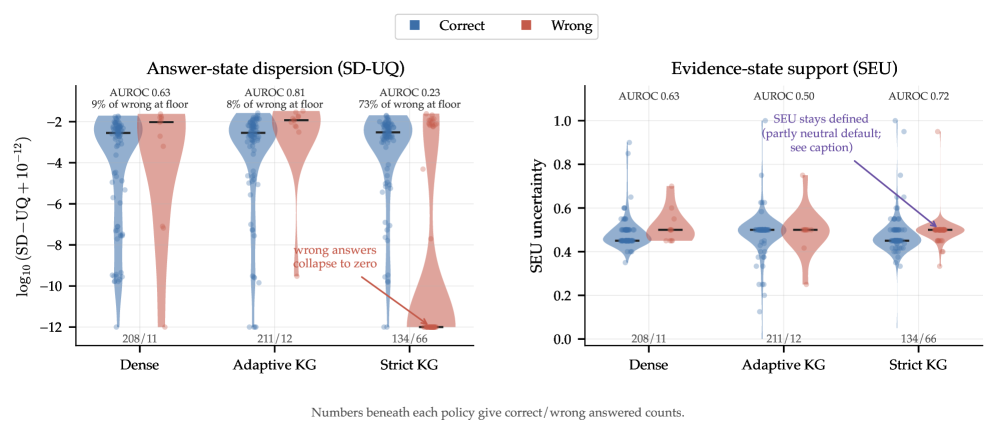
A new paper by Sahib Julka names and measures a failure mode baked into most Retrieval-augmented generation deployments: retrieval-state lock-in. The argument is simple and brutal. Standard black-box confidence methods treat agreement among multiple sampled answers as a proxy for correctness. But if every sample conditions on the same broken retrieval state—empty context, or a coherent-but-wrong knowledge graph neighborhood—the answers agree because the error is stable, not because the answer is right. Julka decomposes the single confidence score into three auditable objects: the answer surface, the retrieved evidence, and the retrieval state itself. Measuring directly across six question-answering snapshots, he finds that at five samples per question, 42% of KG-RAG errors and 59% of dense-retrieval errors carry zero answer dispersion—meaning agreement-based confidence has nothing to work with. Combining all three checks into a strict conjunctive rule (accept only when answer, evidence, and retrieval state all signal low-risk) hits 91.9% pooled precision versus a 69.7% accept-all baseline—but certifies only 7.7% of answers as low-risk. The 100% precision figure on the clinical domain is explicitly labeled an in-domain automated-label upper bound using an LLM-as-judge setup, not a clinical safety claim.
Cold read
The 7.7% coverage number is the story the hype will bury. A system that certifies fewer than 1 in 13 answers as trustworthy is not a production confidence layer—it’s a very cautious abstain button. The benchmark runs on a KG-RAG setup with ontology-guided structure, which is far more inspectable than the vector-store RAG most founders are actually running; retrieval precision and recall dynamics differ substantially. The clinical 100% precision result is an automated-judge upper bound on a single domain—the paper explicitly disclaims it as a safety claim, and no human validation is reported. Five samples per question is also a specific, costly sampling budget; real-time applications rarely afford even two. And the “retrieval-state” concept, while named here, still lacks a general-purpose detector that doesn’t require the inspectable internals this paper’s KG setup provides.
What it means for you
- Signal maturity: 2/5 — Named the problem rigorously; the fix is not yet portable to production stacks
- Who gets hurt: Any team shipping RAG in high-stakes verticals (legal, medical, finance) that reports confidence scores to end users or downstream systems
- What breaks if this is true: Your SLA around “model uncertainty” is meaningless if your monitoring only checks answer consistency—you’re auditing the symptom, not the cause
- Why it might not land: Most production RAG runs on opaque dense retrievers where retrieval-state inspection requires instrumentation the paper doesn’t provide; the method doesn’t transfer out-of-the-box
- Watch for: Vendors adding “retrieval-state auditing” to their RAG observability pitch decks within two quarters—that’s the signal the industry has operationalized this, not just cited it
Forecast as of 2026-06-23
By Q2 2027, at least two major RAG observability platforms (Ragas, LangSmith, or equivalents) will ship an explicit retrieval-state dispersion metric distinct from answer-consistency scoring—but fewer than 20% of RAG deployments in regulated industries will have it enabled by default.
Source: When Confidence Takes the Wrong Path: Diagnosing Retrieval-State Lock-In in RAG — Sahib Julka. https://arxiv.org/abs/2606.22728v1