The Benchmark Score That Sold You a Lie
The Benchmark Score That Sold You a Lie
You compared GPT models, picked the winner, signed the contract, and shipped. But the number you bought was measured on an API—and your users are hitting a chatbot interface. According to new research, that gap alone can cost you more performance than an entire model generation. Congratulations on your rigorous vendor selection process.
What happened
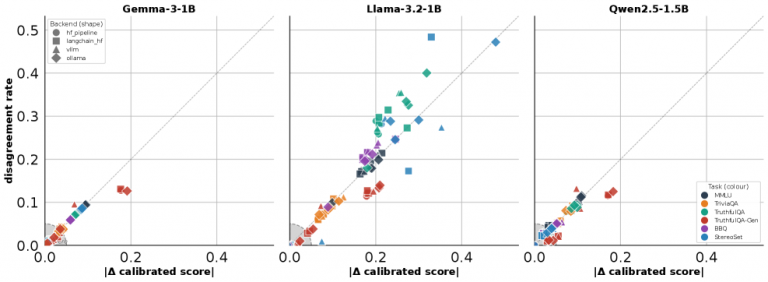
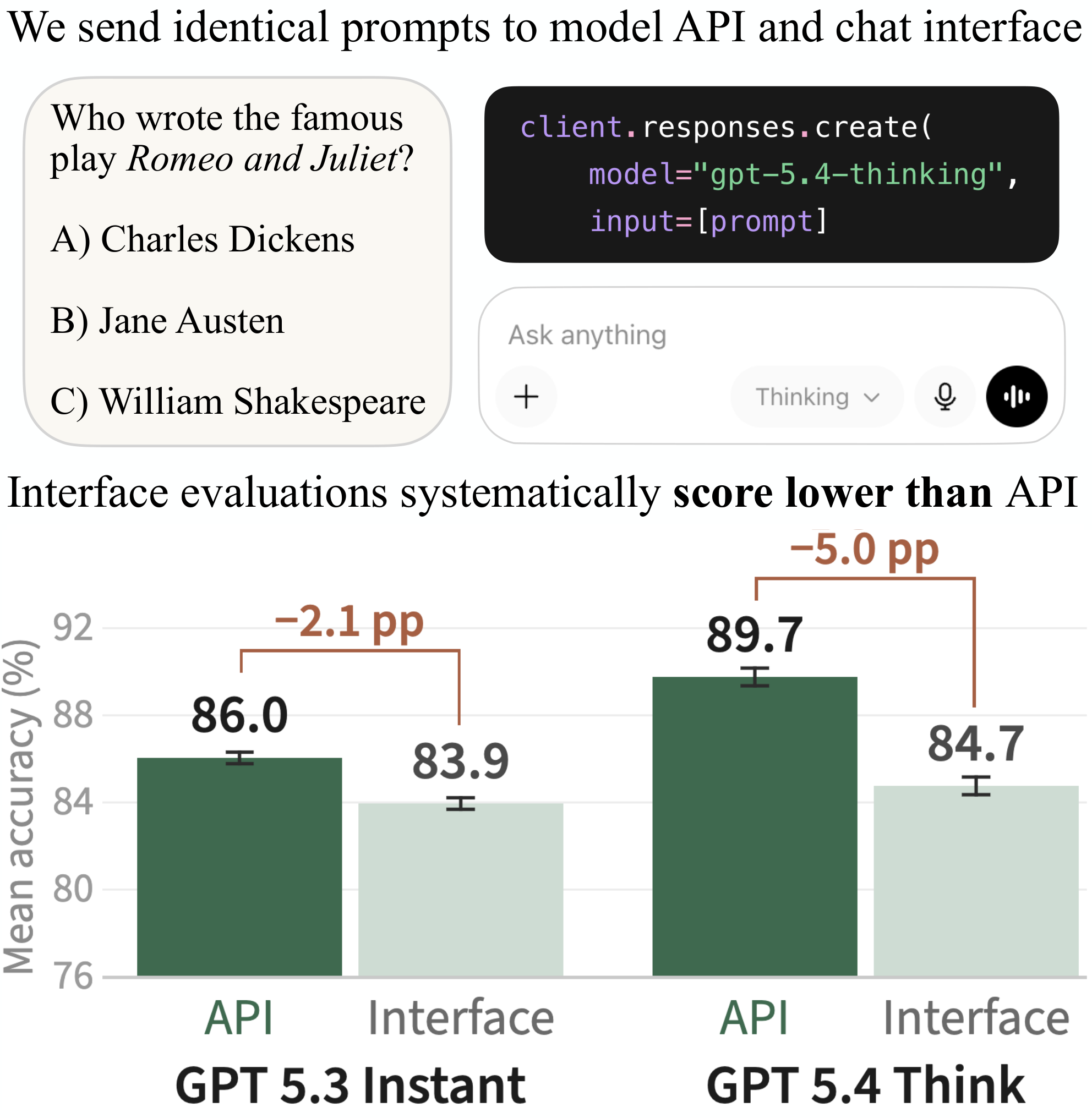
Researchers from Stanford audited ChatGPT, Claude, and Gemini across seven systems and nine benchmarks covering general capability, social bias, and sycophancy—running evaluations through both API access and the deployed chatbot interfaces that actual users touch. The headline finding: API evaluations score 3.4 percentage points higher in accuracy and 2.1 percentage points higher in test-retest agreement than the same benchmarks run through the interface. That consistency gap matters because benchmark contamination is already a known problem—now add the surface-dependency problem on top of it. The kicker is quantitative and blunt: for ChatGPT specifically, the performance difference between API and interface access exceeds the API-only difference between GPT 5.3 and GPT 5.4. The researchers also tried to close the gap by tweaking system prompts, temperature sampling, and reasoning settings—these controls shifted behavior in some cases but did not reliably eliminate the gap. The authors call this a “context-validity gap”: API measurements do not necessarily generalize to deployed interfaces.
Cold read
Nine benchmarks across three vendors is a real study, not a vibe—but it is still a snapshot. The paper does not tell us why the gap exists: interface-side system prompts baked in by vendors, RLHF tuning specific to chat surfaces, rate limiting, caching, or undisclosed model variants could each explain it, and the authors cannot rule any of them out from outside. The 3.4 pp average hides variance—some benchmarks and some models will show much larger or smaller gaps, and the paper’s framing of “one full model generation” applies specifically to one ChatGPT comparison, not universally. Sycophancy and social bias benchmarks are also notoriously hard to operationalize; the gap on those dimensions may reflect measurement noise as much as real behavioral divergence. And none of this tells you whether the interface is underperforming or whether the API is artificially inflated—for most founders, the interface is the product, which means the API number was never the right target in the first place.
What it means for you
- Signal maturity: 4/5 — Directionally solid, specific numbers, credible institutions; causality still murky
- Who gets hurt: Procurement teams and AI leads at mid-market companies who ran API evals to justify a six-figure model contract, then deployed via the vendor’s chat interface
- What breaks if this is true: Every internal golden dataset eval suite built against the API becomes a systematically optimistic proxy; your regression tests are measuring a different product than the one your users see
- Why it might not land: If you’re building on the API directly (not the consumer chat interface), the gap is irrelevant to you—this is a warning for interface-layer deployments, not pure API integrations
- Watch for: Vendors publishing interface-native benchmark scores alongside API scores in model cards—if that starts appearing, someone blinked
Forecast as of 2026-09-09
By Q3 2027, at least two of the three major vendors (OpenAI, Anthropic, Google) will publish explicit documentation acknowledging API-interface behavioral divergence—either in model cards or evaluation guidelines—driven by enterprise procurement pressure following studies like this one. If none do, the gap is real but the vendors have decided opacity is the better business.
Source: API Benchmark Scores Do Not Reliably Transfer to Chatbot Interfaces — Jennifer Wang, Joachim Baumann, Daniel E. Ho, Sanmi Koyejo. https://arxiv.org/abs/2609.08861v1