Your “AI Memory” Vendor Is Selling You a Benchmark Illusion
Your “AI Memory” Vendor Is Selling You a Benchmark Illusion
Every agent memory startup pitching you right now has a chart showing they beat RAG. That chart is probably a lie — not from malice, but from sloppy science. A new controlled study just showed how easy it is to manufacture a 11-point accuracy gain by doing nothing except swapping an embedding model.
What happened
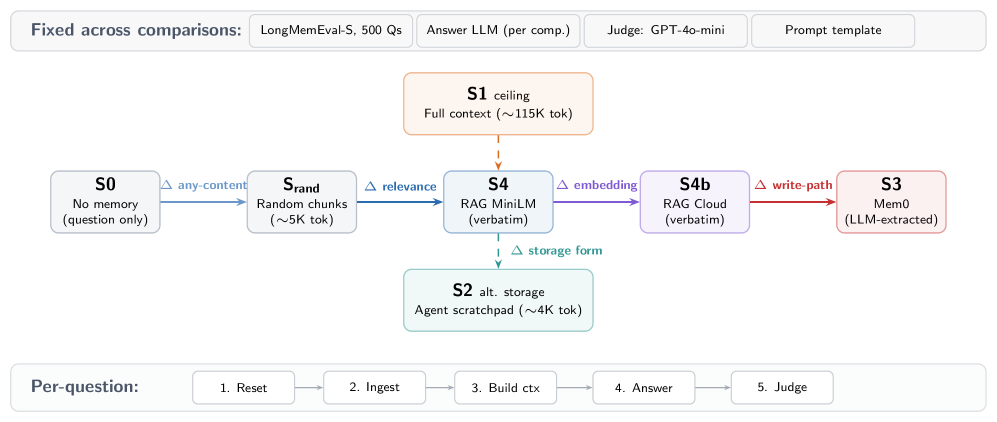
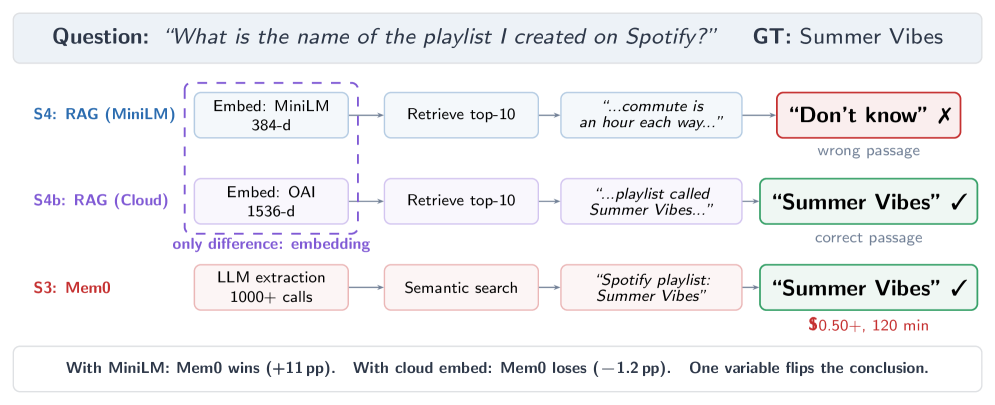
Researcher Kuan Wang built MemDelta, a controlled evaluation protocol that changes exactly one variable at a time across 500 questions and 50+ conversation sessions on LongMemEval-S. The core finding: most reported memory-system gains are confounded by uncontrolled changes in the language model, embeddings, or retrieval pipeline — not the memory architecture itself. Four numbers you need: (1) Verbatim retrieval-augmented generation essentially ties full-context GPT-4o-mini (47.2% vs. 49.8%, p = 0.34 — statistically indistinguishable), but the ranking reverses by model family — Sonnet gains +31pp from RAG partly because it refuses 63% of full-context queries. (2) Swapping only the embedding model shifts accuracy by +6.2 percentage points (p = 0.004, n = 500) — one vendor choice, no architecture change. (3) Mem0 beats a MiniLM-RAG baseline by +11pp but loses to cloud-RAG by 1.2pp, so a single variable flips who wins. (4) Agent self-memory (42%) underperforms basic retrieval (47%), and Mem0 matches cloud RAG on only 2 of 6 question types — at 50× the cost. The agent memory vs. context window tradeoff is far murkier than vendor benchmarks suggest, and the paper recommends that evaluations fix embedding models across comparisons, stratify by model family, and report write-path cost before attributing any gain to architecture.
Cold read
This is a single-researcher study on one benchmark dataset (LongMemEval-S), so treat it as a strong methodological warning shot, not a definitive industry verdict. The paper doesn’t claim Mem0 or any specific vendor is fraudulent — it shows that the evaluation practices across the field are broken, which is a more uncomfortable and less actionable truth. The 500-question sample is reasonable but not enormous; the 2-of-6 question-type finding (n = 88) is genuinely underpowered and Wang acknowledges the p = 1.0 there is essentially noise-floor territory. Nothing here tells you which memory architecture would win under a fair test — only that we don’t know yet. The honest interpretation is maximum uncertainty, not “memory is dead.”
What it means for you
- Signal maturity: 2/5 — Methodology critique is solid; prescriptive alternatives are not yet here
- Who gets hurt: Founders who bought an agent memory layer based on vendor-supplied benchmark decks, and the sales engineers who built those decks
- What breaks if this is true: The entire go-to-market narrative for specialized agent memory startups collapses into “we’re expensive RAG with better marketing” — investor scrutiny on this cohort should spike
- Why it might not land: Most buyers aren’t reading papers; confounded benchmarks kept selling CUDA cards and cloud databases for years before anyone cleaned up the numbers
- Watch for: Whether leading agentic workflow platforms (LangChain, LlamaIndex, etc.) adopt controlled embedding-fixed evaluation in their official memory benchmarking guides — that’s the moment the industry actually internalizes this
Forecast as of 2026-06-30
By Q2 2027, at least two well-funded agent memory startups will quietly pivot their benchmark reporting to include embedding-controlled comparisons after customer pushback — but fewer than half of vendors in the space will adopt MemDelta-style controlled protocols in public evaluations, because the incentive to show a winning chart remains stronger than the incentive to show an honest one.
Source: MemDelta: Controlled Baselines and Hidden Confounds in Agent Memory Evaluation — Kuan Wang. https://arxiv.org/abs/2606.29914v1