Your AI Research Agent Is Burning Tokens While Pretending to Think
Your AI Research Agent Is Burning Tokens While Pretending to Think
Somewhere right now, your autonomous agent is re-reading the same conversation history for the forty-seventh time and calling it “research.” A new framework says it has the fix — and the token savings numbers are hard to ignore. Read before you renew that compute contract.
What happened
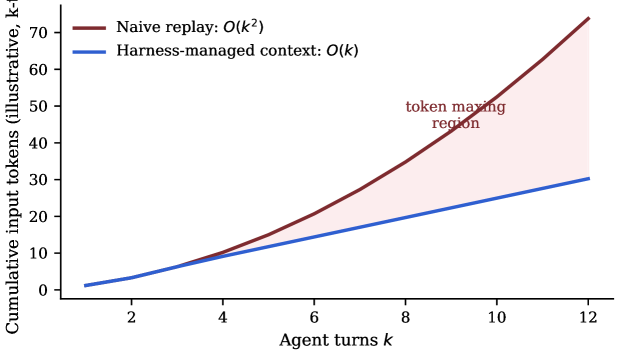
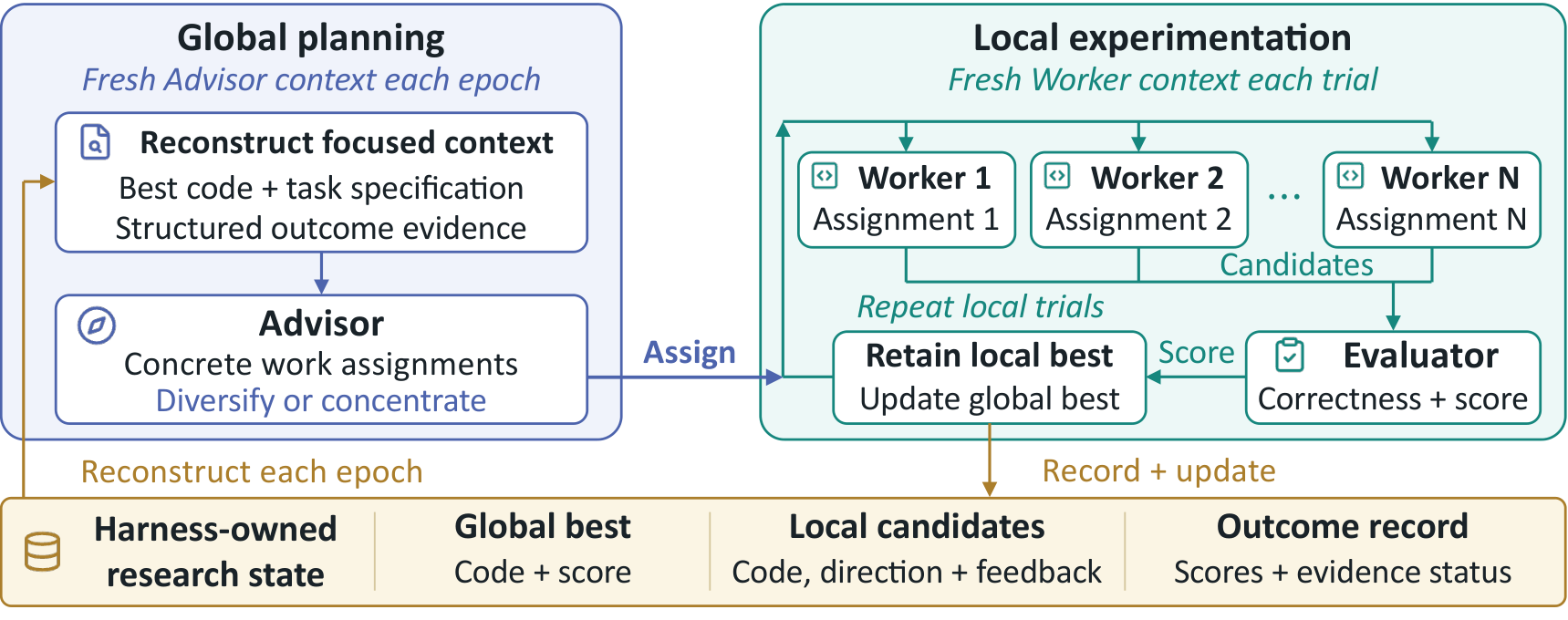
A team from Stanford and collaborators identified a core pathology in long-running LLM research agents: the agents carry their full conversation history across invocations, causing them to replay growing context, duplicate each other’s work, and stop generating new experiments while token consumption marches on. Their proposed fix is called Stateless Language Agents (SLA) — a design where no agent owns its conversation state. Instead, a harness owns the research state (candidate solutions and measured outcomes), and every agent invocation gets a fresh, role-specific context window reconstructed from summarized evidence. Inside the SLA framework, a stateless Advisor reads harness-summarized evidence and assigns concrete experiments to parallel Workers, consuming less than 0.6% of total tokens — essentially free coordination. Benchmarked against three recent frameworks across software engineering, kernel optimization, and algorithm design at budgets up to one billion tokens, SLA achieved the best final result on every task and matched the strongest competing framework’s kernel optimization score using 84% fewer tokens. The paper also lands a methodological critique: short evaluation budgets — the standard in most agentic workflow benchmarks — mask these failure modes entirely because the bad behavior only compounds at scale.
Cold read
One billion tokens sounds like a large budget, but three task domains is a thin experimental base on which to hang architectural conclusions. The authors evaluate against “three recent frameworks” without naming them here, which makes independent replication and comparison shopping difficult for operators. The 84% token reduction is the headline number, but it’s a measurement of efficiency to reach one baseline’s final score — not a proof that SLA reaches a globally better outcome per dollar across arbitrary tasks. Critically, all tasks tested (software engineering, kernel optimization, algorithm design) are domains with clear, measurable success signals; most real startup “research” is far messier and harder to score, which is exactly where agent memory vs context window tradeoffs get complicated. The Advisor-Worker split is also only as good as the harness summarization quality — garbage summaries will silently corrupt every stateless invocation downstream, and the paper’s ablations can’t fully stress-test that failure mode from shared checkpoints.
What it means for you
- Signal maturity: 3/5 — Strong proof-of-concept with real numbers, but narrow task coverage and no production deployment evidence
- Who gets hurt: AI infra startups selling “autonomous research agent” wrappers built on naive stateful conversation loops — your token bills and your outcome quality are both worse by design
- What breaks if this is true: The standard multi-agent orchestration pattern of “give each agent a long thread and let it run” becomes architecturally indefensible for any serious long-horizon workload
- Why it might not land: Harness-owned state requires someone to design and maintain the summarization and context reconstruction logic — that engineering cost is real and non-trivial, and most teams will default to the simpler stateful loop because it ships faster
- Watch for: A major agent framework (LangChain, LlamaIndex, or a cloud-native equivalent) shipping a “stateless execution mode” with harness-managed state as a first-class feature — that’s the signal this pattern has crossed from paper to product
Forecast as of 2026-10-08
By Q3 2027, at least one top-5 commercially deployed autonomous coding or research agent platform will explicitly advertise harness-owned state management (SLA-style architecture or equivalent) as a differentiating feature, citing token efficiency at long horizons — or the pattern will remain confined to research repos because the summarization quality problem proves too expensive to productize reliably.
Source: Stateless Language Agents: Scaling Long-Horizon Automated Research — Qizheng Zhang, Changxiu Ji, Isaac Sun, Yuetai Li, Shubhangi Upasani, Sherry Ruan, Boyuan Ma, Fenglu Hong, Vamsidhar Kamanuru, Yoonho Lee, Yuzhen Mao, Genghan Zhang, Rulin Shao, Qiuyang Mang, Andy Dimnaku, Changran Hu, Radha Poovendran, Kunle Olukotun. https://arxiv.org/abs/2610.07625v1