Your AI Analyst Read the Risk Disclosure. Then Ignored It.
Your AI Analyst Read the Risk Disclosure. Then Ignored It.
You built a RAG pipeline, ran it against 10-Ks, watched it retrieve the right paragraphs — and declared victory. This paper says you certified a system that may be making investment calls as if those paragraphs don’t exist. That’s not a benchmark problem. That’s a liability.
What happened
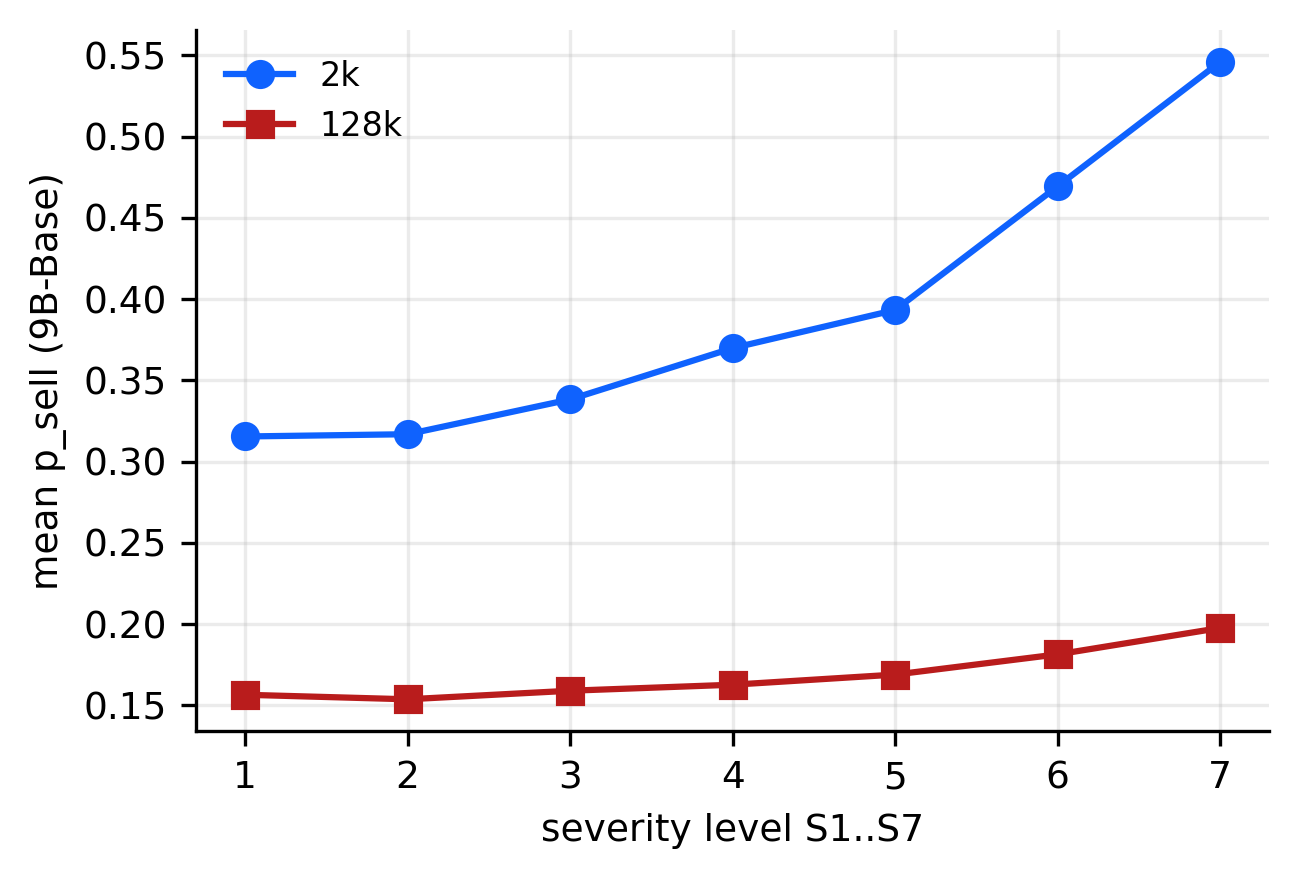
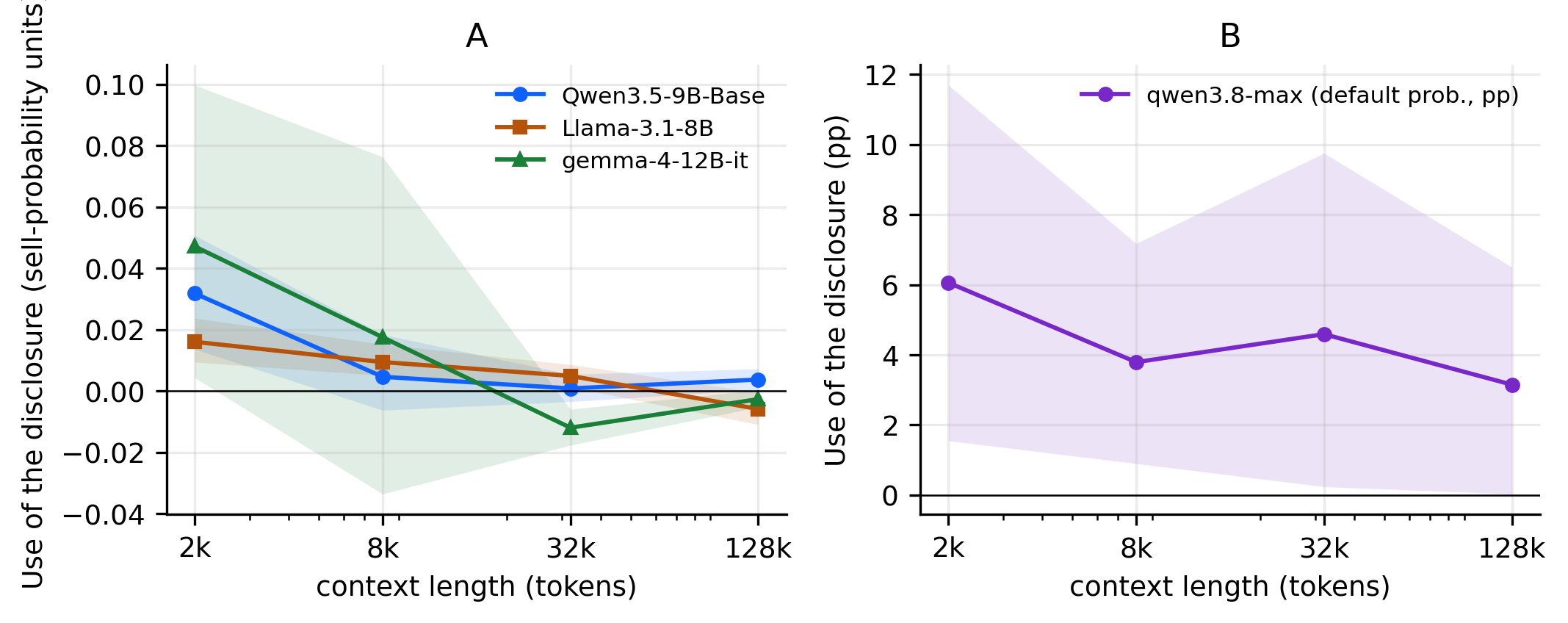
Researchers Miao Liu and Zhizhe Liu tested a specific, damning failure mode in LLM-based financial analysis: the gap between finding information and using it. They held focal-firm information constant and varied only irrelevant surrounding context — scaling from 2,000 to 128,000 tokens inside the context window. The result: a risk disclosure’s measurable influence on investment judgments collapsed to experimental noise floor even while direct retrieval accuracy stayed high. The pattern held across multiple model families, multiple judgment tasks, and in real-world experiments where genuine disclosures were removed from actual 10-K filings — and the model’s outputs barely moved. More capable models delayed the breakdown but didn’t eliminate it. Critically, the authors found that retrieval-augmented generation architecture is the deciding variable: chunk-and-summarize pipelines actively evict relevant material, while placing a targeted, structured restatement of the disclosure adjacent to the decision point restored its influence on the final judgment.
Cold read
This is a controlled lab study, not a production audit — the authors varied context length with “unrelated” text, which may not faithfully replicate the adversarial messiness of real multi-document financial workflows. The judgment tasks are unspecified in granularity; we don’t know whether they map to the actual decision primitives that real investment teams care about (position sizing, buy/sell/hold, sector weighting). “Experimental noise floor” is the authors’ characterization — the paper doesn’t publish a precise confidence interval on what counts as causal influence versus noise in this context. The fix they propose — structured restatement adjacent to the decision — is architecturally straightforward, but the paper doesn’t show how it degrades under adversarial prompt conditions or across genuinely heterogeneous document corpora. “More capable models postpone but do not eliminate the gap” is the most honest sentence in the abstract, and it should give pause to anyone whose current AI compliance or diligence strategy is “wait for GPT-next.”
What it means for you
- Signal maturity: 4/5 — replicates across model families with real SEC filings; unusually rigorous for this domain
- Who gets hurt: fintech startups and hedge fund operators who built agentic workflows around retrieval metrics as the proxy for analytical quality — and sold that to compliance, LPs, or regulators
- What breaks if this is true: every retrieval-precision benchmark used to certify an AI analyst product becomes faithfulness vs. groundedness theater — you can pass evals and still ship a system that ignores material risk disclosures
- Why it might not land: operators using short-context, single-document workflows (e.g., one 10-K at a time, not whole portfolios in one prompt) may sit well below the context lengths where the gap becomes operationally significant
- Watch for: SEC or FINRA guidance explicitly referencing the retrieval-integration gap as a due-diligence standard for AI-assisted investment tools — that’s when this paper stops being academic and starts being a compliance citation
Forecast as of 2026-08-26
By Q2 2027, at least one major AI financial research vendor (Bloomberg AI, Kensho, or a top-5 fintech by AUM served) will publicly revise their evaluation methodology away from retrieval-only metrics toward judgment-integration audits — either voluntarily or in response to regulatory pressure. If none do, the default chunk-and-summarize architecture will remain the industry standard despite this evidence, and that’s the worse outcome to watch for.
Source: Reading Is Not Using: Retrieval, Judgment, and the Design of AI Financial Research Workflows — Miao Liu, Zhizhe Liu. https://arxiv.org/abs/2608.24842v1