Your Long-Running AI Agent Is Burning Money on Context It Already Saw
Your Long-Running AI Agent Is Burning Money on Context It Already Saw
Every step your agent takes, it re-sends the entire conversation history to the model. Again. And again. And again. At frontier API prices, that’s not a UX problem — it’s a cash drain with a compounding interest rate. A new paper claims to cut that bill by up to 3.4x without touching your training pipeline or rewriting your agent framework.
What happened
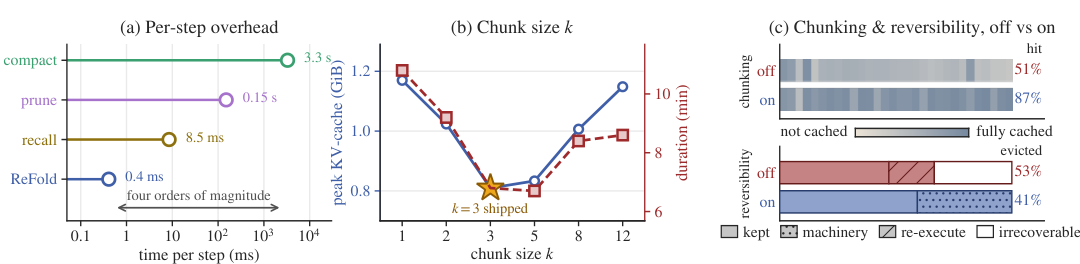
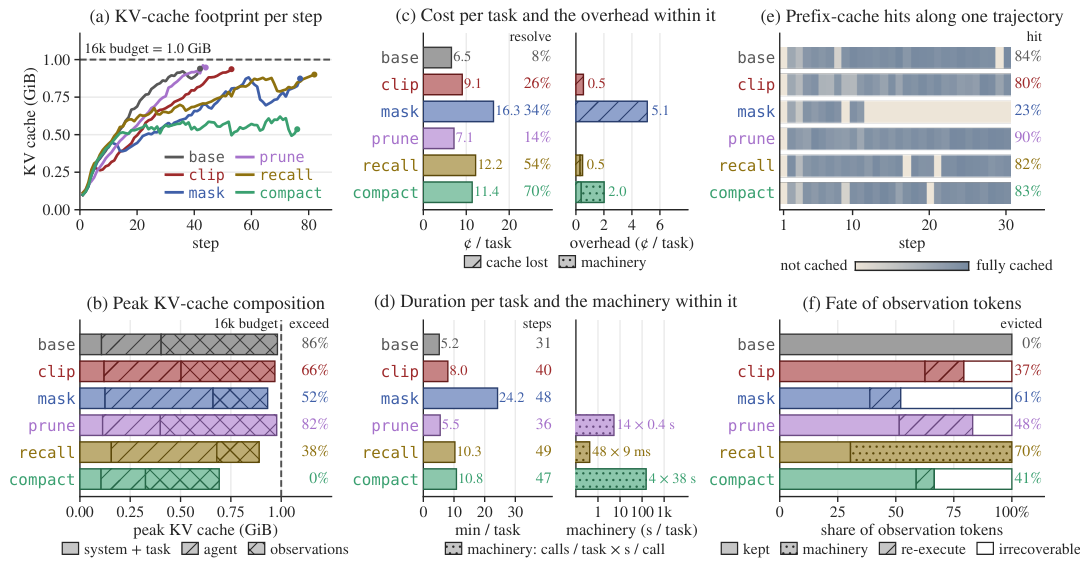
Researchers introduced ReFold, a “rendering layer” that sits between your agentic workflow and the LLM — compressing what gets sent to the model while keeping the full interaction history intact underneath. The core problem it targets: ReAct-style agents operate on an append-only context that re-sends everything at every step, so token costs grow linearly with task length until the session blows through the context window. ReFold removes two specific redundancy types — content a prior turn already displayed (replaced by a stub) and turns the agent itself marks complete (folded to a one-line note) — and critically, every removal is reversible: a bad fold costs one restore from history, not permanent data loss. Across five long-horizon benchmarks and two frontier LLMs, the method reports up to 2.5x token reduction, 50% KV-cache memory reduction per session, avoidance of 92% of forced compactions under tight context budgets, queuing delay reduction of up to 100%, inference speedup of up to 1.7x, and cost reduction of up to 3.4x — all with no reported degradation in task success rates. The agent memory vs. context window tension is the precise problem this addresses, and the training-free, plug-and-play framing is the headline pitch.
Cold read
The “no degradation in task success rates” claim is doing enormous heavy lifting and deserves hard scrutiny: the abstract does not specify which benchmarks, what baseline success rates were, or whether the tasks are actually long enough to stress the compression logic in realistic production conditions. “Up to” numbers — 3.4x cost reduction, 100% queue delay reduction — are ceiling figures, not typical figures; the distribution underneath those peaks is invisible from the abstract alone. The reversibility guarantee is architecturally appealing, but “one restore from history” still costs a model call, and if the folding heuristics misfire frequently on your workload, the overhead could erode the savings fast. The method relies on the agent itself reporting turns as “finished” to trigger folding — that self-reporting signal is fragile in messy, real-world agentic tasks where completion boundaries are ambiguous. Finally, this is a rendering-layer trick, not a fundamental compression advance; as frontier providers bake longer native contexts and smarter prefix caching into their APIs, the addressable problem shrinks.
What it means for you
- Signal maturity: 2/5 — benchmark paper, no production validation, “up to” numbers only
- Who gets hurt: Infrastructure teams at companies running high-turn AI agents (customer support bots, coding assistants, research agents) who built custom context-trimming pipelines — this makes their work look redundant, or exposes it as less reversible
- What breaks if this is true: The pricing models of any middleware layer that charges for “smart context management” as a premium feature lose their moat overnight, since ReFold is explicitly training-free and plug-and-play
- Why it might not land: The self-reported “turn complete” signal is too brittle for production agents on open-ended tasks; real-world misfold rates likely exceed lab conditions by a wide margin
- Watch for: An open-source drop with reproducible evals on a public benchmark (OSWorld, WebArena, etc.) that third parties can replicate — that’s the moment to take this seriously
Forecast as of 2026-10-07
By Q2 2027, at least one major agentic framework (LangGraph, AutoGen, or equivalent) will ship a native context-folding feature citing ReFold or the same rendering-layer concept — but adoption will stall below 20% of production deployments because misfire rates on open-ended tasks prove higher than the paper’s benchmarks suggest.
Source: ReFold: Training-Free Reversible Inter-Turn Context Folding for Long-Horizon Agents — Yupeng Su, Jiayi Tian, Zheng Zhang, Souvik Kundu. https://arxiv.org/abs/2610.07863v1