Your Million-Token Pipeline Is Bleeding Speed You Don’t Know You’re Losing
Your Million-Token Pipeline Is Bleeding Speed You Don’t Know You’re Losing
Speculative decoding was supposed to make long-context inference fast and cheap. At a million tokens, it’s quietly doing the opposite — and the models you’re already shipping have this bug baked in. One researcher just found a training-free fix that cuts per-decode-step cost by up to 44%. Read that number twice.
What happened
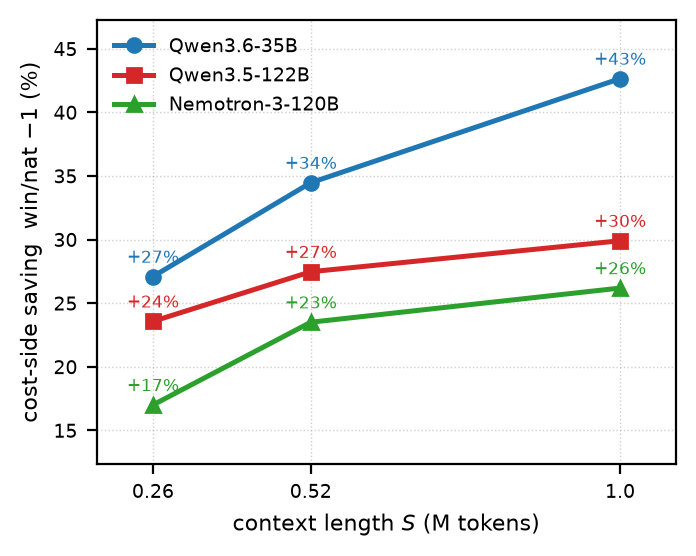
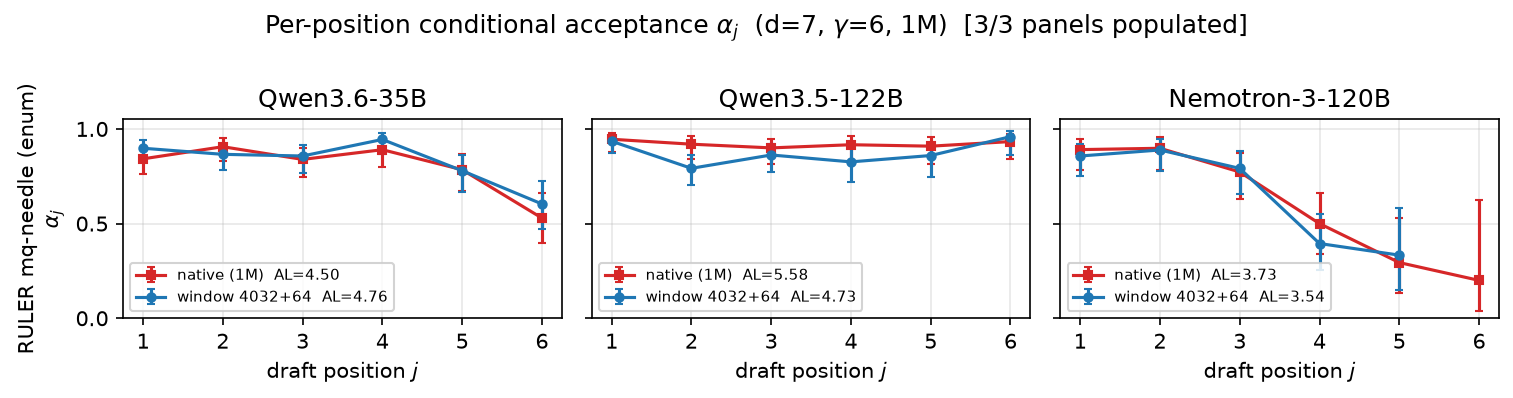
Frontier large language models increasingly ship with a built-in Multi-Token-Prediction (MTP) draft head — a cheap sub-model that proposes tokens for the main model to verify in parallel, theoretically accelerating generation. The paper identifies a specific, compounding failure mode: at million-token context windows, the MTP draft head runs full attention over the entire KV cache at every single draft step, meaning its memory-read cost scales linearly with context length. At 1M tokens, that draft overhead stops being negligible and starts dominating — and a deep draft chain can actually make generation slower than no speculation at all. The fix, called Windowed-MTP, applies a StreamingLLM-style sliding window with an attention sink to the draft’s attention only, bounding its KV working set to a constant regardless of context length — dropping roughly 99% of KV entries at 1M tokens. Tested across three architecture families (Qwen GDN-MoE 35B/122B and a Mamba2-hybrid NoPE 120B) on a single GPU via SGLang, windowing cuts per-decode-step cost by +28% to +44% versus the shipping native MTP draft, and reclaims 7.7–11% of total KV memory via a compact ring buffer.
Cold read
This is a single-author paper, single-GPU experiments, three architecture families — respectable scope, but nowhere near the breadth you’d want before ripping out production inference defaults. The core claim of “lossless by construction” is theoretically sound (the full-attention target still decides every accepted token), but “lossless” here means output distribution is preserved — it says nothing about whether acceptance rates hold across diverse real-world workloads beyond the benchmarks tested. The paper measures at exactly 1M tokens; the improvement margin is described as “input-invariant” and widening with context, but the behavior at 128K–512K (where most operators actually live today) isn’t quantified with the same specificity. The result also sharpens under hybrid/linear-attention targets — meaning the gains are most dramatic in an architecture configuration that isn’t yet the dominant production default. And “training-free, drop-in” is doing a lot of work: integration into your specific inference stack, quantization setup, and batching configuration could easily eat the margin.
What it means for you
- Signal maturity: 3/5 — Theoretically clean, empirically narrow; needs third-party replication across more context lengths and batch sizes
- Who gets hurt: Inference infrastructure teams at AI companies running long-document workloads (legal, biomedical, code review) on MTP-equipped models who optimized their serving stack assuming draft cost is negligible
- What breaks if this is true: The cost model underlying your long-context API pricing is wrong — you’re paying a hidden latency tax that compounds the longer the context, and competitors who implement this reclaim margin you don’t have
- Why it might not land: Most production deployments don’t operate at 1M tokens today, and below ~256K the draft-KV tax may be small enough that the operational complexity of a custom windowed draft isn’t worth the engineering debt
- Watch for: SGLang or vLLM merging Windowed-MTP as a configurable option, or Qwen/DeepSeek shipping updated inference configs that enable windowed draft by default — that’s the signal this crossed from paper to practice
Forecast as of 2026-07-24
By Q1 2027, at least one major open-source inference framework (SGLang or vLLM) will ship Windowed-MTP as a named, production-ready configuration option — but fewer than 30% of operators running MTP-capable models will have it enabled by default, because the gains only become compelling at context lengths most teams haven’t instrumented to measure.
Source: Windowed-MTP: Removing the Full-Context Draft-KV Tax at Million-Token Context — Alagappan Valliappan. https://arxiv.org/abs/2607.21535v1