Your AI Agent “Knows” When to Act — It’s Wrong 98% of the Time
Your AI Agent “Knows” When to Act — It’s Wrong 98% of the Time
Agentic AI systems are being wired to pull the trigger when they feel confident. A new paper just showed that confidence, at the exact moment of action, is nearly useless as a signal. One correct high-confidence call out of sixty-two. Read that again.
What happened
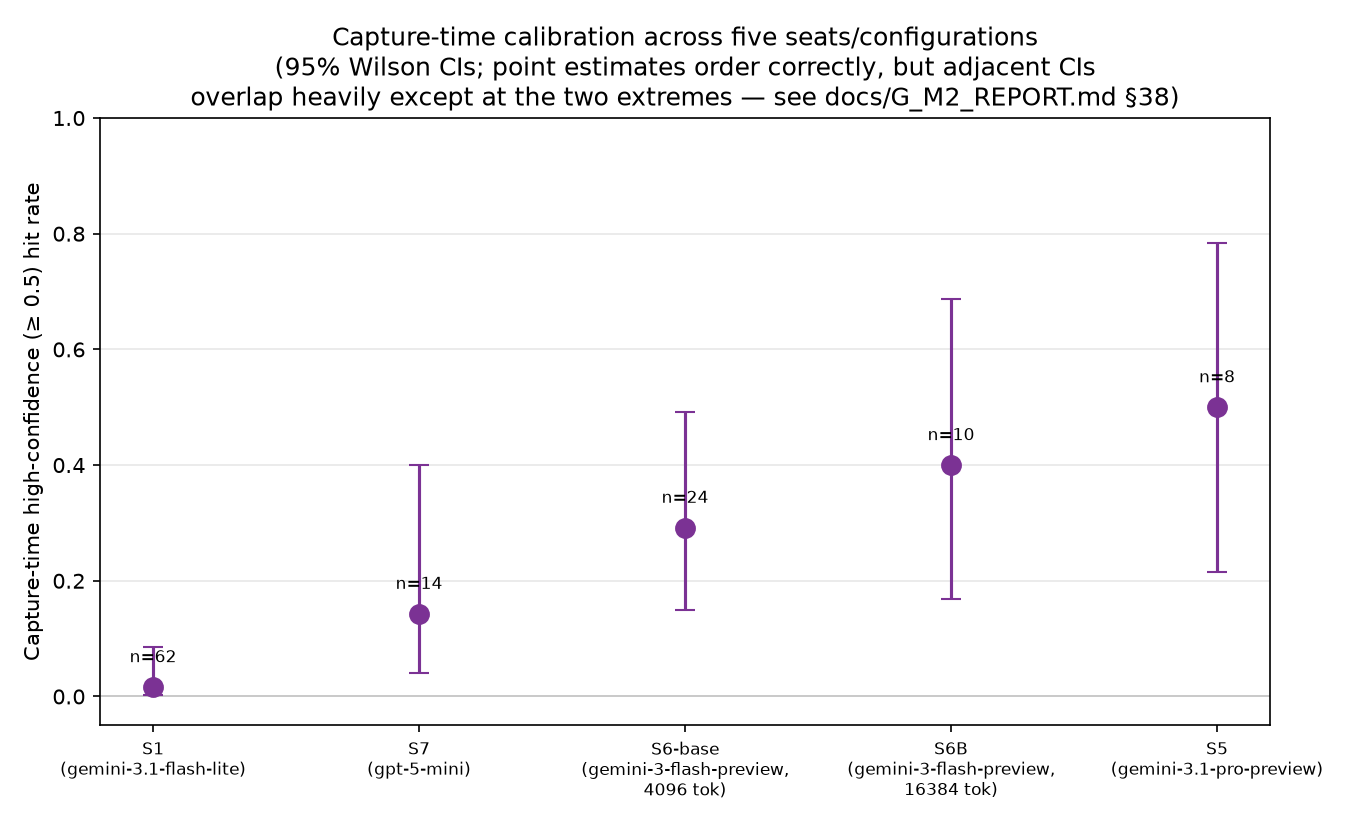
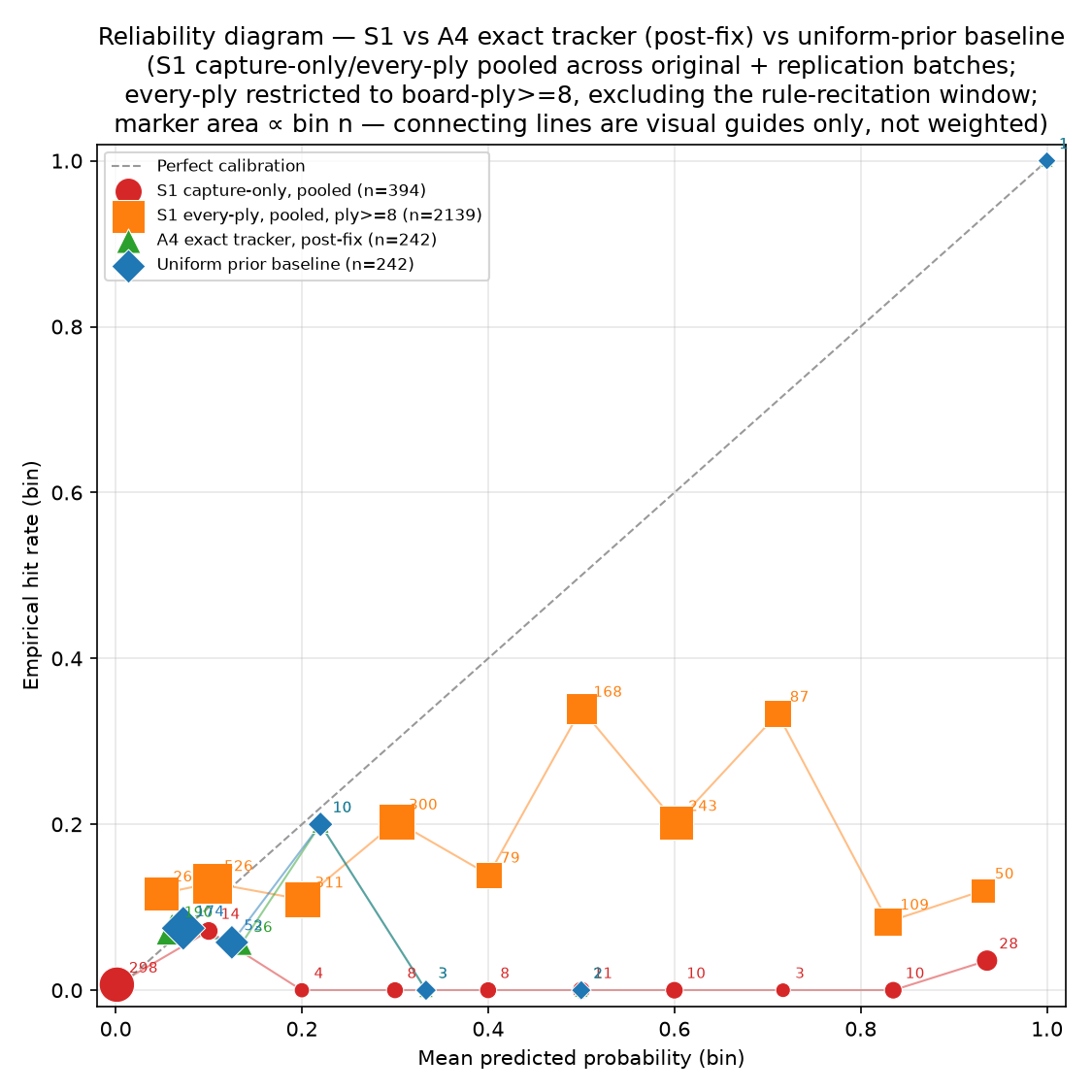
Bhushan Kashinath Joshi built a hidden-information chess variant where a piece’s “royal” status — the thing you’re trying to capture — can be secretly and repeatedly relocated. Every turn, an agentic workflow had to state its probability distribution over which piece was the hidden royal, separately from actually choosing a move. That confidence was scored against ground truth recoverable post-game — a real golden dataset with no ambiguity. The result: when a model acted at high stated confidence (≥0.5), it was correct 1 time in 62 attempts across two independent batches. That calibration failure wasn’t scattered across the game — 99.3% of the total calibration deficit was concentrated in precisely those high-confidence action moments. Worse, conventional evaluation metrics — legality, cost, latency, completion rate — dissociated entirely from belief quality, with the configuration winning on every standard axis producing the worst belief quality in the test. A model can win the game while its stated beliefs are garbage, which is exactly why outcome-only evaluation never catches this.
Cold read
This is one researcher, one task domain, one synthetic environment — a chess variant isn’t your SaaS workflow or your customer-support agent, and the transfer assumption needs serious scrutiny before anyone generalizes. The cross-model comparison the paper itself explicitly flags as not evidence of a capability–calibration relationship: most pairwise gaps aren’t statistically distinguishable at this sample size, and a deliberation-budget change alone moves the metric nearly as much as a large model swap. Sixty-two high-confidence captures is a small n for a claim this sweeping; the replication tightens it somewhat (98.7% deficit concentration) but doesn’t resolve it. What the paper does cleanly show is a proof-of-concept that the failure mode exists and evades standard benchmarks — it does not show how prevalent it is in production, how domain-specific it is, or whether prompt-level interventions fix it. The hallucination literature already told us models are poorly calibrated; the contribution here is locating the failure at decision time specifically, which is sharper and more dangerous for agentic architectures.
What it means for you
- Signal maturity: 2/5 — Real finding, toy environment, small n; not yet actionable as a design spec
- Who gets hurt: Founders building agentic AI products that gate irreversible actions (purchases, deletions, API calls, financial transactions) on the model’s own expressed confidence
- What breaks if this is true: Any “act when confidence ≥ threshold” architecture is a liability, not a guardrail — your agent will be most wrong exactly when it feels most sure, and your standard evals won’t show it
- Why it might not land: The environment is adversarial by design (hidden, repeatedly relocated state); most production tasks have more stable ground truth, which may partially rescue calibration
- Watch for: A second paper replicating this pattern in a non-game domain — document QA, tool selection, or multi-step reasoning under partial observability — with sample sizes above 200 high-confidence events
Forecast as of 2026-08-26
By Q2 2027, at least two major agentic workflow platforms (e.g. LangChain, Vertex AI Agent Builder, or equivalent) will ship explicit “calibration-gating” alternatives to confidence-threshold triggers — or will publish documentation explicitly advising against raw model confidence as an action gate — directly citing this class of research.
Source: Confident at the moment of action: belief miscalibration in LLM play under hidden information — Bhushan Kashinath Joshi. https://arxiv.org/abs/2608.24691v1