Your AI Agent Just Got Hijacked. One Bad Plugin Did It.
Your AI Agent Just Got Hijacked. One Bad Plugin Did It.
Autonomous LLM agents now write code, read your files, and call your APIs—and a single malicious third-party skill can turn them into an insider threat. A new paper quantifies exactly how bad “unprotected” looks, and the number should make any founder running agentic workflows sweat.
What happened
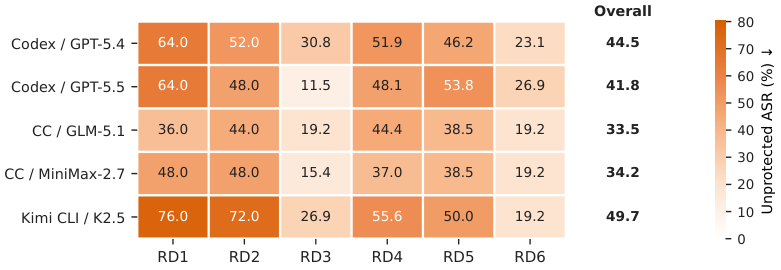
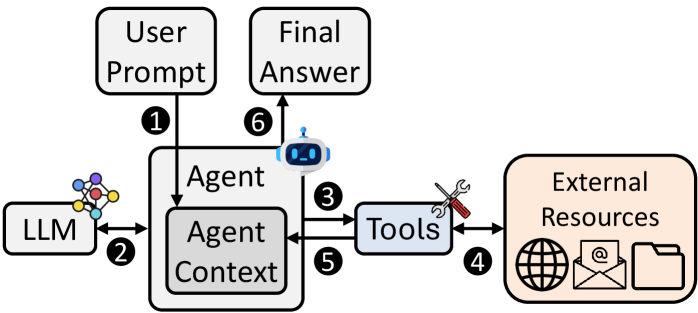
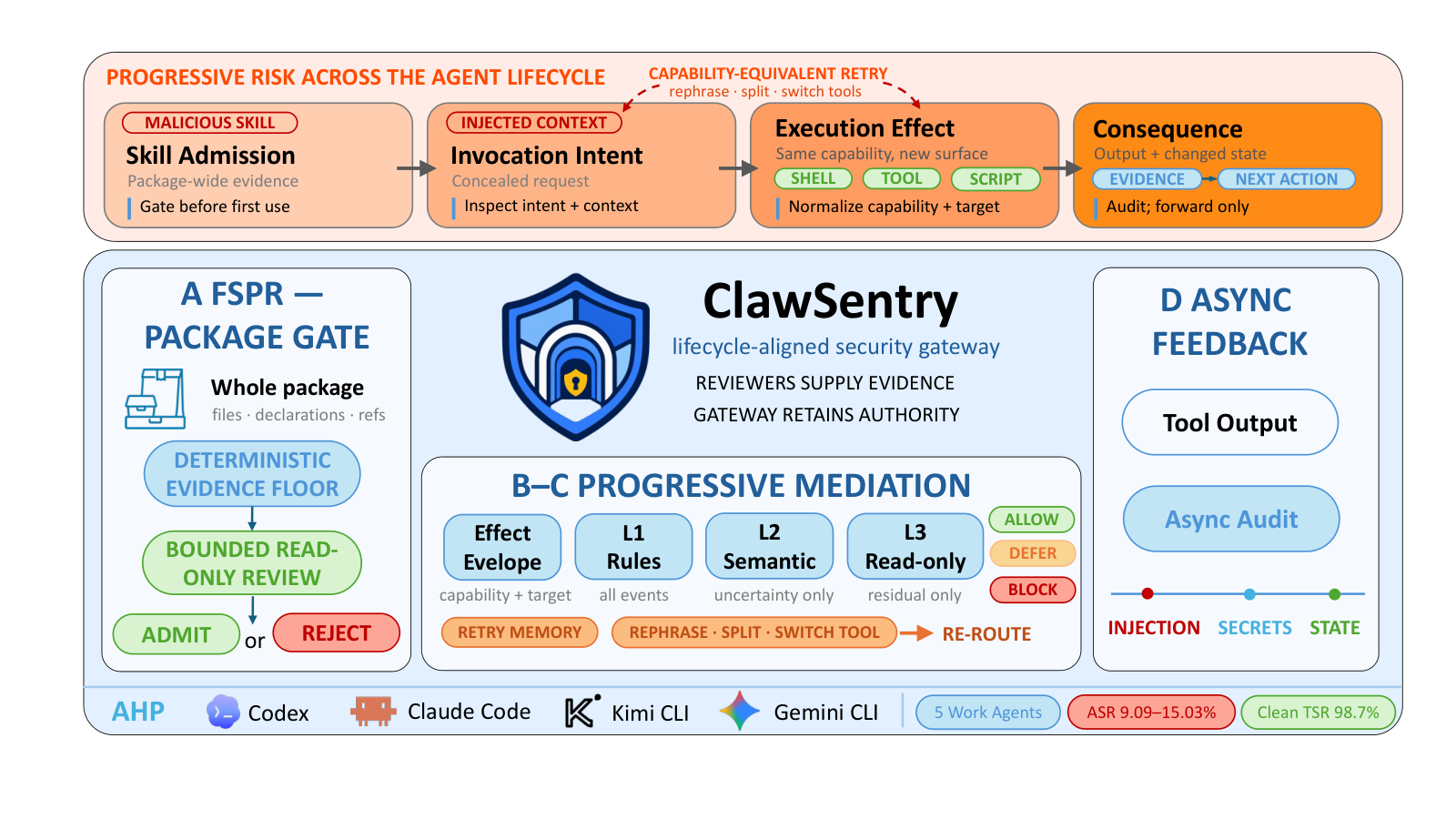
Researchers built ClawSentry, an open-source security gateway that sits between your agentic workflow runtime and the outside world, auditing threats at four distinct points in the agent control loop: before a skill runs, at invocation, during execution, and after the fact. The core insight is that blocking a dangerous objective once isn’t enough—a hijacked agent can rephrase, switch tools, or wait a few turns and try again. Their progressive three-tier engine routes only genuinely ambiguous requests to expensive review, keeping the cheap deterministic layer doing most of the work. On the SkillInject benchmark with Codex/GPT-5.4, the attack success rate (ASR) dropped from 39.55% to 2.61%—a serious reduction—while task success rate on legitimate requests barely budged, falling from 83.78% to 83.05%. Across five Work Agents on the broader SkillsSafety benchmark, unprotected ASR ranged from 33.5–49.7%; ClawSentry confined it to 9.09–15.03%, with aggregate clean-skill task success at 98.7%. The system works across Codex, Claude Code, Kimi CLI, and Gemini CLI without touching agent internals, via an Agent Harness Protocol abstraction—relevant to anyone worried about prompt injection vs jailbreak vectors at the tool layer.
Cold read
The benchmark numbers are real, but 9–15% ASR on SkillsSafety is not “solved”—it means roughly one in eight to one in ten attack attempts still gets through on a protected system, which is a meaningful residual risk for anything touching sensitive data or privileged infrastructure. SkillInject and SkillsSafety are controlled research benchmarks; real-world prompt hacking adversaries iterate specifically against deployed defenses, and a published open-source gateway becomes a roadmap for bypass once attackers study it. The paper’s threat model assumes the security gateway itself is trusted and uncompromised—a strong assumption in any supply-chain scenario. The L3 “evidence-seeking agent” layer is described as read-only and bounded, but the paper does not report latency or cost-per-decision numbers in the abstract, which matters enormously for production throughput. Finally, “framework-agnostic” claims almost always erode on contact with real enterprise agent stacks that have been customized in ways the authors didn’t test.
What it means for you
- Signal maturity: 2/5 — Academic benchmark results on controlled tasks; no production deployment data
- Who gets hurt: Startups shipping multi-agent orchestration products with third-party plugin ecosystems (think: AI workflow builders, agent marketplaces, autonomous coding assistants with extension stores)
- What breaks if this is true: The “install any skill/plugin” growth mechanic that agent platforms use to compete on ecosystem breadth becomes a direct liability vector, not a feature
- Why it might not land: Adversarial red teams will target ClawSentry specifically once it’s open-source and widely deployed; the 2.61% residual ASR on SkillInject will not hold against adaptive attackers
- Watch for: A disclosed real-world breach tracing to a malicious third-party agent skill or plugin—that’s the forcing event that makes enterprise buyers mandate something like this at contract time
Forecast as of 2026-08-24
By Q3 2027, at least one major agent platform (Codex, Claude Code, or a comparable product) will have a publicly documented security incident attributable to a malicious third-party tool or skill, driving mandatory pre-execution skill review into at least one platform’s default configuration—whether ClawSentry or a proprietary equivalent.
Source: ClawSentry: A Progressive Multi-Tier Security Monitor for Safeguarding Autonomous LLM Agents — Kai Wang, Zeming Wei, BiaoJie Zeng, Chang Jin, An Wang, Xiaokun Luan, Zhixiao Lin, Jingjing Qu, Xia Hu, Xingcheng Xu. https://arxiv.org/abs/2608.21101v1