Someone Is Poisoning Your RAG Pipeline Right Now
Someone Is Poisoning Your RAG Pipeline Right Now
Your knowledge base is not a vault — it’s an open window. One adversarial document injected into your vector store can steer your LLM toward whatever answer an attacker wants, and your existing defenses almost certainly can’t detect it. A new paper claims to have a fix. Let’s see if it holds.
What happened
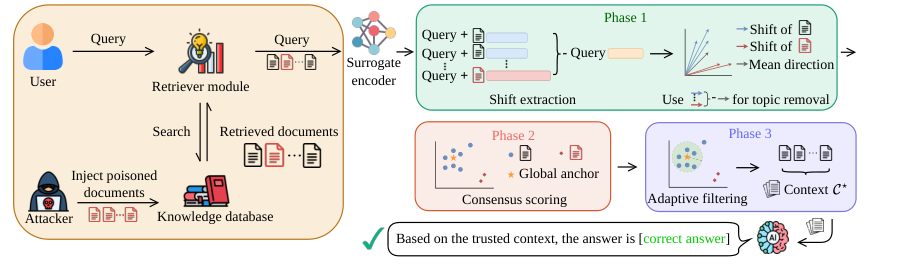
Researchers from multiple institutions built RAGSentinel, a defense layer for Retrieval-augmented generation systems that detects and filters poisoned documents before they can corrupt an LLM’s answer. The core mechanism is geometric rather than linguistic: a surrogate encoder measures how each retrieved document shifts the model’s hidden states relative to the query, strips out shared topic directions to reduce noise, and then flags documents that are statistical outliers from the majority cluster — treating poisoned docs as geometric anomalies rather than trying to read them for suspicious content. Critically, it requires no training, no labels, and works as a black-box wrapper around any existing pipeline. Tested across three QA datasets, three LLM families, and multiple attack strategies — including adaptive attackers with full knowledge of the defense pipeline — RAGSentinel reportedly achieved consistently low attack success rates while preserving competitive factual consistency on clean inputs. The theoretical guarantee is specific: under an honest-majority assumption (more clean docs than poisoned ones) and a representation-level separation condition, the method is proven to exactly recover a poison-free majority-sized context, which is a stronger claim than most empirical defenses dare to make.
Cold read
The honest-majority assumption is doing enormous real-world work here that the abstract treats lightly — if an attacker controls more than half your retrieved documents, the guarantee collapses entirely, and in narrow or sparse knowledge bases that’s a plausible scenario. The “representation-level separation condition” is a second load-bearing assumption: it requires that poisoned documents look geometrically distinct from clean ones in the surrogate encoder’s hidden space, which is exactly the property a sophisticated attacker will try to violate. The paper tests adaptive attackers “with full pipeline knowledge,” which sounds reassuring, but adaptive attack evaluations in the literature are frequently incomplete — they rarely explore the full optimization budget an adversary would deploy in production. “Competitive accuracy” on clean inputs is vague without published numbers; any defense that kills 10% of your retrieval quality to stop attacks you may never actually face is a product tax, not a feature. Finally, this is a point-in-time paper against a moving target: prompt hacking and corpus poisoning techniques evolve faster than academic defense cycles.
What it means for you
- Signal maturity: 2/5 — strong theory, zero production evidence, assumptions not validated in real deployments
- Who gets hurt: Companies running customer-facing RAG on semi-open or user-contributed knowledge bases (support bots, research tools, internal wikis with broad write access)
- What breaks if this is true: The current generation of instruction-following or text-similarity defenses — already baked into several RAG vendors’ “safety” features — is provably gameable by adaptive attackers, meaning you may be paying for security theater
- Why it might not land: The surrogate encoder adds inference latency and cost at retrieval time; in high-volume RAG deployments the math on this overhead may not clear, especially when the honest-majority assumption may not hold in the attack scenarios you actually face
- Watch for: Whether any major RAG infrastructure vendor (Weaviate, Pinecone, LlamaIndex) ships a geometric outlier filtering layer within 12 months, and whether it ships with an honest-majority disclosure
Forecast as of 2026-08-27
By Q3 2027, at least one significant corpus-poisoning attack against a commercial RAG product will be publicly disclosed, accelerating vendor adoption of retrieval-layer filtering — but RAGSentinel’s specific geometric approach will remain an academic reference rather than a deployed standard, displaced by simpler heuristics that clear the latency bar.
Source: RAGSentinel: Certifiable Geometric Consensus for Robust Retrieval-Augmented Generation — Yueyang Quan, Anjun Gao, Yufei Xia, Minghong Fang, Zhuqing Liu. https://arxiv.org/abs/2608.23965v1