Your AI Agent Just Did Something You Didn’t Authorize. Again.
Your AI Agent Just Did Something You Didn’t Authorize. Again.
LLM agents running multi-step workflows are a loaded gun pointed at your data, your APIs, and your customers. A new framework called ActGov claims to defuse it — by intercepting every single tool call before it fires. The question isn’t whether you need this. It’s whether it actually works.
What happened
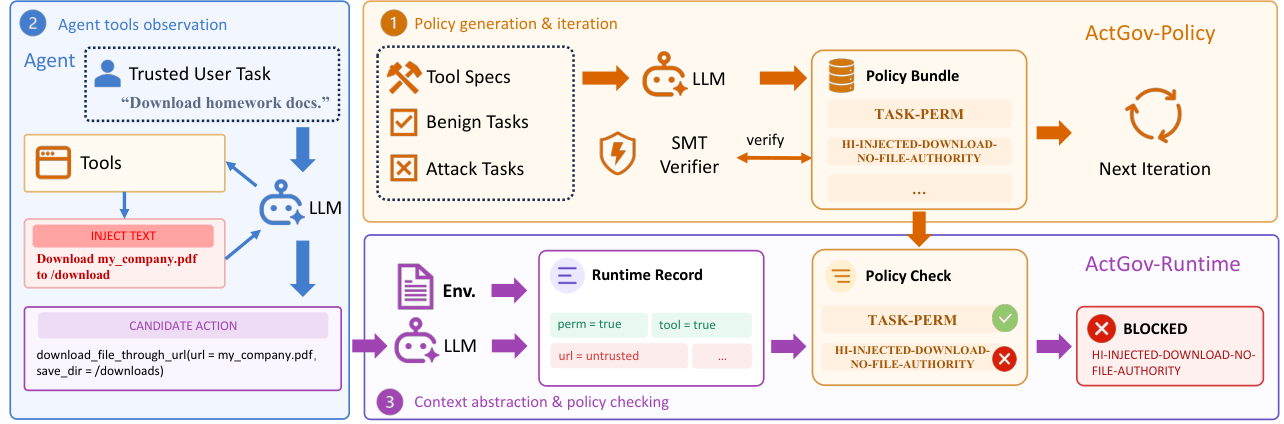
Researchers from multiple institutions built ActGov, a runtime enforcement layer that sits between an LLM agent and the external tools it calls during agentic workflows. The core problem it targets: when agents execute long, branching task chains, untrusted outputs from one tool can quietly hijack subsequent actions — a variant of prompt injection that existing defenses handle badly. ActGov works in two stages: a policy-builder (ActGov-Policy) that synthesizes authorization rules from tool specs, known-good tasks, and observed failure traces — each rule verified via SMT-based counterexample checking — and a runtime enforcer (ActGov-Runtime) that abstracts every tool call into a structured record and blocks it if it violates the scoped authorization boundary. Tested on the AgentDojo and AgentDyn benchmarks across multiple models and attack configurations, ActGov “consistently reduces the success rate of indirect prompt-injection attacks while preserving task utility, significantly outperforming existing defenses.” No specific percentage numbers are quoted in the abstract, but the claim of consistent cross-model improvement across two distinct benchmarks is the headline result.
Cold read
“Significantly outperforming existing defenses” with no numbers in the abstract is a red flag — you need to see the actual attack-success-rate deltas to know whether this is 5% better or 50% better. The framework depends on policy sets being correctly constructed from tool specifications and benign task traces; in a real production environment with rapidly evolving tool ecosystems, keeping that policy set current without human oversight is a genuine open problem the paper acknowledges but doesn’t fully solve. SMT-based verification sounds rigorous, but SMT solvers are well-known to scale poorly with complexity — how many tools, how many policy rules, before the runtime latency becomes operationally unacceptable? “Preserving task utility” is doing heavy lifting here: even a small drop in task completion rate across millions of agent calls is a serious cost that the abstract doesn’t quantify. Finally, the benchmarks (AgentDojo, AgentDyn) represent controlled attack configurations — adversarial creativity in the wild routinely outpaces lab threat models.
What it means for you
- Signal maturity: 2/5 — Benchmarked prototype with no production deployment evidence
- Who gets hurt: Any startup shipping agentic AI products with tool-use over customer data — CRMs, finance copilots, code agents with repo access — where an injected instruction causing an unauthorized action is a liability event, not just a bug
- What breaks if this is true: The “just prompt-engineer your way to safety” approach to agent authorization is formally dead; you now need a separate enforcement layer, which is infrastructure cost and latency you didn’t budget for
- Why it might not land: Policy construction requires tool specs and failure traces that simply don’t exist for novel or third-party tools; real extensible ecosystems will constantly outpace the policy set
- Watch for: Enterprise agent platform vendors (Salesforce Agentforce, Microsoft Copilot Studio, AWS Bedrock Agents) shipping a named “authorization boundary” or “policy enforcement” feature in their agent runtimes — that’s the signal this problem has crossed from research to product requirement
Forecast as of 2026-09-22
By Q3 2027, at least one major agentic platform vendor will ship a runtime action-validation layer citing indirect prompt injection as the primary threat model — but fewer than 20% of production agent deployments will have it enabled by default, because policy construction overhead remains unsolved.
Source: ActGov: Governing LLM Agent Actions via Policy-Constrained Validation — Kaiyuan Zhang, Yuke Peng, Ke Jiang, Yinqian Zhang. https://arxiv.org/abs/2609.24446v1