A 122B Shell Agent Just Outscored GPT-5.4 on Real Terminal Work
A 122B Shell Agent Just Outscored GPT-5.4 on Real Terminal Work
A model trained to live inside a real Linux shell, running 300+ tool calls per task, just beat GPT-5.4 on long-horizon terminal benchmarks. If this holds up outside the lab, the floor just dropped out from under a category of “AI coding assistant” startups that are charging enterprise prices for glorified autocomplete.
What happened
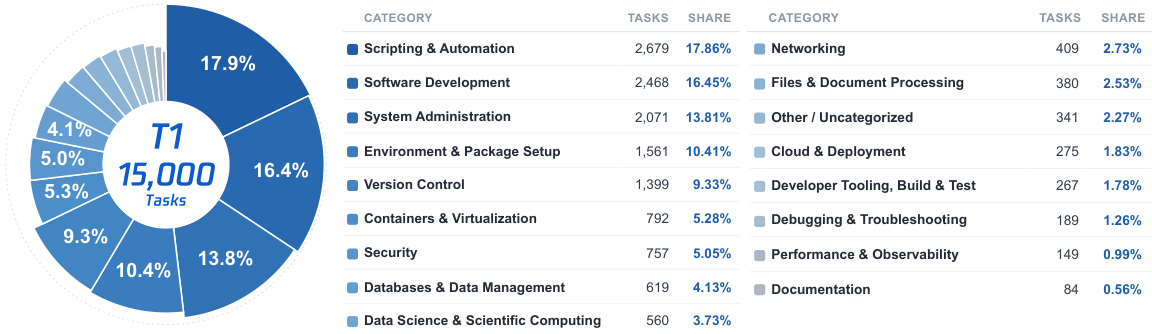
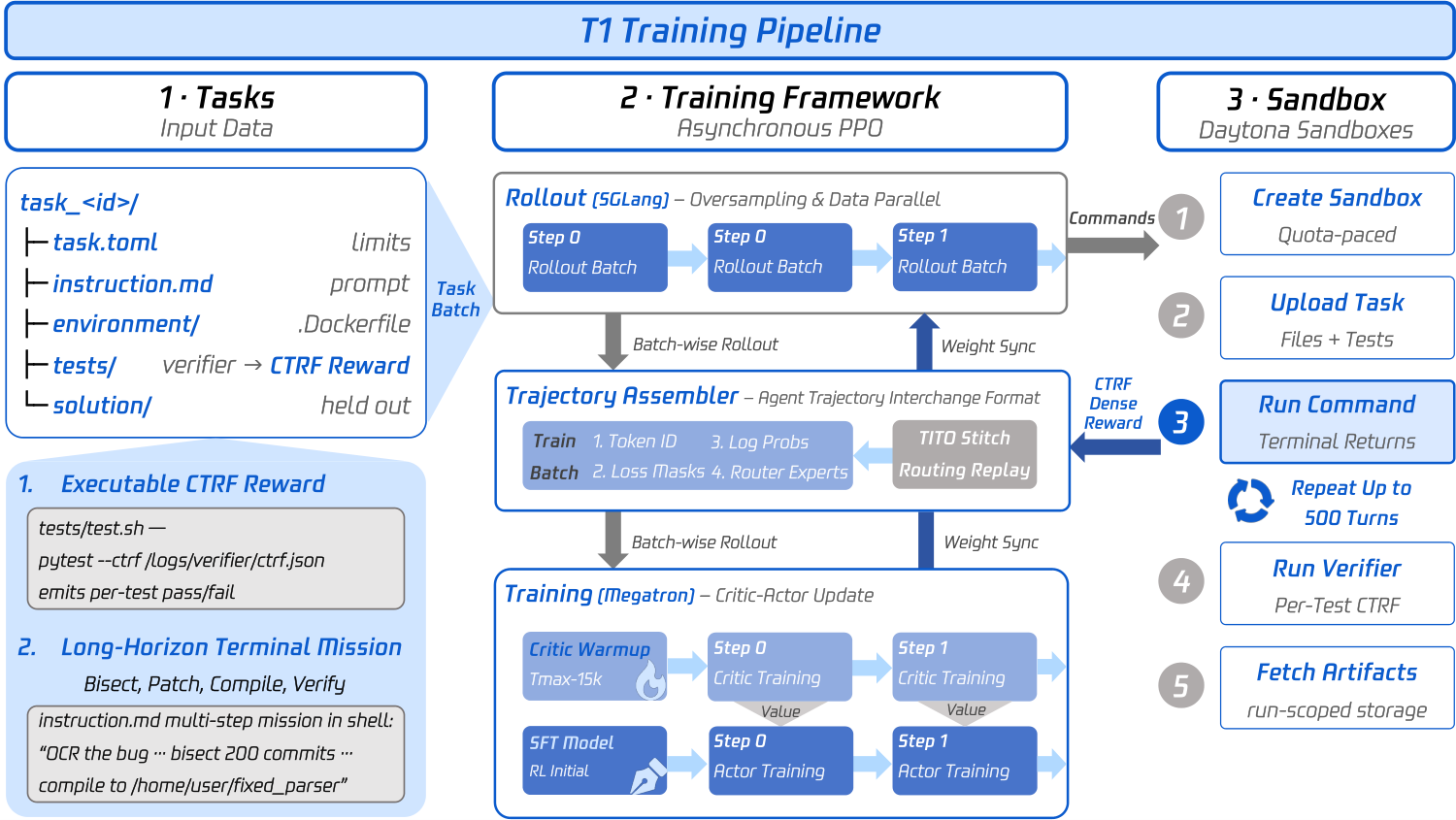
The team behind T1 trained a 122-billion-parameter Mixture-of-Experts model using reinforcement learning in a genuine cloud sandbox — not a simulated environment, an actual shell — rewarded by task-specific verifiers rather than human labels. The agentic workflow can stretch to 300+ tool use turns per task, which is an order of magnitude longer than most deployed agent systems today. On Terminal-Bench 2.1, the post-training pipeline lifted the base model from 43.8% to 64.0% resolved — a 20-point absolute gain from RL alone. On the harder Long-Horizon Terminal Bench, T1 reached 27.9% and surpassed both GPT-5.4 and GLM-5.1. Critically, the authors report a fully out-of-distribution training corpus with no overlap against the benchmark, which directly addresses benchmark contamination concerns — the usual first objection to any impressive leaderboard number.
Cold read
27.9% on the long-horizon bench means the model fails nearly three out of four hard tasks — that’s the number you should anchor on, not the GPT-5.4 comparison. “Surpasses GPT-5.4” is true by the paper’s own metric, but we don’t know the task distribution, the margin, or whether GPT-5.4 was given the same shell access and turn budget. The TITO and rollout routing replay techniques (which cut training-to-inference log-probability difference from 0.021 to 0.013) are genuine engineering contributions, but they’re training stability tricks — they don’t tell you anything about real-world reliability when the shell state is messier than a sandbox. The out-of-distribution claim is self-reported; independent replication on a held-out benchmark suite hasn’t happened yet. And 122B MoE at 300+ turns per task carries a compute cost that makes the unit economics genuinely ugly for anyone outside hyperscaler budgets.
What it means for you
- Signal maturity: 2/5 — Impressive benchmark, but single paper, no third-party replication, and a 27.9% success ceiling on hard tasks
- Who gets hurt: Vertical “AI DevOps” and “AI SRE” startups selling long-running automation at SaaS margins — your moat just got thinner if this architecture becomes accessible
- What breaks if this is true: The assumption that long-horizon terminal tasks require human-in-the-loop checkpoints; fully automated infra pipelines become plausibly real at sub-hour horizons
- Why it might not land: Sandbox != production. Real environments have messy state, secrets, partial failures, and blast radius. A model that solves 64% of clean benchmark tasks may solve 20% of your actual oncall queue
- Watch for: An API or cloud offering from the authors’ org, or a major cloud provider citing this architecture in a product announcement — that’s when the compute cost problem either gets solved or gets priced in
Forecast as of 2026-09-12
By Q2 2027, at least one major cloud provider (AWS, Google, or Azure) will have announced a managed terminal-agent product citing RL-from-verifier training as a core design choice — but production pass rates on unstructured enterprise tasks will be publicly reported below 40%, keeping human-in-the-loop as a mandatory feature rather than an option.
Source: T1: Terminal Agent Reinforcement Learning for Long-Horizon Tasks — Junyao Yang, Yucheng Shi, Zhongzhi Li, Ruhan Wang, Zongxia Li, Haitao Mi, Leowei Liang. https://arxiv.org/abs/2609.11042v1