Your AI Quality Layer Is Grading Papers It Never Read
Your AI Quality Layer Is Grading Papers It Never Read
You built a self-evaluation pipeline because everyone said models are better judges than generators. One paper just ran the controlled experiment you assumed someone else had already done — and the assumption didn’t hold. If your eval stack grades its own outputs, you may be shipping confident garbage.
What happened
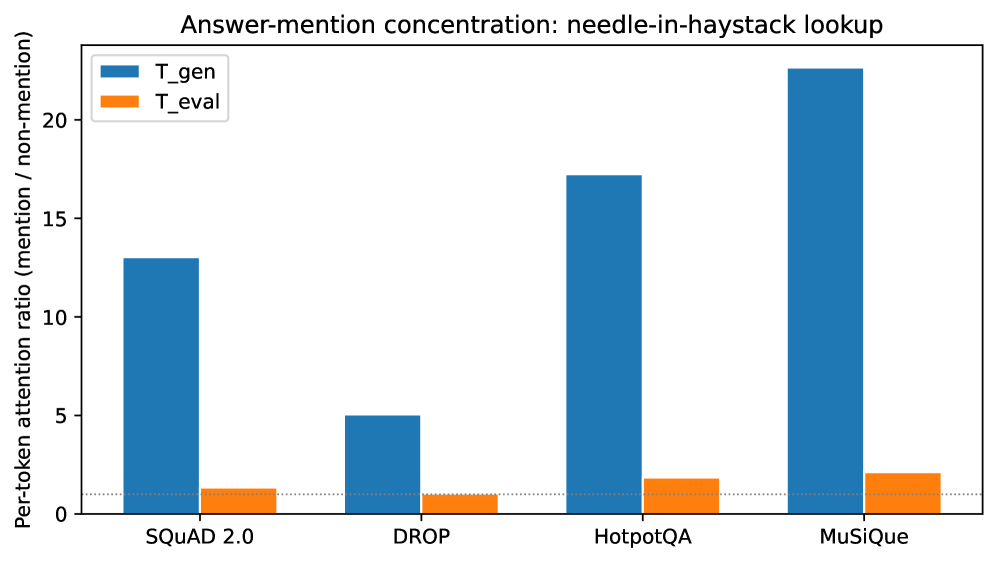
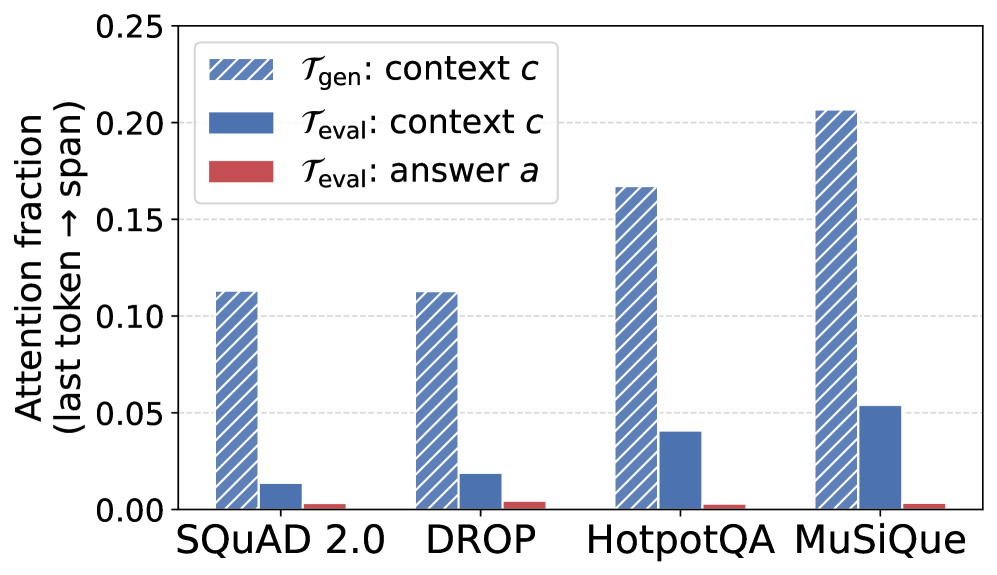
Sambaran Bandyopadhyay tested the core premise baked into every LLM-as-judge pipeline: that evaluation is easier than generation. The setup is tighter than most: a context passage is the only allowed information source, and each model judges its own answers — no open-domain parametric memory to muddy the water. Across four benchmarks (SQuAD 2.0, DROP, HotpotQA, MuSiQue) and two models, generation accuracy beat self-evaluation accuracy on three of four datasets. The lone exception was MuSiQue, a multi-hop reasoning task. Attention analysis showed why: when judging, models attend to the source context 3–5× less than they do when generating, and barely read the candidate answer they’re supposed to be scoring — a direct faithfulness vs. groundedness failure in the eval layer itself. LoRA fine-tuning sealed the finding: training on generation tasks caused over-acceptance in evaluation, and training on evaluation degraded generation — confirming this asymmetry is structural, not a quirk of the base model weights. The asymmetry held across in-context learning conditions tested on these golden dataset benchmarks.
Cold read
Two models across four benchmarks is a thin empirical base — we don’t know if this generalizes to frontier-scale models (GPT-4o, Claude 3.7, Gemini 2.5) or to tasks outside closed-context QA. The controlled setup that makes the experiment clean also limits it: real-world self-eval pipelines operate with open-domain knowledge, tool calls, and multi-turn context, none of which are tested here. “Evaluation accuracy” is measured against benchmark labels, which are themselves imperfect — so the gap between generation and judgment accuracy may partly reflect benchmark noise rather than model behavior. The attention analysis shows where the model looks, not why, and attention weights are a notoriously unreliable proxy for causal reasoning. And “over-acceptance” after generation fine-tuning is interesting, but the magnitude of degradation in cross-task transfer isn’t quantified in the abstract — so you can’t yet size how badly this breaks in practice.
What it means for you
- Signal maturity: 2/5 — Two models, closed-context only; needs replication at scale before you restructure your eval stack
- Who gets hurt: Any team running LLM-graded evals or RAG pipelines where the same model scores its own retrieved answers — your quality signal is noisier than your dashboards suggest
- What breaks if this is true: Self-evaluation as a cheap substitute for human annotation collapses as a strategy; you’re measuring the model’s confidence in itself, not its accuracy against the source
- Why it might not land: Larger models at inference scale may exhibit fundamentally different attention behavior; the asymmetry could shrink or reverse above a capability threshold nobody tested here
- Watch for: Replication studies using GPT-4-class or Gemini-class models on the same four benchmarks — if the generation-beats-judgment finding holds at 100B+ parameters, this becomes a field-wide infrastructure problem
Forecast as of 2026-06-29
By Q1 2027, at least two major LLM providers or evals-focused labs will publish results explicitly testing this generation-vs-judgment asymmetry at frontier scale; if the finding replicates on models ≥70B parameters, expect a measurable shift in how evaluation-pipeline startups pitch their architectures — away from same-model self-eval toward cross-model or human-in-the-loop judgment layers.
Source: Can LLMs Judge Better Than They Generate? Evaluating Task Asymmetry, Mechanistic Interpretability and Transferability for In-Context QA — Sambaran Bandyopadhyay. https://arxiv.org/abs/2606.28050v1