Your AI Agent Is Poisoning Itself—and Has Been Since Day One
Your AI Agent Is Poisoning Itself—and Has Been Since Day One
Every memory your agent writes is a liability waiting to misfire. Stale facts don’t just sit quietly—they actively corrupt future decisions, and until now nobody shipped a clean fix. This paper says it has one, and the numbers are genuinely hard to dismiss.
What happened
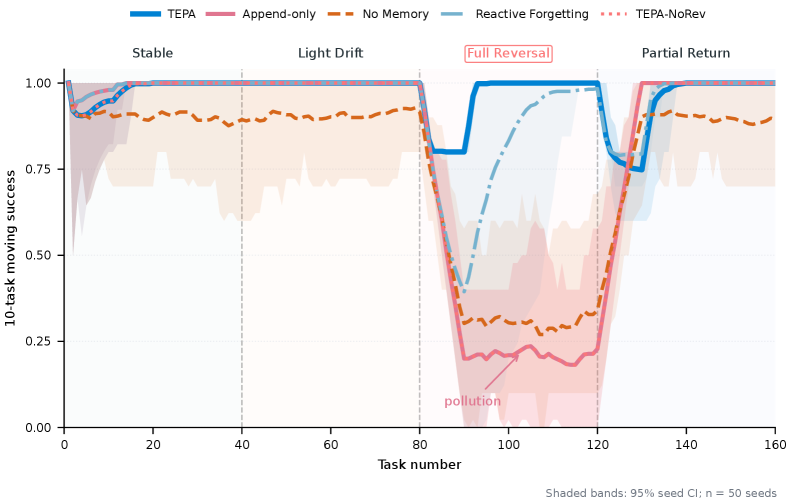
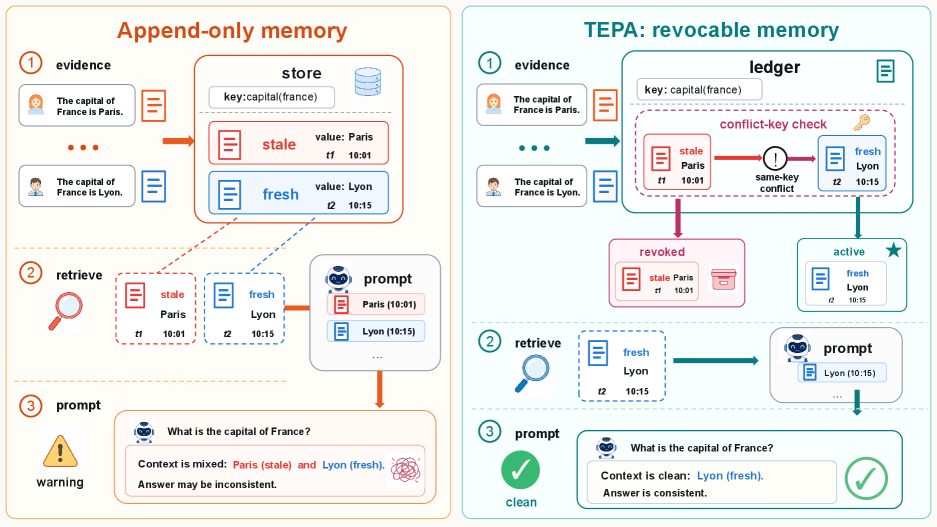
Researchers from Shanghai and related institutions identified what they call memory pollution: when an agentic workflow accumulates long-term memory, outdated facts stay retrievable and contaminate the agent memory vs context window pipeline even after the world has moved on. They built TEPA, a revocation layer that tags each memory as a “precedent” under a key and explicitly tombstones it when contradicting evidence arrives—like a ledger with hard deletes, not an ever-growing append log. The benchmark results are stark: under controlled drift with 50 seeds, standard append-only and last-write-wins memory both scored 0.210 after full reversal—worse than an agent with no memory at all (0.309). TEPA scored 0.950. The same collapse and recovery reproduced under real file-backed execution (append-only 0.203, no memory 0.298, TEPA 0.950). On a clean, non-drifting benchmark (MemoryAgentBench SH-6k), TEPA merely matches a good last-write-wins cache, which tells you most of the value is in the revocation, not in some exotic retrieval trick. The authors also flag that multi-hop and very long-context settings expose problems TEPA doesn’t solve—retrieval-chain and context-selection failures that are upstream of fact validity entirely.
Cold read
The controlled drift experiments are synthetic by construction—50 seeds, hidden-regime reversals—and it’s not obvious how “full reversal” maps to the messy, partial, gradual changes in real products (user preferences shift in shades, not binary flips). The flat 0.950 scores on both controlled and real-file tests are suspiciously clean; real production systems carry noise that tends to shave those numbers significantly. TEPA’s mechanism depends on matching new evidence under the same key, which assumes you can reliably identify when two observations address the same fact—a non-trivial retrieval precision and recall problem the paper doesn’t deeply stress-test. The authors openly admit multi-hop settings expose “retrieval-chain and context-selection bottlenecks” that TEPA doesn’t address, meaning any agent doing complex reasoning over memory is still flying blind. This is a rigorous proof-of-concept for a specific failure mode, not a production memory stack.
What it means for you
- Signal maturity: 2/5 — Strong benchmark story, zero production validation
- Who gets hurt: Any team shipping an AI assistant, copilot, or ops agent that maintains persistent user or environment state across sessions—think CRM bots, DevOps agents, or personal AI tools with long user histories
- What breaks if this is true: The implicit assumption baked into most RAG-adjacent memory architectures—that “more memory = smarter agent”—is provably backwards under drift; your agent with six months of history may be dumber than a fresh one
- Why it might not land: Key-matching is the load-bearing mechanism, and key collision or ambiguity in real-world agent observations will degrade revocation accuracy in ways these benchmarks don’t capture
- Watch for: An open-source memory layer or LangGraph/LlamaIndex integration shipping explicit revocation primitives with audit logs—if the frameworks adopt this pattern, it’s real; if they don’t in 12 months, it stayed in papers
Forecast as of 2026-08-10
By Q3 2027, at least one major agentic framework (LangGraph, LlamaIndex, or Mem0) will ship an explicit memory-revocation primitive citing lifecycle invalidation as the design rationale—but fewer than 20% of production agent deployments will actually adopt it, because the key-matching problem will prove harder than the benchmark suggests.
Source: TEPA: Revoking Stale Memories for Conflict-Robust Language Agents — Yan Zhou, Yue Ouyang, Kaiyang Zheng, Suncheng Xiang. https://arxiv.org/abs/2608.07429v1