Your AI Agent Just Rewrote Its Own Safety Rules—Without Asking You
Your AI Agent Just Rewrote Its Own Safety Rules—Without Asking You
Every agentic workflow you ship has a safety layer that’s either too paranoid or too permissive. A team out of academia says they’ve automated the fix. Before you retool your compliance stack, read the fine print.
What happened
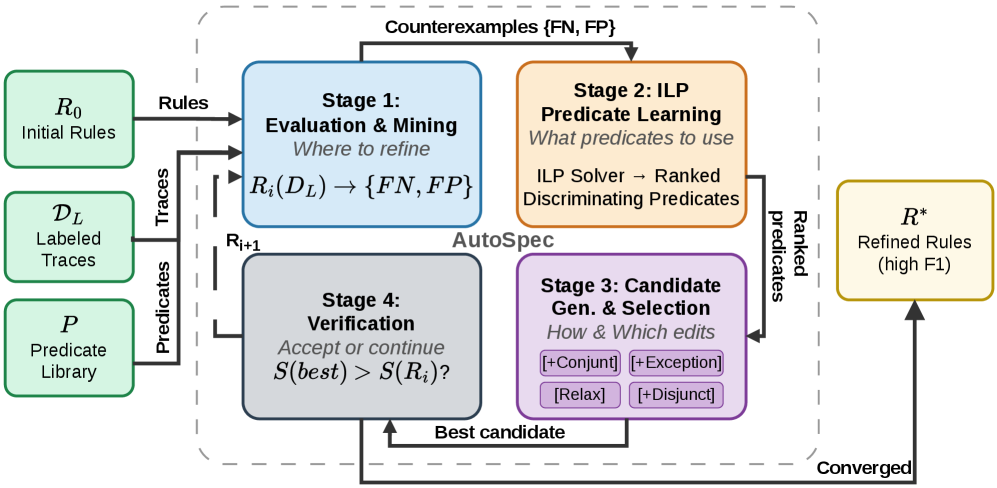
Researchers built AutoSpec, a framework that takes your existing hand-crafted safety rules for LLM agents and automatically evolves them using a technique called counterexample-guided inductive synthesis (CEGIS), steered by inductive logic programming (ILP). The loop is mechanical: feed the system annotated safe/unsafe execution traces, let it find where your current rules fail, use ILP to identify which logical predicates discriminate failures from safe behavior, propose rule edits, verify them, repeat. Across 291 execution traces in two domains—code execution and embodied agents—AutoSpec pushed rule F1 scores to 0.98 and 0.93 respectively, cutting false positives by up to 94% while keeping recall high. The system converges in 4–5 iterations, and the ILP-guided approach hit up to 4.8× higher F1 than naive heuristic counterexample search. Crucially, the output rules remain human-readable and auditable—which matters enormously for any agentic AI deployment that needs to pass a compliance or legal review. The ILP layer does the real work: it prunes an exponentially large search space of possible rule edits down to a tractable set by filtering on predicate frequency across false negatives versus false positives.
Cold read
291 traces is a toy dataset. Production agent deployments see millions of tool calls across chaotic, adversarial, and context-dependent environments that no lab benchmark has captured. The two domains tested—code execution and embodied agents—are relatively constrained; the abstract says nothing about how AutoSpec behaves when the trace distribution shifts post-deployment or when a prompt injection deliberately crafts inputs to fool the ILP-learned predicates. The “annotated traces” requirement is a hidden cost: someone with domain expertise has to label safe versus unsafe behaviors, and that labeling process is itself error-prone and expensive in novel domains. Convergence in 4–5 iterations sounds clean, but the abstract gives no data on what happens when the underlying agent behavior changes—whether the system degrades gracefully or needs a full re-run. Finally, F1 of 0.98 on a held-out set drawn from the same distribution as training is not the same as generalization to genuinely unseen adversarial scenarios, however the authors claim it.
What it means for you
- Signal maturity: 2/5 — Academic benchmark results, tiny dataset, no production validation
- Who gets hurt: Startups selling static rule-based agent guardrail products (think hard-coded policy engines bolted onto LLM pipelines); AutoSpec’s pitch is a direct threat to their “we wrote the rules, trust us” moat
- What breaks if this is true: The assumption that you need a dedicated ML safety team to maintain agent guardrails—if rule evolution can be automated with a few hundred labeled traces, that headcount justification collapses
- Why it might not land: Labeling 291+ traces per domain per deployment context is not free; in practice, who owns the annotation pipeline and who’s liable when the evolved rules miss a novel unsafe behavior are unsolved organizational problems
- Watch for: A production case study—not a paper—showing AutoSpec deployed on >10K traces in a live agent environment with documented false-negative incidents tracked over 90+ days
Forecast as of 2026-06-24
By Q4 2027, at least one agent safety vendor will ship an ILP-or-equivalent rule-evolution product to market, but fewer than 20% of enterprise agent deployments will use automated rule evolution as their primary safety mechanism—manual rule audits and neural classifiers will still dominate due to regulatory conservatism and annotation cost.
Source: AutoSpec: Safety Rule Evolution for LLM Agents via Inductive Logic Programming — Pingchuan Ma, Zhaoyu Wang, Zimo Ji, Yuguang Zhou, Zhantong Xue, Zongjie Li, Shuai Wang, Xiaoqin Zhang. https://arxiv.org/abs/2606.24245v1