85% of Restaurants Are Ghosts to AI — Including Yours
85% of Restaurants Are Ghosts to AI — Including Yours
AI assistants are eating local discovery. If your venue isn’t in their answers, you don’t exist to a growing slice of customers — and new data shows the rules for getting in look nothing like what Google trained you to expect. Quality doesn’t get you through the door. Documentation does.
What happened
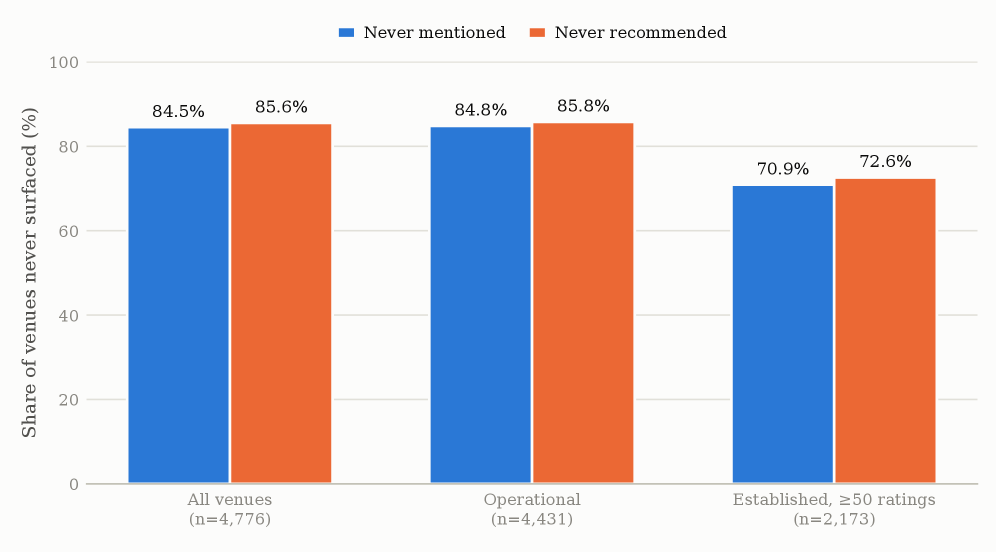
Researcher Vladimir Pitenin built a complete census — every cafe, restaurant, and bar in two Bali markets (4,776 venues total) — then fired 2,208 queries at ChatGPT, Claude, Gemini, and Perplexity across 96 persona-conditioned prompts over seven days. Because he enumerated the full market first, he could measure true omission rates rather than just sampling patterns. The headline: 85.6% of venues were never recommended by any system. Even among established venues with 50 or more ratings, 72.6% received zero mentions. Getting into an answer at all is driven by documentation — review volume (OR 1.64), having your own website (OR 1.92), listed price information (OR 1.54), and third-party web mentions (OR 1.44). Star rating is effectively null for entry (OR 0.89). The pattern inverts once you’re in: among recommended venues, rating predicts first position (OR 1.17), which is the Prompt-level ranking dynamic operators should understand. Hallucination was nearly irrelevant at 0.08% of mentions — but systems recommended permanently closed venues 93 times, making staleness the real operational hazard. Cross-system overlap was low (top-20 Jaccard similarity 0.33–0.54), meaning no single system dominates and AI visibility is not a unified target.
Cold read
Two markets in Bali is a thin empirical base to generalize from — these are tourist-heavy, English-query-friendly, bounded geographies that probably over-represent English-language web documentation relative to local venues globally. The two-margin finding (documentation drives entry; rating drives rank) is interesting but observational: it shows correlation, not a causal mechanism, and it could reverse in markets where AI systems are trained on different data distributions. The protocol covers four systems over seven days in mid-2026; Retrieval-augmented generation pipelines update continuously, so the specific odds ratios are a snapshot, not a law. The Foursquare null finding — presence in an open POI dataset shows no positive effect — is genuinely surprising and worth replicating, but “no effect in Bali” doesn’t settle whether Knowledge graph inclusion matters in other systems or geographies. The low Jaccard overlap (0.33–0.54) also means any GEO (Generative Engine Optimization) playbook that works on one system may actively fail on another.
What it means for you
- Signal maturity: 3/5 — Rigorous methodology, but single-geography, single-researcher, not yet replicated
- Who gets hurt: Independent restaurant and hospitality operators running lean on digital presence; also local SEO agencies whose frameworks were built for Google, not generative answers
- What breaks if this is true: The assumption that a high rating and strong review count is sufficient for AI-era discovery; operators with great food and thin documentation infrastructure are invisible regardless of quality
- Why it might not land: Bali’s tourist markets may be structurally different from dense urban markets (NYC, London, Tokyo) where venue documentation density is much higher — the 85.6% omission rate could be an artifact of the gap between English-query AI systems and Indonesian-market data coverage
- Watch for: A replication study in a high-documentation Western urban market; if omission rates stay above 70% there, the documentation-over-quality thesis hardens into a real operational crisis for the industry
Forecast as of 2026-08-10
By Q2 2027, at least one major hospitality software platform (reservation, POS, or review aggregator) will launch an explicit “AI visibility” product feature citing documentation completeness — own website presence, price listings, review volume — as the primary lever, directly mirroring this paper’s OR findings; if no such product ships, the research will have failed to cross the practitioner gap.
Source: Invisible to the Machine: Auditing AI Restaurant, Cafe, and Bar Recommendation Against a Complete Market Census — Vladimir Pitenin. https://arxiv.org/abs/2608.07069v1