The First Brand Cited in Your AI Chat Session Wins Everything
The First Brand Cited in Your AI Chat Session Wins Everything
A new framework suggests that getting mentioned once in a multi-turn AI conversation is not one citation — it’s a compounding machine. If the math holds, single-turn SEO thinking is already obsolete, and the brands that lose the opening exchange lose the entire conversation.
What happened
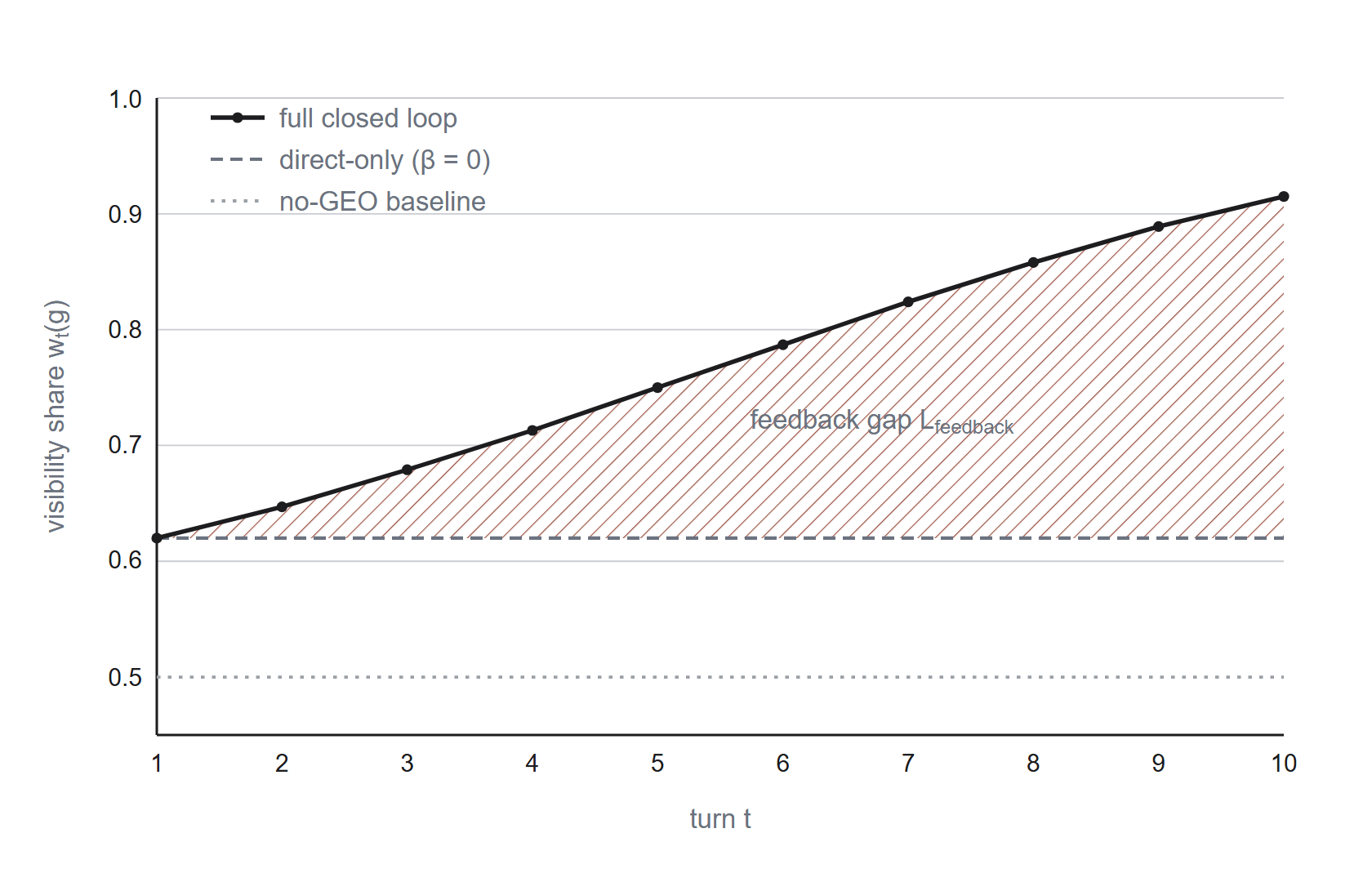
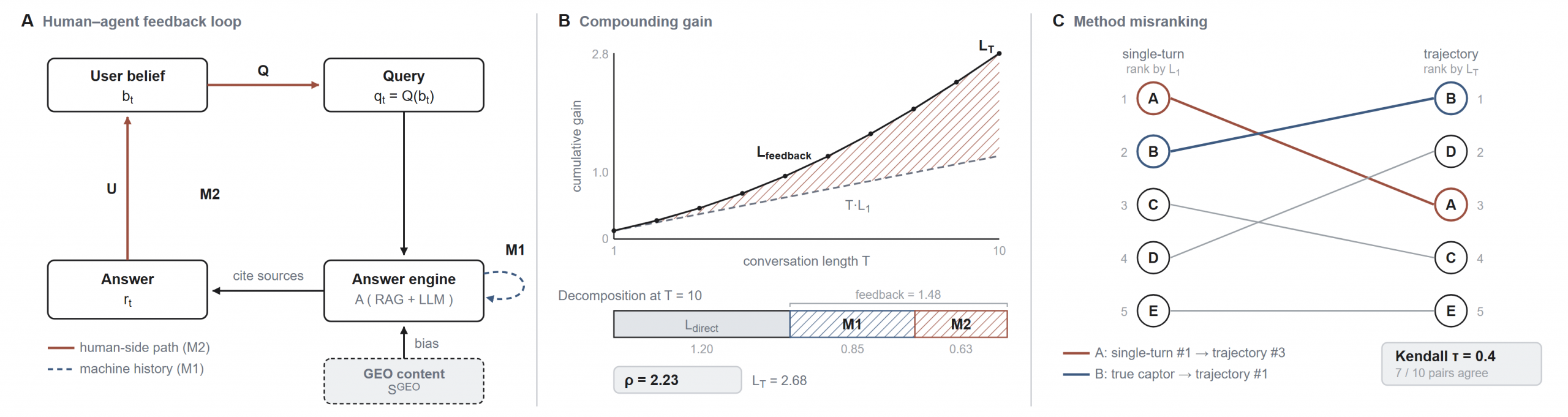
Researchers from the University of Tokyo formalized a phenomenon they call “conversational capture” in the context of GEO (Generative Engine Optimization): once a source gets cited early in a multi-turn conversation with an RAG-powered agent, it becomes substantially more likely to be cited again. The mechanism is two-sided. On the machine side, conversation history shapes what gets retrieved next — history-conditioned retrieval creates a self-reinforcing feedback loop. On the human side, users direct follow-up questions toward sources they just encountered, which the paper connects to information foraging theory and Bayesian persuasion. The authors formalize the whole interaction as a “two-layer closed-loop system” and prove, using Pólya-urn (reinforcement-process) mathematics, that standard single-turn evaluation misses the feedback term entirely — it is identically zero in single-turn measurement. Their model-derived illustration is the headline number: within ten turns, the compounding ratio exceeds 2×, and the feedback term from capture can exceed the direct visibility term. Critically, single-turn and trajectory-level source rankings agree only weakly — Kendall’s τ = 0.4 — meaning your current AI visibility benchmarks are probably ranking the wrong sources as winners.
Cold read
The central quantitative results — the compounding ratio exceeding 2×, the τ = 0.4 ranking disagreement — come from a “model-derived illustration,” not an empirical study of real users or real RAG deployments. That is a simulation calibrated to the authors’ own formal model, which means it proves the math is self-consistent, not that the real world behaves this way. The paper does not report any controlled experiment measuring whether actual users, talking to actual AI products, exhibit the predicted capture dynamics at the predicted rates. The human-side channel — users steering follow-up questions toward already-cited sources — is theoretically motivated (information foraging, trust calibration) but empirically unvalidated here. It’s also worth noting that retrieval architectures vary enormously: some systems use session-stateless retrieval that would break the machine-side channel entirely, and citation policies differ across products. The framework may describe a real and important dynamic, but the specific numbers should be treated as illustrative parameters, not measured baselines.
What it means for you
- Signal maturity: 2/5 — Elegant theory, zero empirical validation on real systems
- Who gets hurt: Content and SEO teams at B2B SaaS companies spending budget to optimize for single-query citation rate in tools like Perplexity or ChatGPT search — they’re optimizing the wrong unit
- What breaks if this is true: The entire current measurement stack for AI SEO — tools that score your brand’s single-turn visibility — becomes a misleading vanity metric, and first-mover advantage in AI answers becomes far more durable and harder to displace than anyone has priced in
- Why it might not land: Most enterprise RAG deployments deliberately suppress conversation history in retrieval to avoid context drift and hallucination accumulation; if the machine-side channel is architecturally blocked, the compounding effect shrinks sharply
- Watch for: Any major AI answer engine (Perplexity, Google AI Overviews, ChatGPT search) publishing retrieval architecture details that confirm or deny history-conditioned retrieval — that’s the empirical crux
Forecast as of 2026-10-02
By Q3 2027, at least two enterprise AI visibility measurement vendors will have launched “trajectory-level” or “multi-turn” visibility scoring products explicitly citing this framework — but fewer than half will have published validation data showing their scores predict actual citation compounding in live deployments.
Source: Conversational Capture: A Trajectory-Level Framework for Evaluating Generative Engine Optimization in Multi-turn Human-Agent Interaction — Junwei Yu, Jieyu Zhou, Mufeng Yang, Yepeng Ding, Hiroyuki Sato. https://arxiv.org/abs/2609.40069v1