Your Tiny Local AI Can Actually Do Real Work Now (Maybe)
Your Tiny Local AI Can Actually Do Real Work Now (Maybe)
A new harness claims to close 70% of the gap between a $300 laptop model and a frontier API. If that holds, the entire “you need GPT-4 to run agents” orthodoxy cracks. Put down the Anthropic invoice and read carefully — but don’t cancel it yet.
What happened
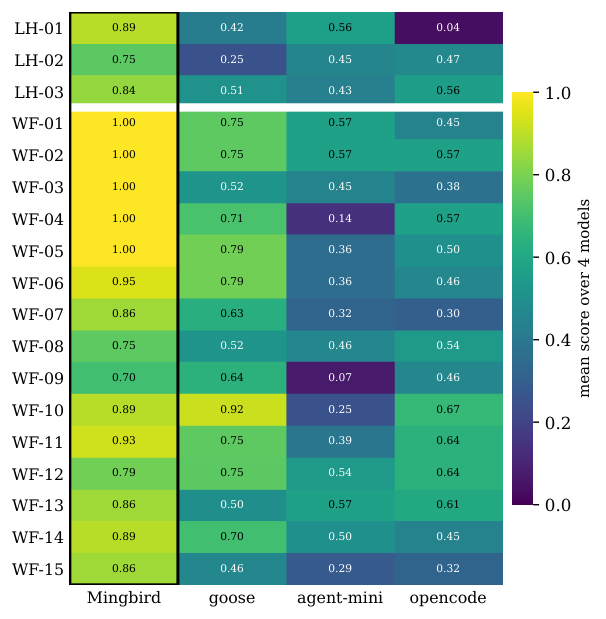
Wang and Huang argue that when small open-weight models (2–9B parameters) fail at agentic tasks, the harness is usually the culprit, not the model. They built Mingbird, a local-first agentic workflow harness for Windows + Ollama, with ten targeted fixes for known small-model failure modes: a byte-level “net-zero prefill budget” to prevent context window overflow, a “finish gate” that re-reads the task before accepting completion, and signature-level loop detection to stop runaway tool use cycles. On their own controlled benchmark (LRAB: 4 harnesses × 4 models × 18 real tasks), Mingbird scored 0.886 versus 0.631 for the next-best competitor (goose), 0.479 (opencode), and 0.405 (agent-mini) — a 40% relative improvement over second place. On the third-party τ²-bench (278 tasks), Mingbird hit 0.856 against 0.791 and 0.737. A frontier-model probe on the same 18 tasks showed that good scaffolding keeps frontier models within 0.072 of each other, while bad scaffolding collapses them to 0.478.
Cold read
The primary benchmark, LRAB, is self-built by the authors — an immediate credibility discount. Eighteen tasks on a single machine with single-trial scoring is a thin evidentiary base; the paper itself admits same-night replications of the same arm move the mean by up to 0.069, which is the same magnitude as every nominal single-mechanism delta, meaning the ablation results are essentially noise. The leave-one-mechanism-out analysis is flagged as “directional only,” which is academic for “don’t bet money on this.” The one batch-matched comparison (full stack vs. text re-read alone) gives a paired +0.10 across only three replications — a promising signal, but not a settled one. Third-party τ²-bench replication is real corroboration, but it covers only one protocol arm, and benchmark contamination risk from a self-selected evaluation setup is nonzero.
What it means for you
- Signal maturity: 2/5 — Single machine, self-built benchmark, single-trial scoring; promising direction, unproven at scale
- Who gets hurt: Cloud AI API resellers and “local AI” consultants whose pitch is complexity — if harness quality matters more than model size, the moat is thinner than sold
- What breaks if this is true: The case for paying frontier-model API costs for routine agentic tasks (file ops, form completion, structured workflows) weakens substantially; a 7B model on a developer’s laptop becomes a credible alternative
- Why it might not land: 18 tasks is not a product. Real enterprise agentic AI deployments involve dozens of tool integrations, adversarial inputs, and multi-session state — none of which are tested here
- Watch for: Independent replication on LRAB-style tasks by a lab with no authorship stake, or Mingbird adoption numbers on Ollama/GitHub within 90 days
Forecast as of 2026-10-02
By Q2 2027, at least one independent benchmark (not self-built) will replicate Mingbird-style harness improvements for small models at ≥0.15 absolute score gain over a naive harness — but the effect size will be smaller than 0.255 (the LRAB gap), landing in the 0.08–0.15 range once real-world task diversity is applied.
Source: Mingbird: A Local-First Agent Harness Enabling Small Open Models to Complete Real Tasks — Hao Wang, Ting Huang. https://arxiv.org/abs/2610.02001v1