Your Data Problem Just Got Nuked — Or Did It?
Your Data Problem Just Got Nuked — Or Did It?
The most painful, expensive part of building a fine-tuned AI product is gathering training data. A new system claims to conjure 20,000 high-quality, diverse samples from nothing but a text description — no seed data required. If it holds up, the moat you built by hoarding labeled examples just got a lot shallower.
What happened
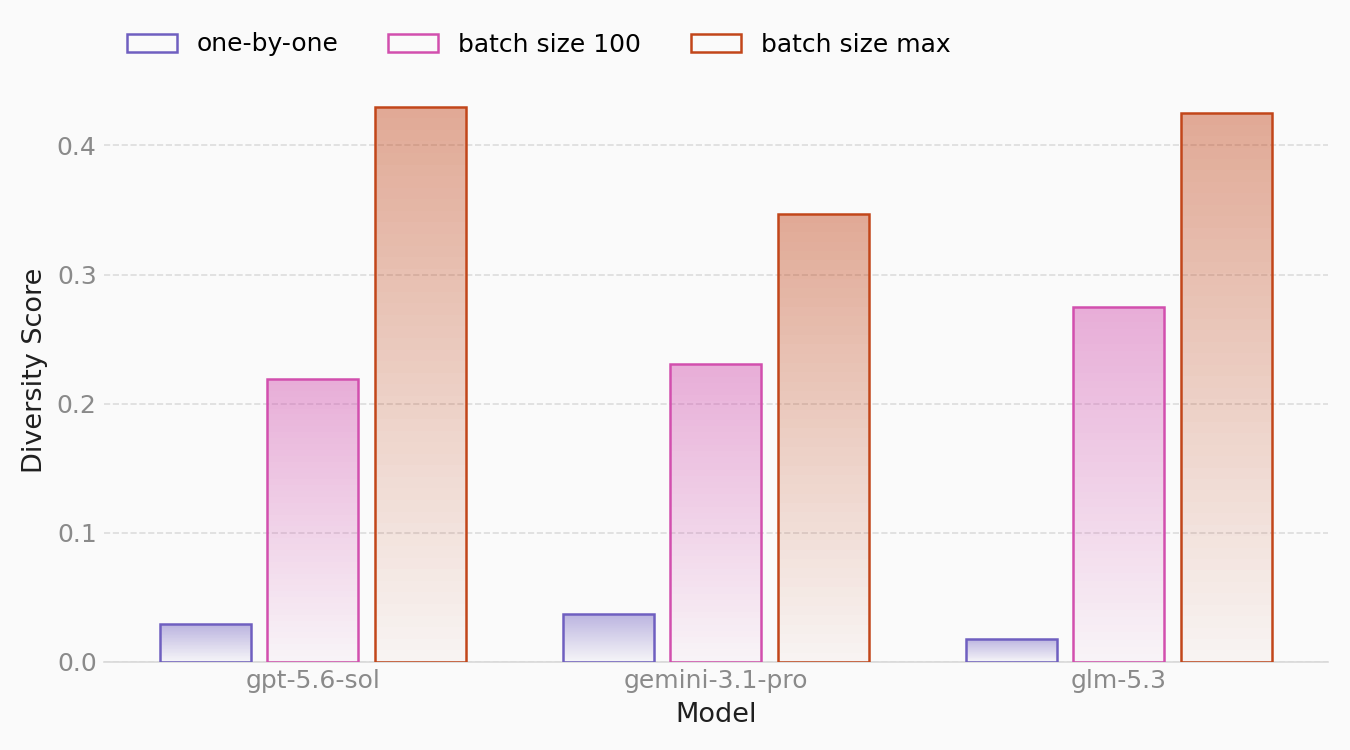
Researchers from Cohere (Sara Hooker’s lab) built Invent-A-Dataset, a prompt engineering-based pipeline that takes a plain-language dataset description and outputs large-scale post-training datasets with zero seed examples. They benchmarked it against five frontier model APIs — Anthropic, Google, OpenAI, DeepSeek, and Zai — across eight task types and dataset sizes up to 20,000 samples. Invent-A-Dataset beat all comers on both quality (+17% relative) and diversity (+19% relative). The diversity advantage is the more interesting finding: at 200 samples, it’s roughly at parity with frontier APIs; at 20,000 samples, the gap balloons to 37% relative gains. That diversity translates downstream — models fine-tuned on Invent-A-Dataset outputs consistently outranked models fine-tuned on data generated by competing approaches, across multiple post-trained model architectures. Think of this as a better golden dataset factory, except the gold is supposedly self-generated.
Cold read
The paper is a technical report, not a peer-reviewed study — the authors built the system and ran the evaluation, which is a conflict of interest the abstract does not address. “Quality” and “diversity” are measured metrics, but the abstract doesn’t specify who or what is doing the measuring; if it’s an LLM-as-judge setup, you’re evaluating synthetic data with synthetic judgment, which is a circular problem. The downstream training gains are real but architecture-specific — “consistently ranks higher across different post-trained model architectures” tells you nothing about magnitude or whether the gains survive real-world deployment on your actual task. The diversity advantage widening at scale is genuinely interesting, but 20K samples is modest; production fine-tuning pipelines often need far more, and we don’t know if the curve holds or inverts. Finally, eight task types chosen by the authors may not include the messy, domain-specific task you actually care about.
What it means for you
- Signal maturity: 2/5 — Self-reported technical report with no independent replication yet
- Who gets hurt: Data labeling shops, annotation marketplaces, and any startup whose differentiation is “we have proprietary training data for X niche”
- What breaks if this is true: The assumption that cold-start fine-tuning requires expensive human-labeled bootstrap data — which currently gates entry into many vertical AI plays
- Why it might not land: Synthetic diversity is not the same as real-world distribution coverage; models trained on cleverly varied synthetic data still hallucinate in ways that only real user data surfaces
- Watch for: An independent group replicating the 37% diversity gain at 20K scale on a task they chose, not the authors
Forecast as of 2026-10-03
By Q3 2027, at least two independent fine-tuning benchmarks will test zero-seed synthetic data generation head-to-head against human-labeled baselines; the synthetic approach will match human labels on structured tasks (classification, extraction) but trail by a measurable margin on open-ended generation tasks requiring real-world grounding — making the “data moat is dead” narrative premature but not entirely wrong.
Source: Invent a Dataset: Measuring dataset generation abilities with zero seed — Shivalika Singh, Andrija Djurisic, Gbemileke Onilude, Sudip Roy, Sara Hooker. https://arxiv.org/abs/2610.01674v1