DeepSeek Just Made Long-Context AI 8× Cheaper. Your Vendor Didn’t.
DeepSeek Just Made Long-Context AI 8× Cheaper. Your Vendor Didn’t.
A 552-billion-parameter model that cuts its own memory footprint to 890 bytes per token — roughly the size of a tweet — while claiming better performance than its predecessor. If the numbers hold, the economics of running million-token agentic workflows just shifted underneath every API-dependent startup.
What happened
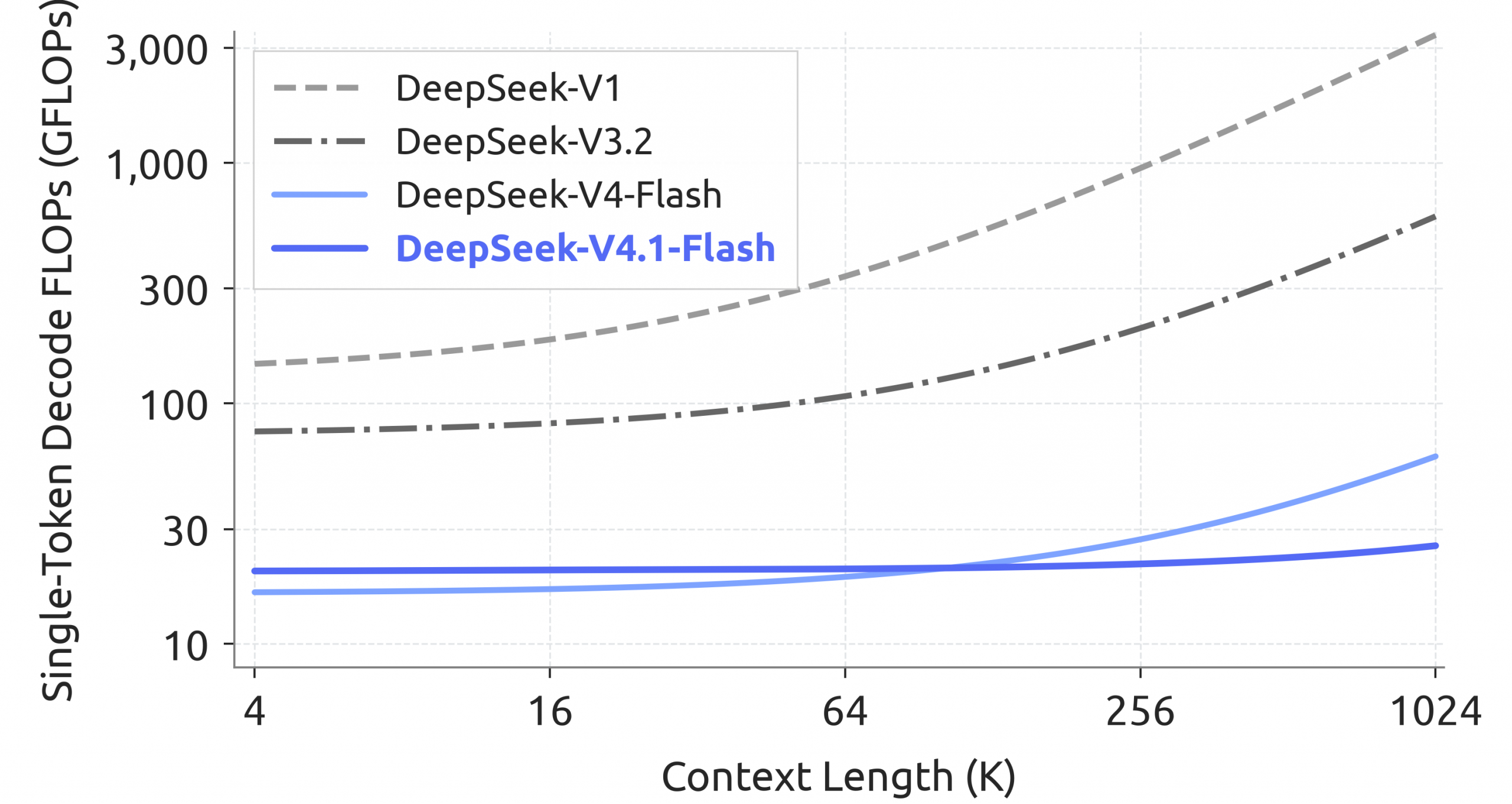
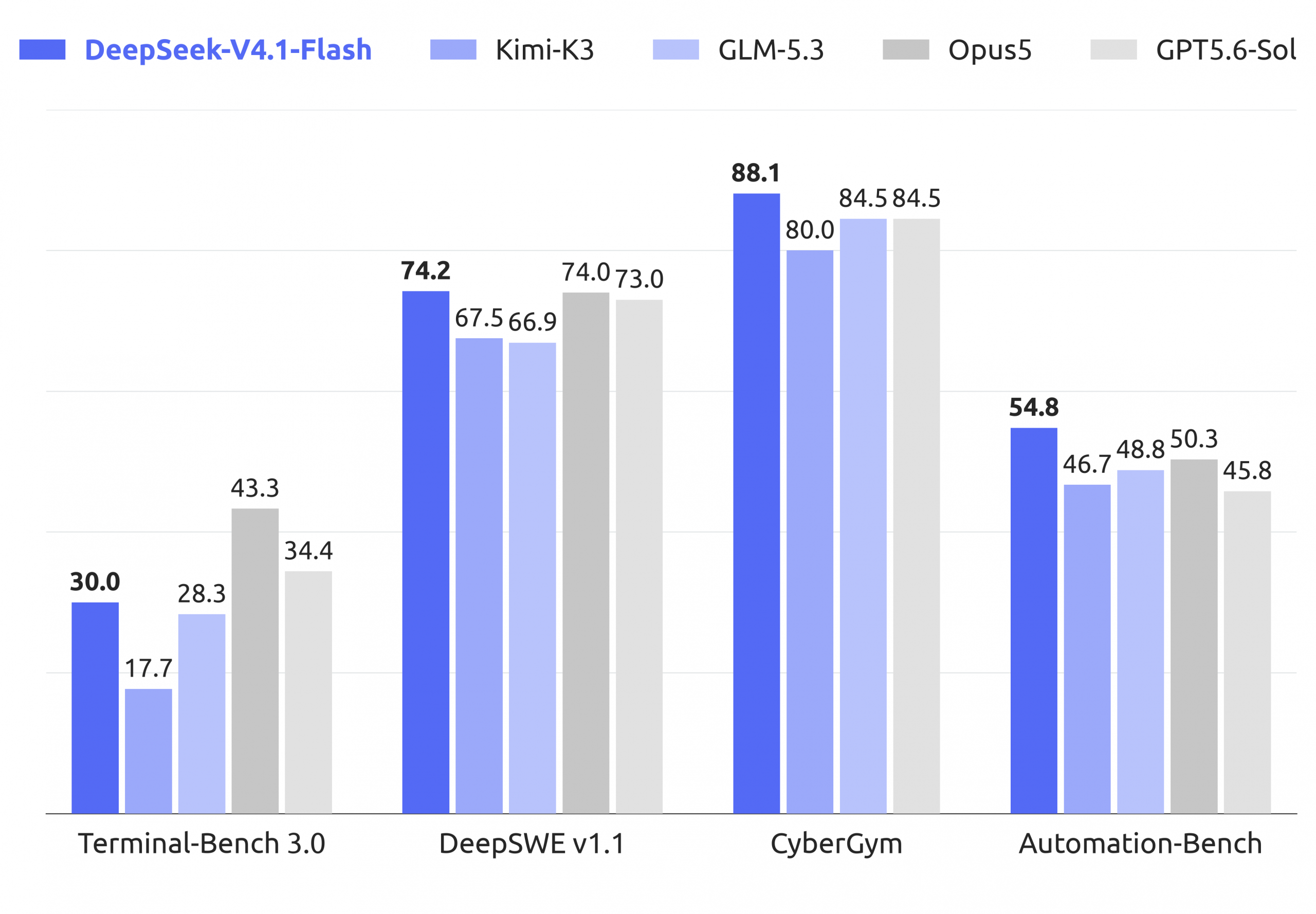
DeepSeek released DeepSeek-V4.1-Flash, a multimodal Mixture-of-Experts model with 552B backbone parameters and a 1-million-token context window. The headline engineering trick: a Causal Encoder-Decoder (CED) architecture that activates 16B parameters per token during decode but only 8B during prefill — the expensive phase where long inputs get processed. On top of that, two compression techniques stack: Compressed Sparse Attention 2 (CSA2), which reuses KV cache across layers, combined with FP4 KV caching. Together these shrink the “global” KV cache (what lives in fast HBM memory) to 890 bytes per token — approximately one-quarter of the footprint of DeepSeek-V4-Flash. A separate deployment trick called SWA Bounded Replay further cuts the “persistent” KV cache (spilling to SSD or host RAM) to roughly one-eighth of V4-Flash’s footprint. The model was pretrained on 45 trillion tokens across text and multimodal data, with post-training targeting agentic AI scenarios specifically. Checkpoints are public on Hugging Face.
Cold read
Every number here comes from DeepSeek’s own abstract — there is no independent third-party replication cited, and “substantially better performance than the baseline” is a phrase that should make any operator reach for the benchmark methodology section before celebrating. The baseline being beaten is DeepSeek-V4-Flash, a model DeepSeek also controls, which makes this a self-graded exam. FP4 quantization of the KV cache is a known lossy trade-off: precision degradation can be task-dependent and often surfaces worst on exactly the kind of multi-hop reasoning that agentic workflows require — the paper’s own target use case. The 1/8 persistent cache reduction via SWA Bounded Replay sounds dramatic, but sliding-window attention bounded replay has known recall limits: information outside the window boundary is discarded, not compressed, which matters enormously for tasks that require agent memory over very long horizons. Finally, a 552B MoE model, even with 8B active parameters at prefill, still demands serious cluster infrastructure; “Flash” in the name doesn’t make it runnable on a single H100.
What it means for you
- Signal maturity: 2.5/5 — Self-published, no independent eval, architecture claims unverified externally
- Who gets hurt: Startups building on OpenAI or Anthropic long-context APIs at premium pricing, and inference infrastructure vendors selling proprietary KV cache management as a moat
- What breaks if this is true: The cost argument for avoiding open-weights models collapses for input-heavy agentic workflow products — document processing, code agents, multi-turn research assistants
- Why it might not land: FP4 KV cache quality degradation on precision-sensitive tasks (legal, financial, medical) may disqualify it for exactly the verticals where long-context matters most; and self-hosting a 552B model remains a CapEx bet most Series A companies can’t make
- Watch for: Third-party evals on RULER, LongBench, or agentic task suites (e.g., SWE-bench long-context variants) that stress-test recall at 500K–1M tokens with the FP4 cache active — if those numbers hold, the story gets real fast
Forecast as of 2026-09-18
By Q2 2027, at least two inference API providers (likely Together AI, Fireworks, or a Chinese cloud) will offer DeepSeek-V4.1-Flash at a publicly advertised price below $0.10/1M input tokens, triggering a visible pricing response from at least one frontier closed-model provider on their long-context tiers — or the model will have been quietly superseded by V4.2 and this architecture will be a footnote.
Source: DeepSeek-V4.1-Flash: Pushing the Limits of KV Cache Compression — DeepSeek-AI, Anyi Xu, B. Li, Bangcai Lin, et al. https://arxiv.org/abs/2609.19969v1