Your AI Agent Is Already Compromised. Here’s the Firewall.
Your AI Agent Is Already Compromised. Here’s the Firewall.
Persistent AI agents don’t just answer questions — they remember, plan, and act. That means a single poisoned memory update or malicious tool argument can propagate silently through your entire system before a human ever notices. A new paper proposes intercepting the threat at the token level, before execution, with sub-second overhead.
What happened
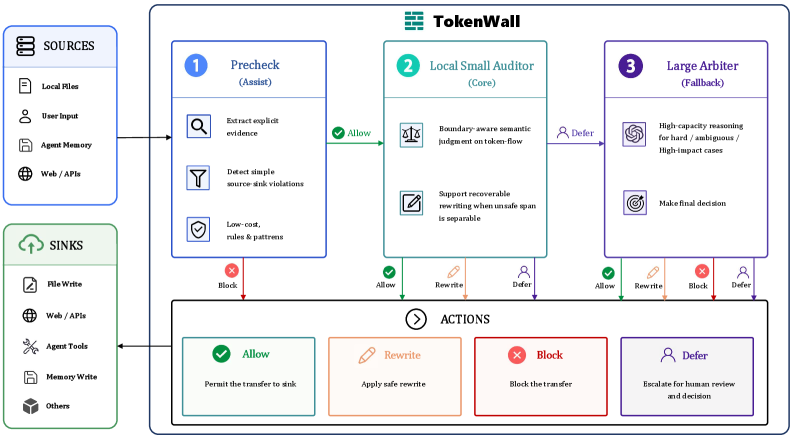
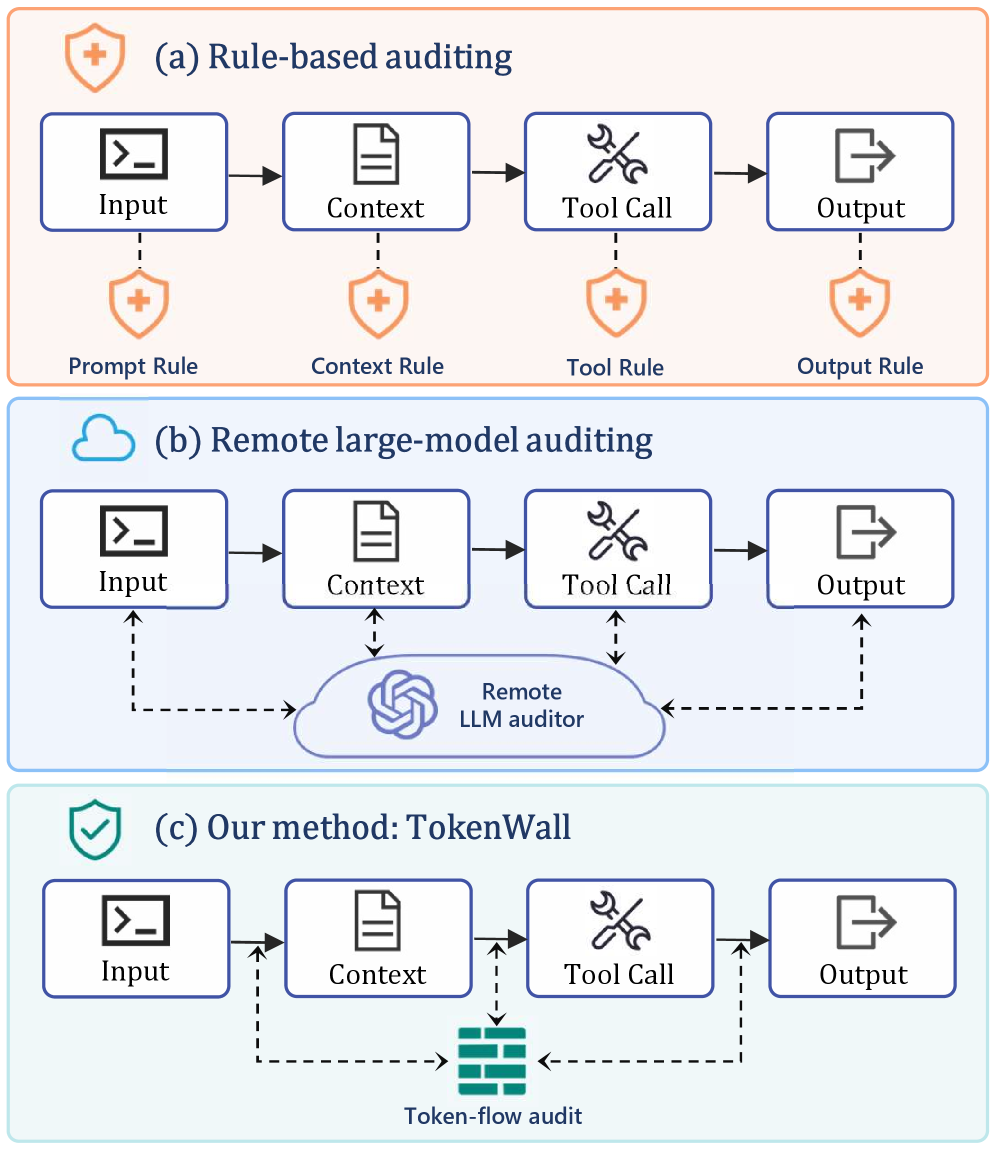
Researchers from the Chinese Academy of Sciences identified a structural security gap in agentic AI systems: unlike single-turn chatbots, persistent agents carry state across sessions through memory, reusable skills, and tool calls — each of which is a potential attack vector. Their core insight is that nearly all security-critical data in these systems travels as natural-language token flows (memory updates, tool arguments, retrieved files, inter-component messages), which means unsafe behavior can be caught before it reaches privileged runtime sinks. Their framework, TokenWall, acts as a semantic firewall: it constructs structured source-sink audit records, runs lightweight local inspection pre-execution, and escalates only ambiguous high-risk cases to a heavier arbitration module. Tested on CIK-Bench, TokenWall reduced attack success rate to 12.5%, maintained a 97.4% benign executable pass rate, and added only 0.69 seconds of latency on benign cases — all without requiring human confirmation in the loop. The approach directly targets prompt injection vectors that bypass traditional input filtering by hiding malicious intent inside agentic workflows.
Cold read
CIK-Bench is one benchmark, and benchmark performance on security research is notoriously gameable — attackers who know the defense exists will specifically craft payloads to stay under its detection threshold, and the paper gives no evidence of adversarial red-teaming against TokenWall itself. The 12.5% residual attack success rate sounds good until you’re the company whose agent executed that 1-in-8 malicious instruction autonomously at scale. The “lightweight local inspection” doing the heavy lifting is underspecified in the abstract: its false-negative behavior on novel attack patterns — the ones that actually hurt you in production — is unknown. The 97.4% benign pass rate also means roughly 1 in 38 legitimate operations gets blocked or escalated, which in a high-volume multi-agent orchestration pipeline is a friction cost that compounds fast. Finally, this is a framework paper, not a shipped product — the gap between “experiments on a benchmark” and “deployed in a hostile production environment” is where most security research quietly dies.
What it means for you
- Signal maturity: 2/5 — Academic benchmark result, no production validation, adversarial robustness untested
- Who gets hurt: Founders shipping autonomous agents with persistent memory (CRM bots, coding agents, ops automation) who assume their existing input filters cover agentic attack surfaces — they don’t
- What breaks if this is true: The “just add a system prompt guardrail” security posture for agent products becomes formally indefensible; runtime semantic auditing becomes a product requirement, not a nice-to-have
- Why it might not land: The escalation module for ambiguous cases almost certainly calls a large remote model — reintroducing the latency and cost problem the paper claims to solve; at scale, this math gets ugly fast
- Watch for: A major agent platform (LangChain, Vertex AI Agent Builder, AWS Bedrock Agents) shipping a native pre-execution semantic audit layer as a configurable middleware option — that’s the signal this approach crossed from research to infrastructure
Forecast as of 2026-07-10
By Q1 2027, at least one publicly disclosed production incident involving persistent-agent state poisoning (malicious memory update or tool-argument injection) will force a major agent-platform vendor to ship a runtime semantic filtering layer — but it will not resemble TokenWall’s architecture closely enough to validate this specific paper’s approach.
Source: Token-Flow Firewall: Semantic Runtime Auditing for Persistent AI Agents — Puji Wang, Yingchen Zhang, Ruqing Zhang, Jiafeng Guo, Xueqi Cheng. https://arxiv.org/abs/2607.08395v1