Your LLM Inference Bill Just Got a Target on Its Back
Your LLM Inference Bill Just Got a Target on Its Back
What if you could swap from a small model to a large one mid-conversation and never pay for the re-read? That’s the promise here. Researchers claim a cheap linear formula can recycle your cheap model’s internal state so the expensive model can skip the most wasteful step in the pipeline. Before you call your infrastructure team: read the cold part.
What happened
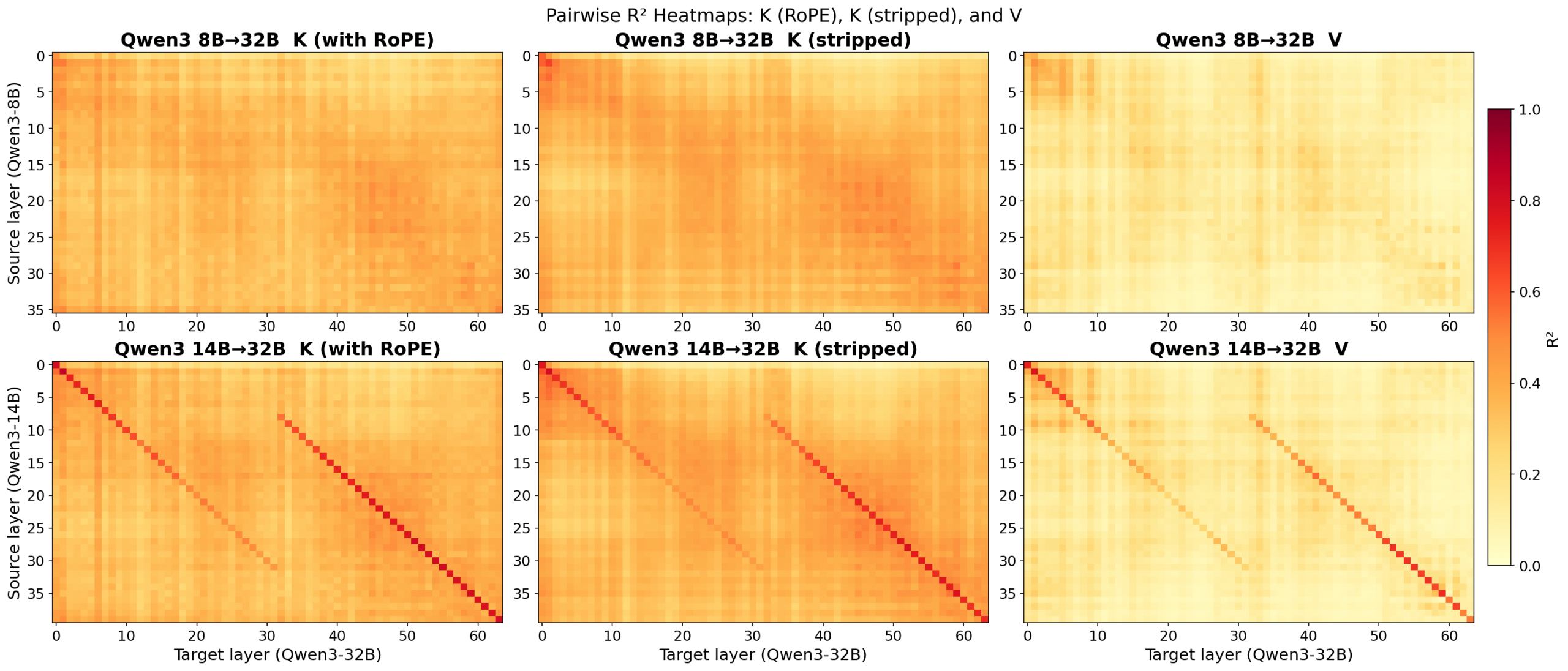
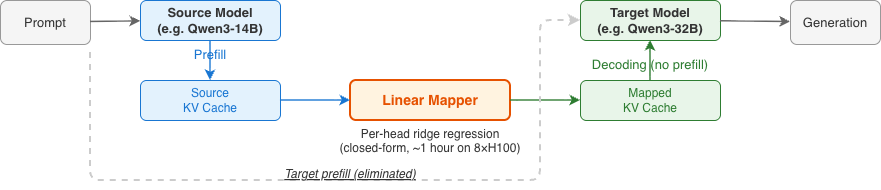
Teams running cost-quality cascades — a small model handles easy queries, a big one takes over when things get hard — currently force the receiving model to reprocess the entire conversation from scratch every time a handoff happens. This paper proposes skipping that prefill entirely by transferring the KV cache from the source model to the target via a learned linear mapping. The key empirical finding: within a model family, one source layer already explains 56% of the variance in the target model’s keys and 32% in values (Qwen3 14B→32B); using multiple source layers pushes that to 79% and 65%. The mapper is fitted with nothing but ridge regression on 500 sequences of 1,024 tokens — a genuinely small calibration set. Across six model-pair experiments in three families, the linear mapper preserved 73–98% of standalone-prefill accuracy on four of the six pairs, and ran 2.7–25× faster than re-prefill. The position encoding (RoPE) is stripped before mapping, making the mapper reusable across context lengths — a meaningful engineering win.
Cold read
The headline number — “73–98% accuracy retention” — is doing a lot of lifting, but it covers only four of six pairs; the other two “degrade sharply,” and the paper’s own fix (a nonlinear MLP) recovers up to +37 percentage points on HellaSwag for the failures, which means the linear story breaks down in ways the authors can’t yet predict in advance. You cannot tell from the abstract which model family pairs will fail — that’s the operationally critical question for anyone building on this. The calibration set is suspiciously tidy: 500 sequences × 1,024 tokens from a single dataset (FineWeb-Edu); real production traffic is messier, longer, and domain-shifted. Accuracy is measured on benchmark tasks like HellaSwag — these are not the same as business-level quality metrics (latency-adjusted task success, user ratings, factual accuracy on your domain). And the entire technique is gated on “matched KV head count and per-head dimension,” meaning it only works within a family where the architecture is deliberately aligned — it offers nothing across vendors or architectures.
What it means for you
- Signal maturity: 2/5 — paper-stage, works on 4 of 6 pairs, not yet in any production inference stack
- Who gets hurt: Inference optimization startups (and teams) selling re-prefill caching or speculative decoding as their moat — a cheap ridge regression mapper is a brutal commoditizing force if it generalizes
- What breaks if this is true: The “always re-prefill on model swap” assumption baked into every cascade routing system becomes dead cost; your per-token bill for multi-agent orchestration pipelines that juggle model sizes drops materially
- Why it might not land: Two of six pairs fail hard with the linear mapper, and there’s no disclosed rule for predicting failure before you deploy; the nonlinear MLP fallback reintroduces latency and complexity that erodes the headline speedup
- Watch for: Qwen, Llama, or Gemini family inference endpoints shipping a “cache forward” API flag — that’s when this moves from paper to pricing pressure
Forecast as of 2026-08-06
By Q2 2027, at least one major open-source inference framework (vLLM, SGLang, or TGI) will merge a cross-model KV transfer feature for same-family model pairs — but it will ship with an explicit “supported pairs only” caveat list, confirming that the two-of-six failure rate is a real production constraint, not a footnote.
Source: Cross-Model KV Cache Transfer in LLM Families: A Closed-Form Linear Mapping for Prefill Reuse — Taekyung Heo, Rasoul Shafipour, Ritchie Zhao, Maximilian Golub, Mohammad Mahdi Kamani, Ritika Borkar, Makesh Tarun Chandran, Pantea Zardoshti, Bita Darvish Rouhani. https://arxiv.org/abs/2608.03893v1