Structured Formatting Is the New Backlink — And It’s Already Eating Your Citations
Structured Formatting Is the New Backlink — And It’s Already Eating Your Citations
AI answer engines are quietly redistribution machines, and the game is already being played without you. One causal audit found that how your content looks — not just what it says — determines whether an agentic search engine credits you at all. If your competitors figure this out before you do, your brand disappears from the answer layer.
What happened
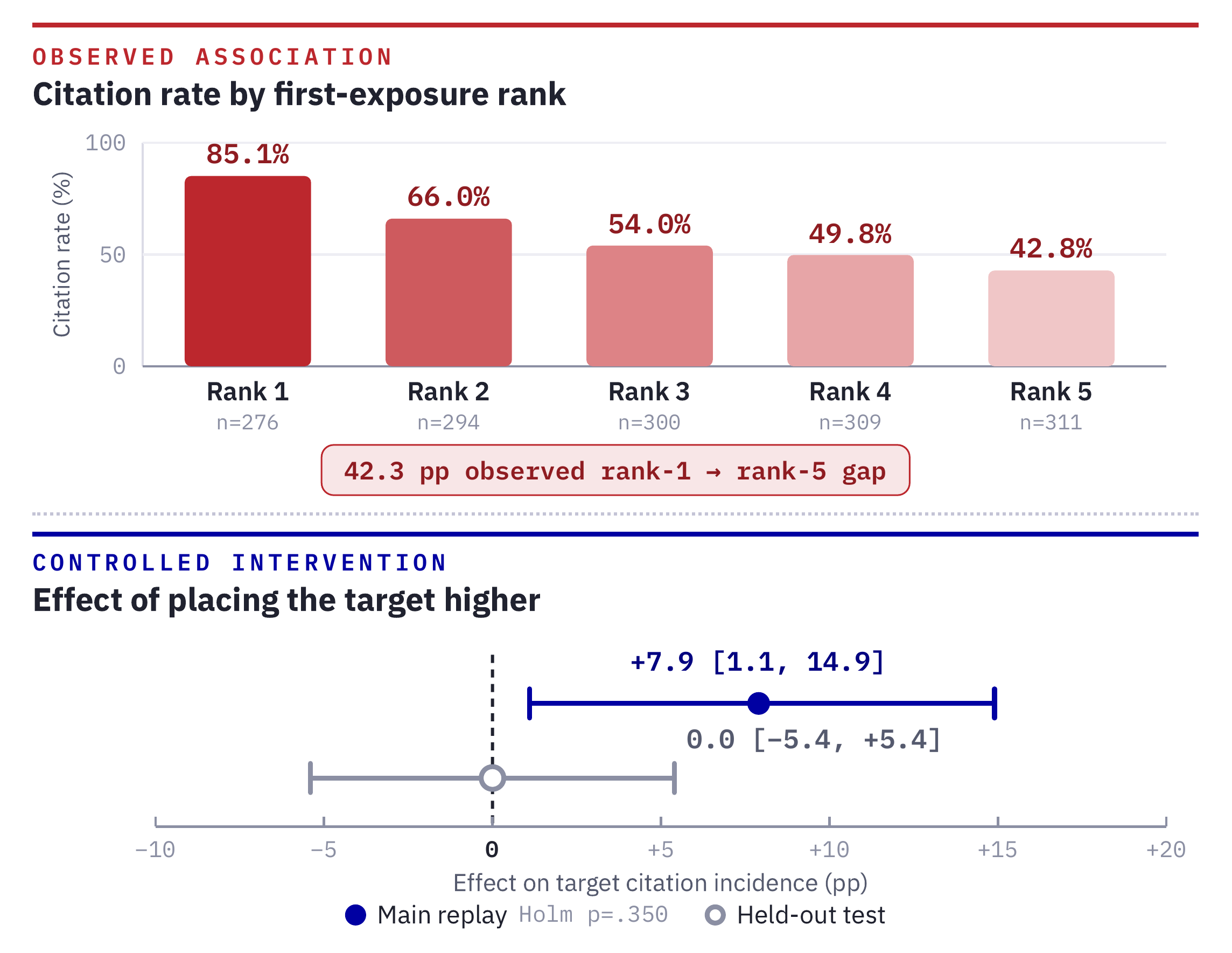
Selvam and Ghosh built CITECHOICE, a controlled causal audit of how agentic search allocates citations when multiple sources equally support the same fact. They pulled 129 real multi-turn query transcripts, identified 113 document pairs where both sources independently verified the same pre-specified claim — blinded human reviewers confirmed 103 of those pairs — then ran a hash-verified 2×2 replay experiment crossing document order against structured versus prose rendering. The headline result: structured formatting increased citation count for the target document by +0.50 citations per answer (95% CI [+0.20, +0.84]; Holm-adjusted p=.033), but this was concentration, not expansion — total citations didn’t rise and competitor credit didn’t fall. Meanwhile, the effect on whether the target got cited at all was +4.5 percentage points and statistically inconclusive (95% CI [-1.4, +10.4]; p=.168). Separately, the observational rank gap between position 1 and position 5 was a massive 42.3 percentage points in citation rate — but controlled reordering produced only +7.9 percentage points, suggesting most of that rank advantage is not causally from rank itself. And in a further sobering finding, 15% of binary citation decisions flipped under fresh decoding, with decoding noise accounting for an estimated 45% of single-generation family-effect variance — meaning source attribution in these systems has a meaningful stochastic floor you cannot engineer around.
Cold read
The study is genuinely careful, and that carefulness is precisely what deflates the hype. The central finding — that structured formatting concentrates credit rather than wins new citations — is a much weaker result than the GEO and AI SEO industry will make it sound. The “get cited at all” incidence effect is statistically inconclusive at p=.168; you cannot build a formatting strategy on that. The experiment is also frozen-transcript, meaning it tests whether reformatting wins within a fixed retrieval context — it says nothing about whether you get retrieved in the first place, which is the earlier and arguably larger gate. 113 valid pairs from 129 transcripts is a small-n study, and the effect was measured on one unnamed agentic search system; generalization across Perplexity, ChatGPT search, Gemini, and whatever ships next quarter is entirely unestablished. The 45% decoding-noise variance figure should also alarm anyone building a measurement program: you may be optimizing against a signal that’s half random on any given generation.
What it means for you
- Signal maturity: 2/5 — Causally rigorous on a narrow effect; too small and too system-specific to operationalize confidently
- Who gets hurt: Content and SEO teams at B2B SaaS, media, and e-commerce companies who are being sold “AI visibility optimization” services on the back of observational rank correlations
- What breaks if this is true: The assumption that ranking higher in retrieval is the primary lever for AI visibility — presentation format is a second, independent axis that most content workflows ignore entirely
- Why it might not land: The inconclusive incidence effect means structured formatting may only help you get more citations when you’re already cited — useless if you’re not in the retrieved set to begin with
- Watch for: A replication on multiple live systems (Perplexity, Gemini, ChatGPT) with a larger pair set; if the +0.50 citation-count effect and the inconclusive incidence effect both hold across engines, the signal becomes actionable
Forecast as of 2026-09-15
By Q3 2027, at least two of the major [GEO](https://llmref.wiki/wiki/GEO_(Generative_Engine_Optimization)/LLMO tooling vendors will ship “structured rendering” as a paid feature explicitly citing concentration effects — but no peer-reviewed multi-system replication will yet exist to validate the incidence claim, leaving the core “does it get you cited at all” question unanswered in production environments.
Source: CITECHOICE: A Causal Audit of How Document Presentation Redistributes Citation Credit in Agentic Search — Sriram Selvam, Anneswa Ghosh. https://arxiv.org/abs/2609.15164v1