Your LLM Benchmark Scores Are Lying to You Right Now
Your LLM Benchmark Scores Are Lying to You Right Now
Every vendor benchmarking slide you’ve seen this year has a structural flaw baked into it. The standard contamination check—”did the model see this data before its cutoff?”—is mathematically incapable of telling you what you think it tells you. Four flagship models failed the check on questions they provably couldn’t have memorized.
What happened
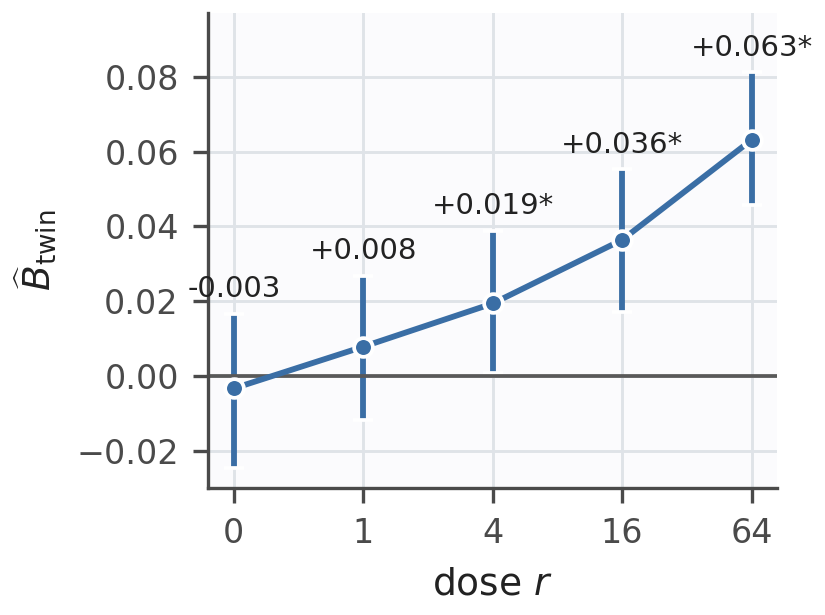
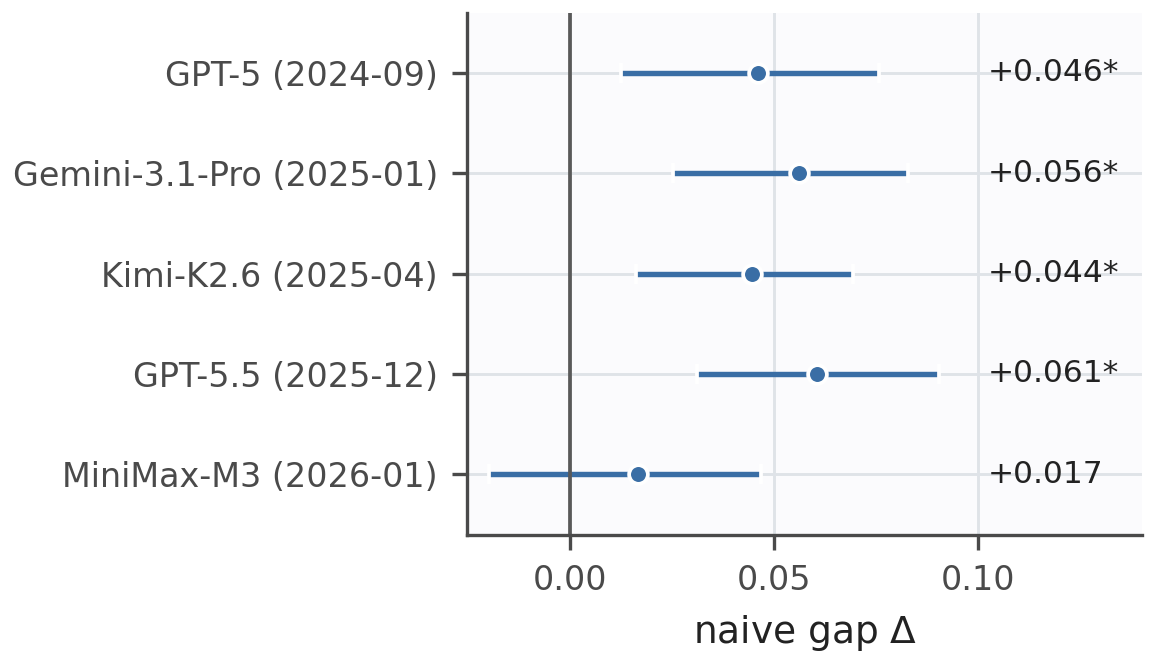
Zhang and Stadie ran the standard pre/post-cutoff contamination check on four major frontier models and found it collapses under scrutiny: every scored question had resolved after the models’ training cutoffs, yet the check still flagged them. The culprit is structural—models legitimately know more about periods close to their training boundary (denser data coverage, more repetition), so recency mimics benchmark contamination and the passive backtest cannot tell them apart. They prove formally that no passive backtest can separate recency from genuine skill without external information. Their solution: two estimators—one using a known cutoff to localize leakage at the boundary, another using a matched clean control sample to measure it globally and produce a leakage-adjusted score. The injected-leakage validation recovered the planted dose accurately and returned null on clean questions. When deployed on frontier models, they detected one cutoff-localized leakage signature and, at the audit’s statistical power floor, cleared five models whose apparent performance edge was recency alone—not skill.
Cold read
The paper proves the detection problem is hard; it doesn’t prove any specific vendor is cheating. “Cleared” means the method lacked power to detect leakage, not that leakage is absent—the authors say so explicitly (“at the audit’s power floor”). The matched clean control approach requires building or sourcing that control, which in practice is nontrivial and opens its own selection-bias questions. The finding that leakage concentrates on “surprising outcomes well covered in training” is theoretically elegant but operationally vague—it’s unclear how actionable that is when you’re buying API access, not auditing training pipelines. This work is also a methodology paper, not an exposé: no model is named as a bad actor, and no golden dataset is provided for you to run yourself today.
What it means for you
- Signal maturity: 3/5 — Rigorous methodology, but tooling for operators doesn’t exist yet
- Who gets hurt: AI product teams and enterprise buyers who used benchmark performance as a procurement signal or pricing justification for verticalized LLMs
- What breaks if this is true: Any ROI case built on “Model X outperforms Model Y on our domain benchmark by N%” needs to be rebuilt with leakage-adjusted scores—which right now nobody is publishing
- Why it might not land: Building the matched clean control requires future-resolved questions, which means a time lag before you can audit anything; most founders won’t wait
- Watch for: Model providers voluntarily publishing leakage-adjusted scores, or a third-party audit firm (think: the METR model evals crowd) adopting this methodology by name before Q2 2027
Forecast as of 2026-08-06
By Q2 2027, at least one major third-party LLM evaluation organization will publish benchmark results that explicitly include a leakage-adjusted score using a methodology substantively derived from this paper—or the benchmark contamination conversation will have moved to requiring held-out live-question audits as standard, making this framework the baseline or a footnote.
Source: Temporal Leakage in LLM Backtesting: Measurement, Validation, and Adjusted Scores — Zeyu Zhang, Bradly C. Stadie. https://arxiv.org/abs/2608.02985v1