Your Agentic AI Stack Is Hemorrhaging GPU Dollars Into Idle CPUs
Your Agentic AI Stack Is Hemorrhaging GPU Dollars Into Idle CPUs
You bought the GPUs. Your agents are using maybe half of them. The rest of the time, your expensive silicon sits stranded while a CPU bottleneck queues requests nobody told you about. Microsoft’s own infrastructure team just put numbers to what your cloud bill has been quietly screaming.
What happened
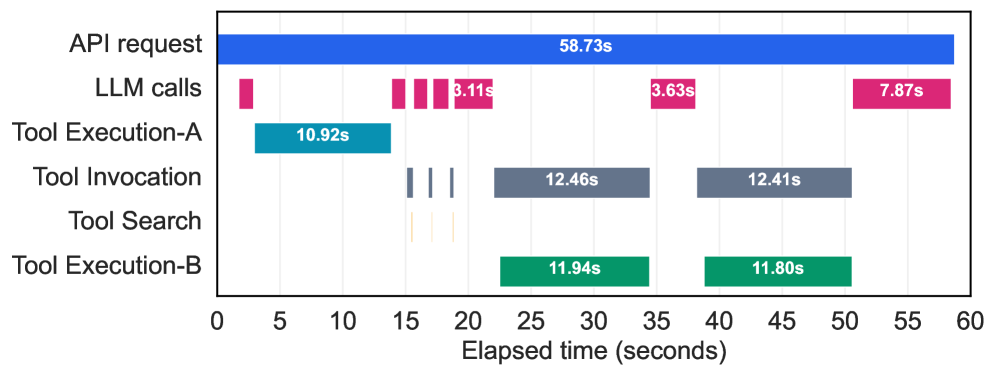
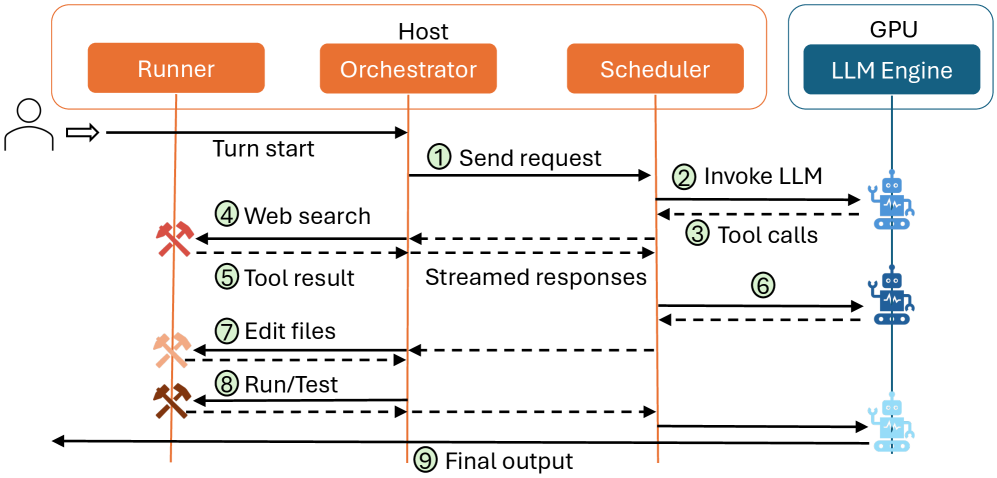
Researchers from Microsoft Azure and collaborators ran a first-of-its-kind architectural characterization of agentic workflows in production — both on live Azure infrastructure and across open-source frameworks in controlled settings. The core finding: every agentic request explodes into a fragmented pipeline of LLM inferences, tool calls, and orchestration decisions that repeatedly cross the CPU-GPU boundary. Because multi-agent orchestration logic and tool use run on the host CPU — not the GPU — the CPU sits on the critical path, and conventional uniform servers are architecturally wrong for this workload. Load stays chronically low but spikes suddenly; GPU utilization is uneven and depends on model composition; multiplexing many agents onto shared CPU cores destroys microarchitectural locality. Their prototype, Agora, addresses this by dynamically harvesting idle CPU cores, oversubscribing GPU memory across agents with prefetching to hide swap latency, and applying affinity-aware scheduling by role — all auto-tuned to workload. The result, per the paper, is improved utilization and throughput while preserving tail latency.
Cold read
This is systems research, not a product benchmark — Agora is a prototype on commodity servers, and the gap between “prototype shows improvement” and “this ships into production infrastructure” is enormous. The paper gives no specific percentage numbers in the abstract (no “X% throughput gain” to anchor on), so the magnitude of Agora’s wins is unverifiable from what’s disclosed. The production study is at Microsoft Azure, which means the workload distribution may not generalize to your startup’s agentic workflow mix, especially if your tool diversity or agent count is orders of magnitude smaller than hyperscaler scale. The architectural mismatches identified are real and well-reasoned, but the paper’s own framing — “implications for future server architectures” — signals this is a roadmap, not a solved problem. Small teams running agents on rented cloud VMs have essentially zero leverage over server architecture; this research matters to cloud providers, not to the founders reading this.
What it means for you
- Signal maturity: 2/5 — solid diagnosis, prototype-stage treatment, no shipping product
- Who gets hurt: AI infrastructure startups selling “optimized agentic compute” on top of uniform GPU clusters — their architecture is precisely what this paper indicts
- What breaks if this is true: The unit economics of GPU-as-a-service for agentic workloads are worse than anyone’s spreadsheet currently shows; GPU utilization rates used to justify pricing are inflated by idle stranded capacity
- Why it might not land: Most agentic deployments today are small enough that architectural inefficiency is masked by low traffic volume — pain only surfaces at scale, and most founders aren’t there yet
- Watch for: AWS, Azure, or GCP announcing agentic-specific compute SKUs or scheduler updates that separate CPU orchestration capacity from GPU inference capacity — that’s the market signal that this research is being operationalized
Forecast as of 2026-08-06
By Q2 2027, at least one major cloud provider will announce a differentiated compute offering (new instance type, scheduler feature, or pricing tier) explicitly targeting agentic AI workload fragmentation — citing CPU-GPU boundary inefficiency as the motivation. If none do, this paper was right about the problem and wrong about the urgency.
Source: Architectural Implications of Agentic AI Workflows — Jirong Yang, Peizhe Liu, Chaojie Zhang, Jovan Stojkovic. https://arxiv.org/abs/2608.04458v1