Your Self-Improving AI Agent Is Probably Just Getting Lucky
Your Self-Improving AI Agent Is Probably Just Getting Lucky
Every AI lab is racing to build agents that evolve themselves — rewriting their own prompts, memories, and skills to get smarter over time. This paper says the whole enterprise may be a slot machine dressed up as a laboratory. The agents aren’t failing to improve; we’re just failing to notice when they do.
What happened
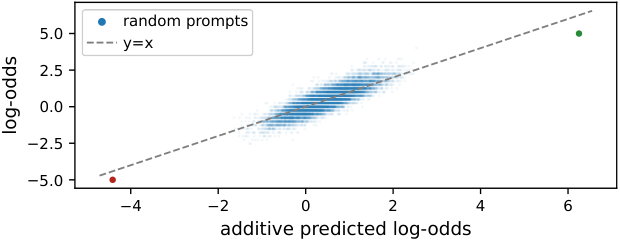
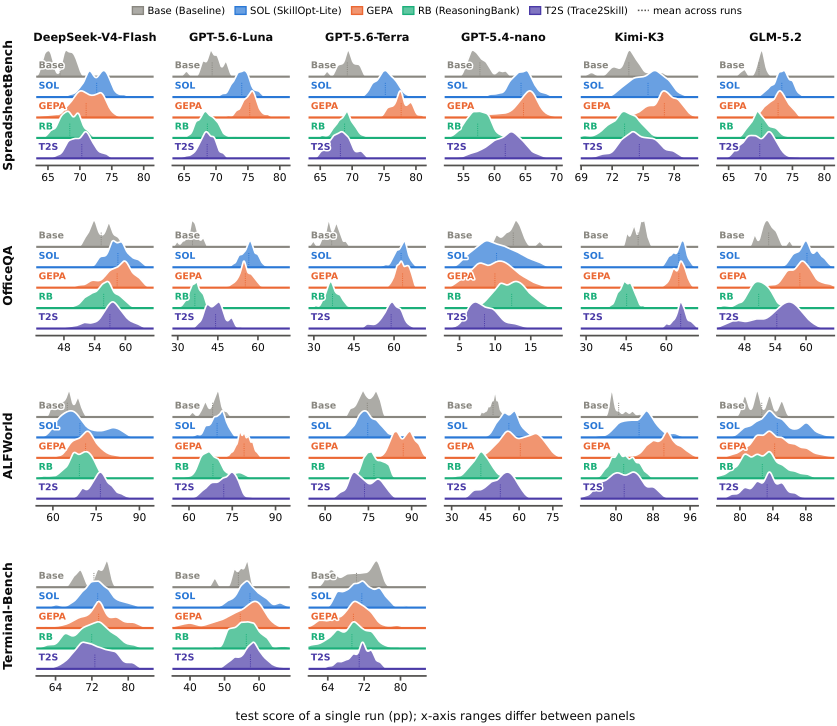
Researchers from multiple institutions ran a systematic audit of agentic workflow self-improvement: the standard loop where a proposer generates candidate artifacts — system prompts, skills, memories — and a selector keeps whichever ones score higher. They tested seven evolution methods across six models, burning through over 10 million LLM calls. Their central finding, which they call the Resolution Hypothesis, is that evolution stalls not because better artifacts aren’t being generated, but because the evaluation layer is too noisy to reliably identify them. The problem operates at two levels. At the candidate level, better artifacts do exist, but selection performs no better than random at distinguishing helpful from harmful ones — meaning errors compound across evolution rounds rather than canceling out. At the method level, the performance margins between competing approaches in published papers (typically a few percentage points) are smaller than the variance between two independent runs of the same method — which means published leaderboard rankings are substantially luck-driven. The core indictment: the field has been optimizing the proposal engine while the bottleneck is the LLM-as-judge evaluation signal.
Cold read
This paper diagnoses a real and underappreciated problem, but the Resolution Hypothesis is a reframing, not a solution — the authors’ own prescription (“make improvements detectable”) is a research agenda, not a deliverable. The 10M-call experiment is impressively scaled, but it was run on the authors’ chosen task set; we don’t know which tasks, how representative they are, or whether the noise profile generalizes to your specific agentic AI use case. “Selection is no better than random” is a strong claim that could be an artifact of benchmark contamination or evaluation design choices the paper may not fully control for. The finding that method rankings rest on luck is striking but also partially self-serving — it makes it harder for anyone to falsify any single approach, including the authors’. Finally, the paper doesn’t quantify how much better evaluation would need to be to unlock accumulation; without that threshold, the actionable takeaway remains abstract.
What it means for you
- Signal maturity: 2/5 — identifies a real bottleneck but offers no validated fix
- Who gets hurt: Startups that have shipped “self-optimizing prompt” features as a product differentiator — their moat may be noise, not compounding improvement
- What breaks if this is true: Any pricing model or customer promise built on agents that “get smarter with use” — if selection is random, the learning curve is flat or regressive
- Why it might not land: Practitioners with narrow, high-volume, deterministic evaluation tasks (e.g., code execution pass/fail) may have sufficient signal resolution already; the hypothesis may be domain-specific
- Watch for: A competitor publishing reproducible, task-specific evaluation protocols that demonstrably beat random selection — that’s the paper that actually moves the needle
Forecast as of 2026-11-18
By Q3 2027, at least two of the major agent frameworks (LangGraph, AutoGen, or equivalent successors) will have shipped explicit “evaluation confidence” or “signal-to-noise” diagnostics in their evolution/optimization loops, directly citing the Resolution Hypothesis — but fewer than half of agent startups will have meaningfully changed their self-improvement architecture in response.
Source: The Resolution Hypothesis: Agent Evolution’s Key Is Identifying Improvements — Yuanhao Zeng, Shaocheng Lan, Ao Lu, Kuang Yan, Heng Lin, Xinang Xu, Yuan Luo, Yueting Wang, Yexin Li, Ruo Shan, Kan Ren. https://arxiv.org/abs/2611.23068v1