Your Vision AI Is Blind to Half the Image and Lying About the Rest
Your Vision AI Is Blind to Half the Image and Lying About the Rest
A drone photo of your construction site. A satellite crop of your competitor’s parking lot. A 48-megapixel product scan. You’re paying for vision AI — and it’s silently mangling the most important details before the model even blinks. The researchers ran the eye exam. The results are embarrassing.
What happened
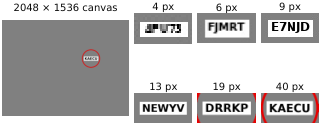
Vohra and Xu ran a systematic stress test of seven vision-language models across four vendors, measuring exactly how small an object can be before the model stops seeing it reliably. The setup: a printed-code “eye exam” plus 601 real-photo questions about small objects. The finding is blunt — a car that’s 20 pixels wide in an 8000×6000 drone photo arrives at Claude as roughly 6 pixels wide; OpenAI’s default pipeline rejects the photo outright. The 50%-accuracy threshold for reading text sits at 6 pixels or fewer on a small image, rising to a predicted 10–13 pixels on an 8K photo under default settings. Tiling — splitting the image into up to nine patches — recovers most of the loss: accuracy jumps 11.1–14.5 percentage points on Claude and Gemini, and lifts GPT-6.1 Sol from 50.7% to 83.7% by simply avoiding the rejection. A smarter two-step approach — model first names the region it needs, then zooms — matches or beats tiling on Gemini and comes within 2.5 points on Claude, using only ~40% of the image tokens. The hallucination profiles diverge sharply: when detail is lost, Gemini issues a confident wrong answer 43–48% of the time; Claude does so only 5–9% of the time, preferring “I can’t tell” — a gap that matters enormously in any agentic workflow where downstream steps trust the output.
Cold read
This paper benchmarks default API settings — the numbers will shift the moment vendors quietly update their preprocessing pipelines, which they do without announcements. The 601-question dataset is real but small; performance on highly domain-specific small-object tasks (medical imaging, PCB inspection, satellite change detection) is not covered and may differ significantly from these results. The “two-step zoom” that saves 60% of tokens sounds like a free lunch — but the model’s region-naming accuracy is itself a function of image quality, so the two steps compound errors rather than isolate them. The five operational rules the authors derive are heuristics, not proofs; “tile only after an unsure reply” comes within 1.4 points of always tiling, which sounds tight, but in production that gap can compound across millions of calls. Finally, the paper does not test fine-tuned or domain-adapted vision models, so the numbers are ceiling estimates for commodity APIs, not the category.
What it means for you
- Signal maturity: 4/5 — concrete numbers, reproducible benchmark, code and data released
- Who gets hurt: Any company running automated visual inspection, document processing, or geospatial analysis on large images through default API calls — you are losing accuracy you are paying for and may not be measuring
- What breaks if this is true: Quality-of-service SLAs for vision pipelines are meaningless if vendors can silently change preprocessing; Gemini’s high confident-wrong rate makes it a liability in any pipeline where a downstream agent treats its output as ground truth
- Why it might not land: Vendors are actively updating multimodal pipelines; GPT-6.1’s tiling-after-rejection gain of 33 points implies the problem is already partly self-healing when you call the API correctly, reducing urgency for most use cases
- Watch for: Whether Anthropic and Google publish updated model cards specifying image downscaling behavior and minimum resolvable object size — that’s the signal that this research hit someone’s roadmap
Forecast as of 2026-11-18
By Q3 2027, at least two of the four major vision API vendors will document minimum-resolvable-object-size guarantees in their official specs, prompted by enterprise computer-vision buyers citing exactly this class of benchmark; if that documentation does not appear, it will be because the vendors absorbed the fix silently into preprocessing without disclosure.
Source: Know When to Zoom: How Small Is Too Small for Vision-Language Models? — Siddharth Vohra, Min Xu. https://arxiv.org/abs/2611.22709v1