Your Multi-Agent Memory Is Leaking, Lying, and Forgetting — Right Now
Your Multi-Agent Memory Is Leaking, Lying, and Forgetting — Right Now
You’ve wired up a fleet of AI agents and called it an architecture. But the paper quietly dropped this week describes four ways that shared memory kills you in production — and one of them was a live security bug the researchers found in their own system while writing it up. This is not a theoretical threat model. This is a postmortem with math.
What happened
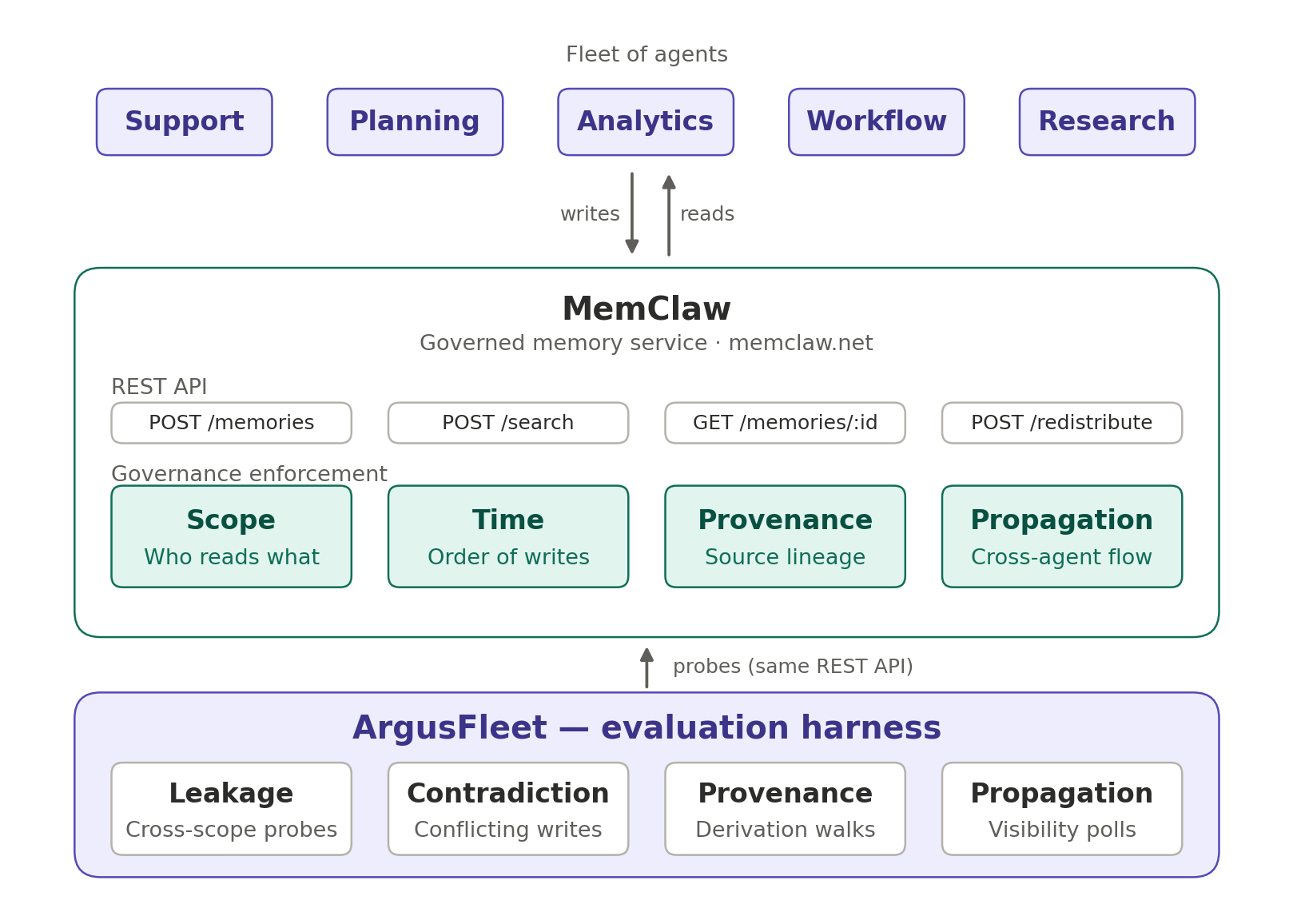
Researchers at IBM formalized what they call the fleet-memory problem: when multiple LLM agents share a knowledge store, you get four distinct failure modes — unauthorized leakage, stale propagation, contradiction persistence, and provenance collapse. They built MemClaw, a production multi-tenant memory service, and a reproducible test harness called ArgusFleet, then measured the live system rather than a synthetic baseline. The headline numbers are real but narrow: provenance chains of depth four were reconstructed with 100% accuracy at sub-second per-hop latency, and intra-fleet writes achieved zero cross-fleet leakage. Under “strong write mode,” write-to-visible latency collapsed to a single search round-trip. But the paper’s most honest contribution is its negative results: agent memory vs context window distinctions matter enormously at scale, and multi-agent orchestration without explicit memory governance produced two architectural bugs in a real system — a scope-bypass on direct GET-by-id requests (disclosed and patched during the study) and a pipeline ordering conflict where a synchronous near-duplicate gate prematurely rejected writes before the asynchronous contradiction detector could evaluate them. Long-context retrieval-augmented generation alone, the authors conclude, is not sufficient — you need systems-level primitives: scoped retrieval, temporal supersession, provenance tracking, and policy-governed propagation.
Cold read
This is a single-system study with no baseline comparison — the authors explicitly say so. You cannot conclude that MemClaw’s design is better than alternatives; you can only conclude that it passed specific self-designed tests and exposed two bugs in itself. The “100% provenance reconstruction” result is at depth four only — real enterprise agent graphs routinely run deeper, and the paper says nothing about degradation beyond that bound. The zero cross-fleet leakage finding is impressive but measured in a controlled harness; it does not cover adversarial prompt injection or tenant enumeration attacks. ArgusFleet is reproducible in principle, but no independent team has yet run it on a competing system, so the governance dimensions being tested are still the authors’ own definitions of correctness. The pipeline ordering bug — a synchronous gate eating writes before the async detector fires — is the kind of race condition that only appears under load, and the paper does not report at what throughput it manifests.
What it means for you
- Signal maturity: 3/5 — Production evidence with real bugs, but single-vendor, no comparative data
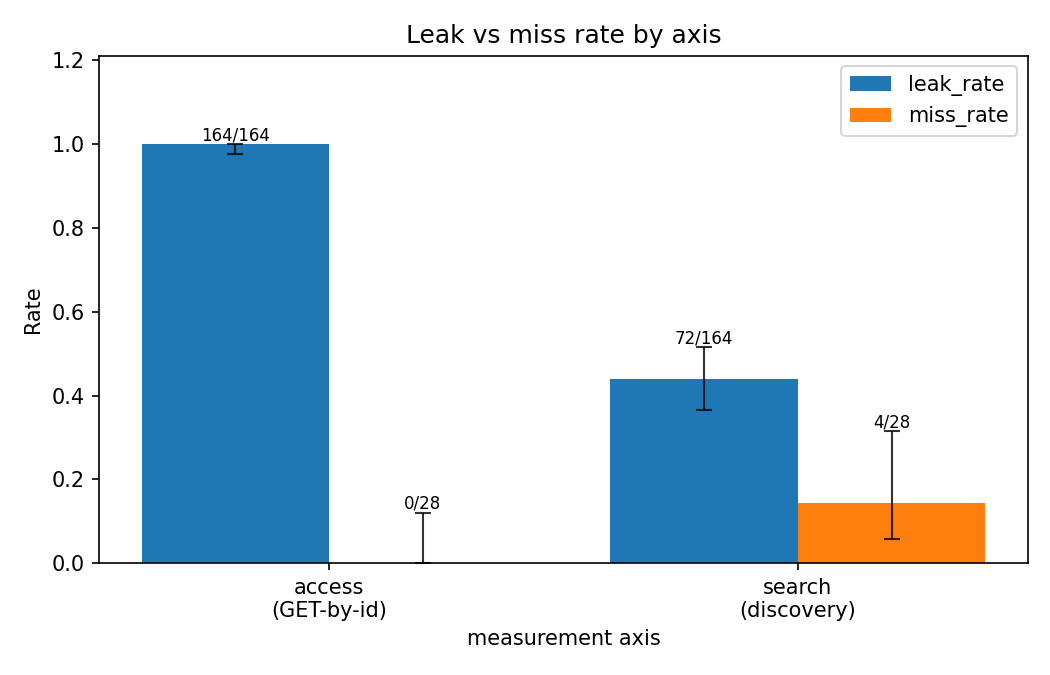
- Who gets hurt: Founders shipping agentic workflows in multi-tenant SaaS — your scope enforcement is probably weaker than you think, and the attack surface is the direct-by-id retrieval path, not just semantic search
- What breaks if this is true: Any shared-memory layer bolted onto an agent fleet without explicit provenance tracking will produce factual consistency failures that are invisible until a tenant notices stale or contradicted data and files a support ticket — or a lawyer
- Why it might not land: Most early-stage agent stacks don’t have enough concurrent agents or write volume to hit these failure modes yet; the fleet-memory problem bites at scale, not at demo
- Watch for: A second team publishing ArgusFleet results against a different memory backend — that’s the moment this moves from one vendor’s architecture post to an industry benchmark
Forecast as of 2026-06-24
By Q2 2027, at least one publicly disclosed data-isolation incident in a commercial multi-agent SaaS product will be traced to a GET-by-id scope bypass or equivalent direct-retrieval gap — and ArgusFleet or a derivative will be cited in the post-mortem or the subsequent vendor remediation documentation.
Source: Governed Shared Memory for Multi-Agent LLM Systems — Yanki Margalit, Nurit Cohen-Inger, Erni Avram, Ran Taig, Oded Margalit. https://arxiv.org/abs/2606.24535v1