Your AI Hacking Agent Can Be Hacked—And It Has Your Keys
Your AI Hacking Agent Can Be Hacked—And It Has Your Keys
You bought an agentic offensive-security tool to find vulnerabilities faster. Congratulations: you’ve also handed an adversary a persistent foothold on your machine, your API keys, and a sandbox-escape route. The weapon has a back door.
What happened
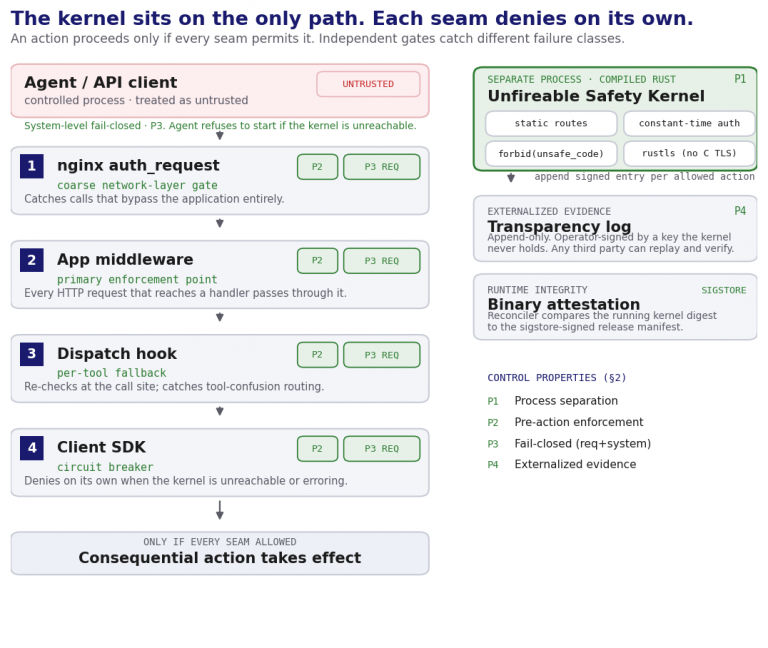
Researchers from EPFL and collaborators performed the first systematic security analysis of widely-deployed agentic workflow tools built for offensive security operations. They didn’t study one niche prototype — they targeted the most widely used systems in this category. The findings are bad across the board: most tools share common architectural flaws that allow an active adversary to exfiltrate API keys, establish persistent footholds, and fully compromise the operator’s host machine. Critically, this succeeds even when the agent runs inside a sandboxed container — the sandbox is not a reliable boundary. To structure the attack surface, the authors introduce a full cyber kill chain specific to these systems, mapping the progression from initial prompt injection and LLM manipulation through lateral movement, persistence, guardrail bypass, and sandbox escape. They close by proposing an architectural blueprint and design principles intended to close these attack paths at the structural level — not as patches.
Cold read
The abstract does not specify how many tools were analyzed, which tools they were, or what version of “widely used” is being applied — so we cannot assess whether the sample is representative or cherry-picked for fragility. “Most tools share common design flaws” is a strong claim; without knowing the N, it could mean three out of four, or eight out of ten — that spread matters enormously for how you calibrate exposure. The sandbox-escape finding is the most alarming claim, but the abstract gives zero technical detail about which sandbox configurations were tested (Docker default? gVisor? VM-level?), making it impossible to know whether your specific deployment is in scope. The proposed “robust architecture” is a research output, not a shipped product — there is no evidence yet that it survives adversarial testing in production. Finally, this is a security paper, meaning the threat model assumes an active, capable adversary who can already inject content into the agent’s context; that is not a zero-effort precondition.
What it means for you
- Signal maturity: 4/5 — The attack classes (prompt injection → persistence → sandbox escape) are technically grounded and not speculative; only deployment specifics are missing
- Who gets hurt: Security startups and red-team-as-a-service shops that have embedded LLM-powered agentic AI tooling into client engagements, and any operator whose API keys live in the same environment as the agent
- What breaks if this is true: The liability model for AI-assisted pentesting collapses — you are now the attack surface you were hired to find
- Why it might not land: Enterprises with mature secrets management, network segmentation, and read-only agent permissions may already have the worst paths blocked; the paper’s architecture proposals could also get absorbed quietly into existing tools without public disclosure
- Watch for: A major agentic security vendor issuing an emergency architectural update or CVE disclosure within 90 days of this paper’s publication — that’s the tell that the findings are as broad as claimed
Forecast as of 2026-06-24
By Q1 2027, at least two named agentic offensive-security platforms will publish public advisories or architectural redesigns directly citing this class of vulnerability; if neither does, the tools are either patched quietly or the affected install base is smaller than the paper implies — either outcome is verifiable.
Source: Red-Teaming the Agentic Red-Team — Dario Pasquini, Michal Bazyli, Taras Fedynyshyn, Artem Sorokin. https://arxiv.org/abs/2606.24496v1