Your Coding Agent Is Burning Money in Ways You Can’t See Yet
Your Coding Agent Is Burning Money in Ways You Can’t See Yet
The infrastructure running your AI dev tools is flying blind—optimized for chatbots, not agents. A new dataset of 350,000 real LLM steps from Claude Code and Codex just exposed exactly how wrong the assumptions are.
What happened
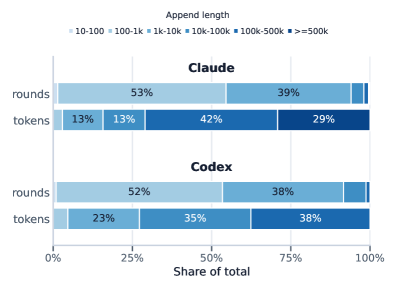
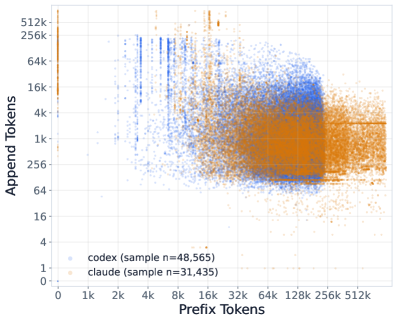
Researchers at UW collected and released traces from roughly 4,300 real coding-agent sessions—their own day-to-day use of Claude Code and Codex—yielding ~350,000 LLM steps and ~430,000 tool calls. This is not a benchmark or a synthetic workload; it’s messy operational data. What they found diverges sharply from the chatbot-shaped assumptions baked into most LLM serving infrastructure. Coding agentic workflows run in long autonomous loops with long inputs but short outputs—the opposite ratio of a typical chat session. Tool calls are heavily-tailed: a few tool types dominate volume but latency variance is enormous. Prefix cache hit rates are high but imperfect, and human-paced gaps (you stepping away for coffee) create cache eviction problems that silently inflate costs. The authors identify four specific optimization targets: lower-overhead tool calling, append-length-aware prefill, semantic-aware tool-latency prediction, and better KV-cache management around those human-paced pauses. The dataset, pipeline, and analysis code are public.
Cold read
The dataset is self-collected from the authors’ own usage—roughly 4,300 sessions from a single academic research group using two specific agent products. That is not a representative sample of production coding-agent workloads at a mid-size SaaS company, a solo founder’s side project, or an enterprise dev team under deadline pressure. Usage patterns, task distributions, and tool repertoires almost certainly differ. The paper characterizes workloads; it does not demonstrate that the proposed optimizations actually work or quantify the cost savings achievable—those are future research. The context window dynamics and tool use patterns observed may also shift fast as agent frameworks evolve; a trace from H1 2026 could look dated by H1 2027. Nothing here tells you how to instrument your own stack, only that your current serving assumptions are probably wrong.
What it means for you
- Signal maturity: 2/5 — characterization paper, no optimization results yet
- Who gets hurt: Founders building on top of managed LLM APIs who assume their per-token costs scale linearly with output; they don’t if your agent is mostly reading and looping
- What breaks if this is true: The unit economics models for coding-agent products built on per-token pricing are miscalibrated—long-context, short-output loops are cheaper to generate but expensive to prefill, and nobody’s billing reflects that nuance yet
- Why it might not land: Inference providers (Anthropic, OpenAI) control the serving layer; even if these optimizations are valid, founders can’t implement them—they can only lobby or switch providers
- Watch for: Anthropic or OpenAI releasing pricing tiers or latency SLAs specifically segmented for “agentic” vs. “conversational” workloads—that’s the signal that this data is being taken seriously commercially
Forecast as of 2026-06-30
By Q2 2027, at least one major inference provider (Anthropic, OpenAI, or a hyperscaler) will announce a pricing structure or serving tier that explicitly differentiates agentic/long-context-short-output workloads from standard chat—directly citing workload characterization research of this type as justification.
Source: TraceLab: Characterizing Coding Agent Workloads for LLM Serving — Kan Zhu, Mathew Jacob, Chenxi Ma, Yi Pan, Stephanie Wang, Arvind Krishnamurthy, Baris Kasikci. https://arxiv.org/abs/2606.30560v1