Your AI Product’s “Open” License Is Probably a Legal Fiction
Your AI Product’s “Open” License Is Probably a Legal Fiction
Somewhere between the dataset and your shipped product, the license your legal team approved quietly ceased to exist. A new study traced 232,270 supply chains and found that obligation-bearing licenses nearly never survive the journey. If you built on “safe” weights, you may have built on sand.
What happened
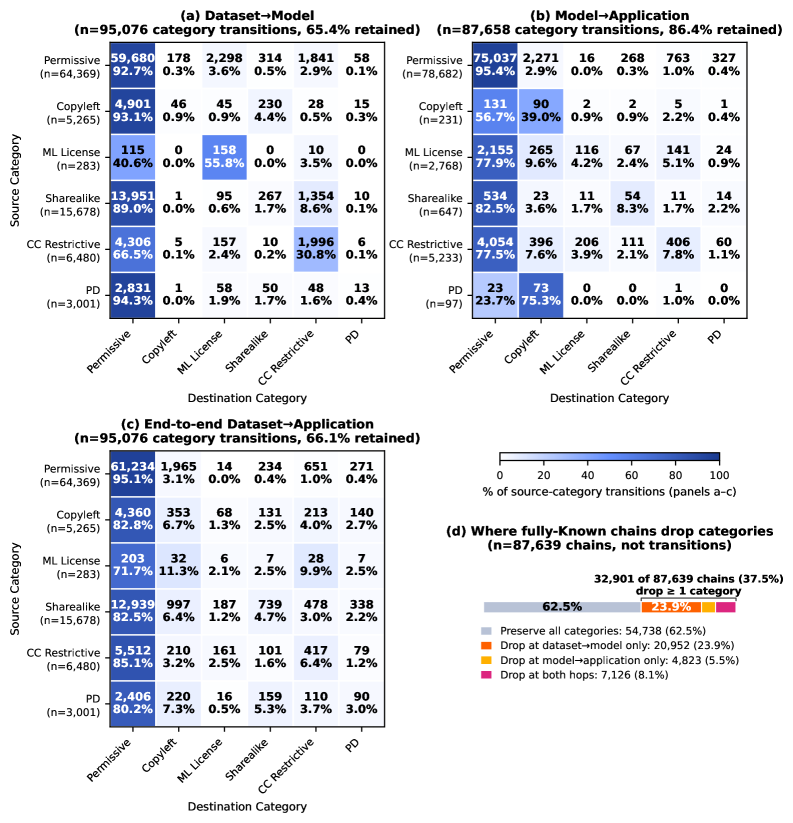
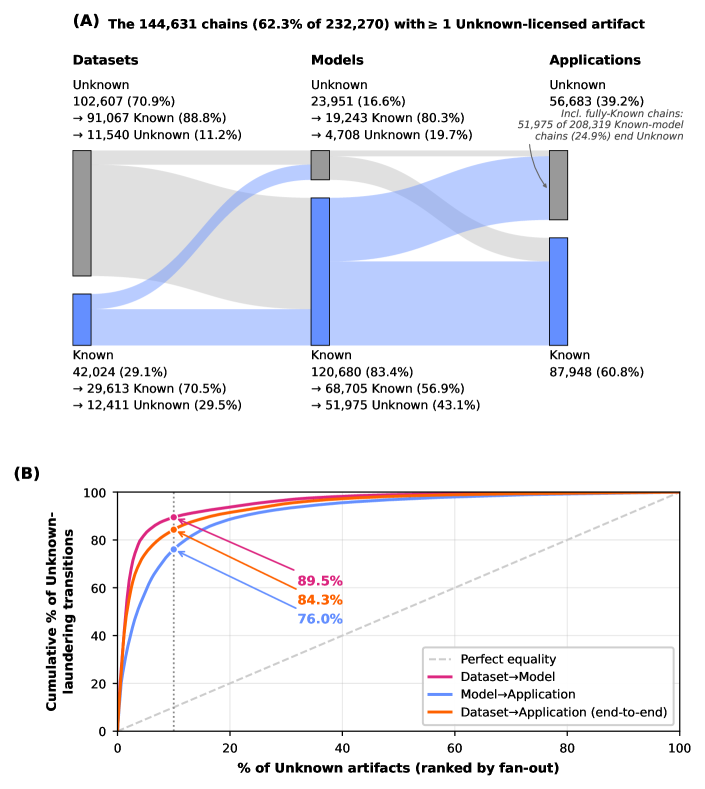
Researchers at Queen’s University traced 232,270 dataset→model→application chains spanning Hugging Face and GitHub, measuring whether license obligations actually propagate downstream — or get stripped and replaced in transit. They quantify two failure modes: “ghost licensing,” where artifacts with no declared license acquire a definitive label somewhere downstream, and outright license substitution, where one category replaces another during redistribution. The headline number: 62.3% of chains pass through at least one artifact with no declared license, and that gap is concentrated in a small set of foundational datasets — meaning the rot starts at the root. More damning: every obligation-bearing license category (copyleft, non-commercial, attribution-required) falls below 7% end-to-end survival, while the Permissive category reaches 95.1%. In practice, the supply chain is a one-way ratchet that launders restrictive licenses into permissive ones. No model card discipline, no platform policy, and no benchmark contamination check currently catches this in production.
Cold read
This study measures declared license metadata, not the legal reality of what licenses actually govern an artifact — those are very different things. A missing label isn’t proof of unlicensed use; it may reflect sloppy documentation on genuinely free material. The authors can show that labels change; they cannot show that rights were actually violated, because that requires tracing the original rights holder’s intent through legal interpretation, not metadata scraping. The finding that 95.1% of chains end up “Permissive” could mean laundering is rampant, or it could mean that most genuinely permissive base models naturally dominate downstream use — the paper’s framing assumes the former without ruling out the latter. Finally, 232,270 chains on Hugging Face and GitHub skews toward open-source artifacts; enterprise pipelines built on licensed APIs or proprietary weights have a very different risk profile that this data doesn’t touch.
What it means for you
- Signal maturity: 3/5 — the measurement is rigorous; the legal consequence is still argued, not proven
- Who gets hurt: Startups that fine-tuned on “permissively labeled” community models and are now in Series A due diligence or enterprise procurement reviews with IP reps-and-warranties
- What breaks if this is true: IP indemnification clauses in SaaS contracts become uninsurable; a single enforcement action against a foundational dataset owner cascades into thousands of downstream products simultaneously
- Why it might not land: License enforcement in AI has moved at glacial speed; rights holders lack efficient tooling to trace infringement through multi-hop model chains, and most are still choosing litigation optionality over active enforcement
- Watch for: A major cloud vendor or foundation model provider publishing an audited license provenance graph for their model weights — that’s the market signal that the legal pressure has turned real
Forecast as of 2026-07-23
By Q3 2027, at least one significant enterprise software procurement process (Fortune 500 or equivalent) will publicly require machine-readable license provenance attestation for AI components as a vendor qualification condition — or at least one AI company will face a material disclosed legal dispute tracing directly to license laundering in its training data supply chain.
Source: Don’t Trust the Label: License Laundering in AI Supply Chains — James Jewitt, Hao Li, Gopi Krishnan Rajbahadur, Bram Adams, Ahmed E. Hassan. https://arxiv.org/abs/2607.20300v1