Screenshot-and-Click AI Agents Are Broken. This Paper Has a Fix.
Screenshot-and-Click AI Agents Are Broken. This Paper Has a Fix.
GUI-based AI agents—the kind scraping pixels to click buttons—are failing in ways the benchmarks hide. A new middleware layer just showed 80%+ task success where screenshot-only control managed 6.6%. That’s not a marginal improvement. That’s a different category of result.
What happened
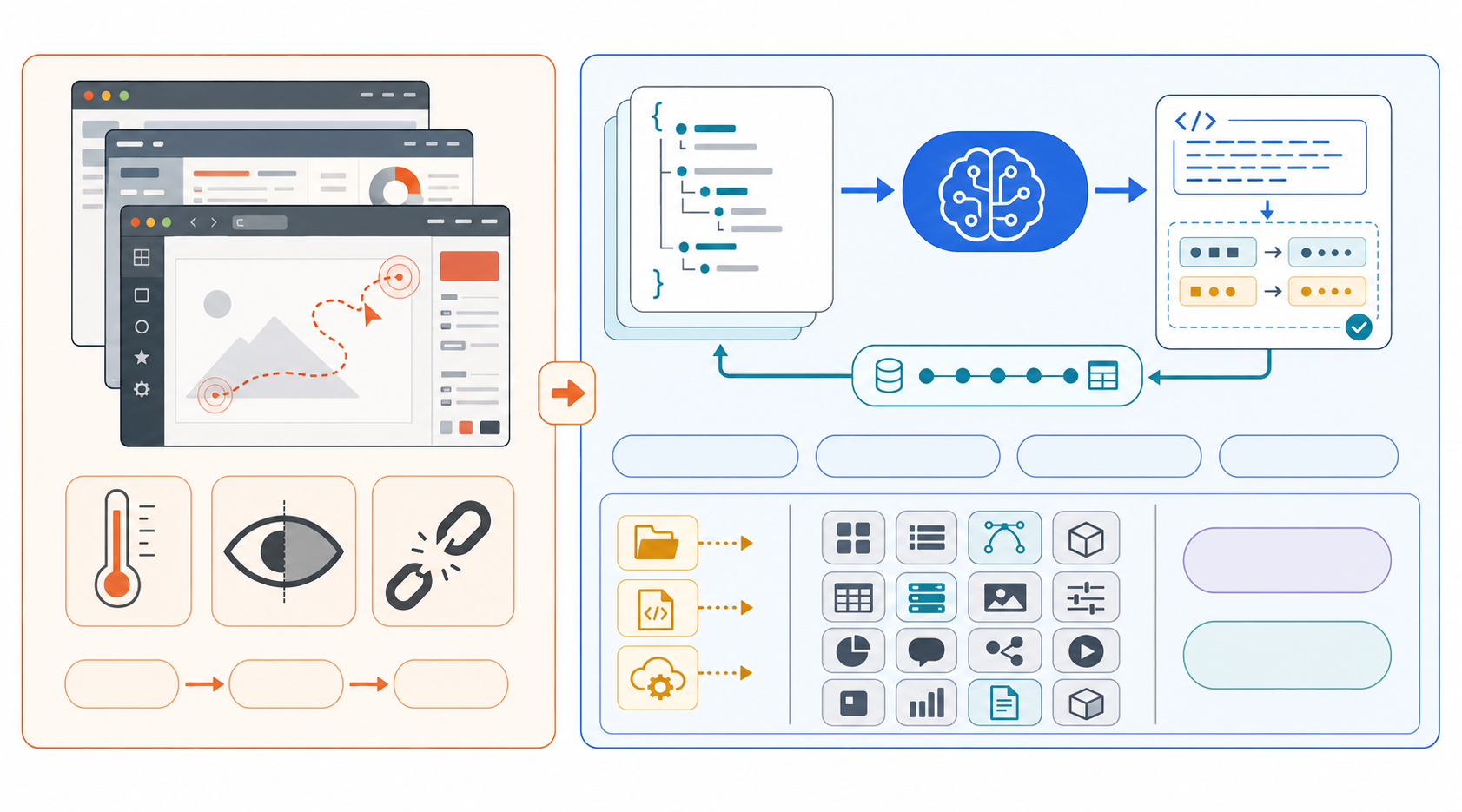
Researchers at (apparently) built ASIL (Agent-Software Interaction Layer), a middleware that replaces the standard screenshot-and-click loop with structured JSON observations and code-executable semantic actions. Instead of an agent staring at a pixel grid and guessing where to click, ASIL hooks into each application at the deepest available access path—think programmatic APIs, not rendered images. They instantiated it across 15 applications and benchmarked 300 single-app and 80 multi-app tasks. The headline numbers: ASIL hits above 80 strict success with closed models using fewer than 5 actions per task. The same tasks under screenshot-and-click control—even with a generous 50-step budget—yielded 6.6 strict success on single-app and 26.6 on multi-app tasks. That 6.6 figure is particularly brutal; it means screenshot agents are essentially guessing on hard tasks. The approach also proved training-friendly inside an agentic workflow: SFT lifted Qwen3.5-2B from 58.0 to 72.1 and Qwen3.5-9B from 66.6 to 80.4, with on-policy RL pushing further to 74.4 and 82.2. Against app-native interfaces, ASIL beat LibreOffice’s UNO API by 28–38 strict points but only matched draw.io’s Model Context Protocol content contract—a telling asymmetry.
Cold read
First, the benchmark problem: 300 tasks across 15 apps is a thin slice of the real software universe. These tasks were almost certainly chosen because ASIL could be instantiated for them—survivorship bias is baked in from the design. Second, the big caveat is in the phrase “deepest feasible access path.” ASIL only works where a structured access path exists—APIs, accessibility trees, COM interfaces. For the long tail of enterprise SaaS and custom internal tooling, no such path exists, and you’re back to screenshots. Third, the draw.io result is the most honest data point in the paper: where a clean MCP contract already exists, ASIL doesn’t beat it—it just matches. That tells you the ceiling is “as good as a well-designed API,” not magic. Fourth, the benchmark contamination risk is real: closed models tested here may have seen task-adjacent data, and the strict success numbers for open models are meaningfully lower before fine-tuning. Fifth, multi-app task success at 53.3 on the “easier band” still means nearly half of multi-app tasks fail—multi-agent orchestration at scale remains unsolved.
What it means for you
- Signal maturity: 3/5 — Strong benchmark delta, but coverage and generalizability are unproven at scale
- Who gets hurt: Companies building screenshot-based RPA or GUI automation wrappers (think Playwright-over-vision products, or anyone whose moat is “our agent can see any screen”)
- What breaks if this is true: The pitch that vision-based agents are “universal”—if structured access paths consistently outperform by 10–30x, buyers will demand native integrations, not pixel scrapers
- Why it might not land: Most real enterprise software is not LibreOffice; it’s closed SaaS with no public API surface and no accessibility tree worth hooking into. ASIL’s own draw.io result shows the method collapses to “match the existing contract” when the contract is clean
- Watch for: Any major agentic AI platform (Anthropic Computer Use, OpenAI Operator, Microsoft Copilot Actions) publicly deprecating or down-weighting screenshot-first control loops in favor of structured state interfaces within the next 12 months
Forecast as of 2026-08-28
By Q3 2027, at least two of the three major agentic platform providers (Anthropic, OpenAI, Microsoft) will have shipped a named “structured state” or “semantic action” integration layer for desktop/enterprise apps that explicitly sidelines screenshot-only control—but adoption will remain below 20% of production agent deployments because the integration surface problem (most apps have no clean access path) won’t be solved in that window.
Source: ASIL: Replacing Screenshot-and-Click with Structured State and Semantic Actions — Rui Xie, Lu Chen. https://arxiv.org/abs/2608.26991v1